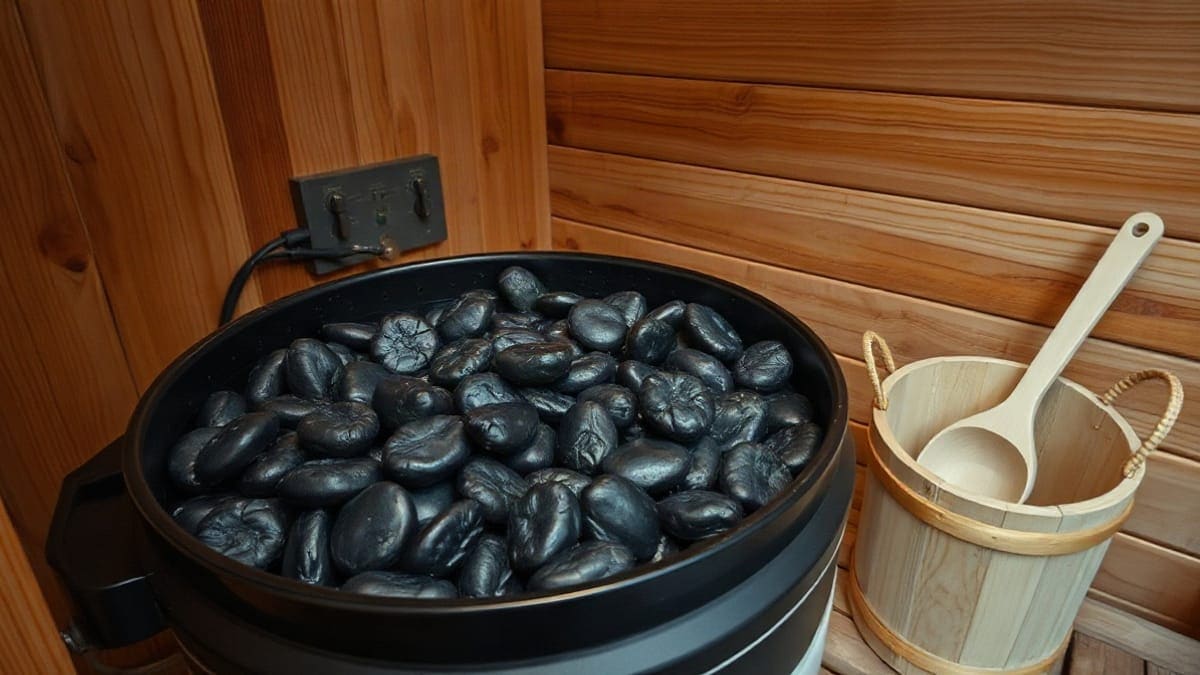
Heater size is a volume problem, and the volume is not only the floor and the ceiling. Glass, stone and tile steal heat, so the math below counts them. Enter your numbers in the calculator, then read why it answers as it does: the formula, the two sizing rules that disagree, the amps and breaker, and the real heaters whose published ranges you can compare. Every range comes from a maker's page or manual, and each one is checked against the maker's own chart. The calculator is a planning aid only: a licensed electrician and your heater's manual have the last word on the circuit.
Calculate your heater size
Room volume 210 cu ft; effective volume with glass and stone 250 cu ft.
Heater size: 7.1 kW by the Harvia rule (1 kW per 35.3 cu ft); 5 to 5.6 kW by the retailer rule (1 kW per 45 to 50 cu ft).
At 240 V a heater of that size draws 29.5 A, so plan a 40 A breaker (125 % of the draw, next standard size).
Heaters whose published room range holds your effective volume:
- Harvia KIP60B 6 kW, rated for 170 to 300 cu ft; 25 A at 240 V, 35 A breakerCheck price
- Harvia Cilindro Half PC60 6 kW, rated for 141 to 283 cu ft; 25 A at 240 V, 35 A breakerCheck price
- HUUM Drop 6 6 kW, rated for 177 to 318 cu ft; 25 A at 240 V, 35 A breakerCheck price
How it works: volume = length x width x height; each sq ft of glass, stone or tile adds about 4 cu ft (Harvia counts 1.2 m3 per m2); size = effective volume / 35.3. Amps = watts / volts; the breaker is the next standard size at or above 125 % of the amps. Your electrician and the heater manual have the last word on wire and breaker.
How do you calculate your sauna heater size in kW?
In two lines
You need a heater whose published room range holds your effective volume. A 6 x 5 x 7 ft cabin with a 10 sq ft glass door is about 250 cu ft, which sits inside the 6 kW range of 170 to 300 cu ft.
Four steps give the answer, and the calculator above runs them in order.
| Step | Formula | Example: 6 x 5 x 7 ft cabin, 10 sq ft of glass |
|---|---|---|
| 1. Volume | length x width x height, in ft | 6 x 5 x 7 = 210 cu ft |
| 2. Glass and stone | sq ft of glass, tile or stone x 4 | 10 x 4 = 40 cu ft |
| 3. Effective volume | step 1 + step 2 | 250 cu ft |
| 4. Heater | pick the model whose range holds step 3 | 6 kW, range 170 to 300 cu ft |
Use the interior size, not the outside of the walls. If you only know meters, 1 cubic meter is 35.3 cu ft and 1 square meter is 10.76 sq ft. A heater near the middle of its range is a better pick than one at the very top: Harvia advises staying away from both ends of the range. Ten models are compared in full on best sauna heater, and cabin choice is on best home sauna.
Why does each square foot of glass or stone add 4 cu ft?
In two lines
Harvia counts each square meter of glass, stone or other uninsulated surface as 1.2 cubic meters of extra room. That is 42 cu ft per 10.76 sq ft, so each sq ft adds about 4 cu ft to the volume the heater must warm.
The rule comes from Harvia's support guidance on selecting heater power. Glass or tile pulls heat out of the room faster than insulated wood, so the heater behaves as if the room were bigger. A 10 sq ft glass door adds 40 cu ft, a door plus a 3 x 4 ft window (22 sq ft) adds 88 cu ft, and a full 6 x 7 ft glass front (42 sq ft) adds 168 cu ft, enough to push a 200 cu ft cabin to 368 cu ft effective and from 6 kW to 8 kW. Wood walls and benches do not count. See best indoor sauna for rooms built with a glass wall.
How many kW per cubic foot: Harvia's rule or the dealers' rule?
In two lines
Harvia says 1 kW per cubic meter, about 35 cu ft per kW. US dealers quote 1 kW per 45 to 50 cu ft. Maker charts show why: their top-of-range figures land near 47 to 53 cu ft per kW, their bottom figures near 22 to 31.
Two rules of thumb circulate, and they give different answers for the same cabin. A 250 cu ft room needs about 7.1 kW by Harvia's rule and about 5 to 5.6 kW by the dealers' rule. The published ranges show that both sit inside the window. Dividing each range by its kilowatts (our arithmetic): the Harvia KIP60B covers 170 to 300 cu ft, which is 28.3 to 50 cu ft per kW; the KIP80B 251 to 424, 31.4 to 53; the HUUM Drop 6 177 to 318, 29.5 to 53; the Drop 9 283 to 460, 31.4 to 51.1; and the Finnleo Designer 4.5, 6 and 8 kW 22.2 to 46.7, 29.2 to 51.7 and 31.3 to 53.1.
So Harvia's 35 cu ft per kW sits in the lower half of the range, where the heater reaches temperature fast and cycles often, while the dealers' 45 to 50 sits at the top, where it works near full output. Use the range for your model, not either rule alone, and put your effective volume in the middle of the window.
Saunum's fan-assisted Air 5 is the outlier: its US manual pairs 4.95 kW with up to 318 cu ft, about 64 cu ft per kW, because the fan spreads heat. Scandia's electric heater sizing sheet gives its 6 kW Ultra up to 294 cu ft, about 49 per kW, and its 9 kW up to 616 cu ft, about 68 per kW, so ask Scandia before using the top of those ranges.
How many amps does a 6 kW sauna heater use?
In two lines
A 6 kW heater on 240 V draws 25 A: amps are watts divided by volts, 6,000 divided by 240. A 4.5 kW heater draws 18.75 A, an 8 kW heater 33.3 A and a 9 kW heater 37.5 A.
The same division gives the current of any heater, and on a 120 V circuit the current doubles: a 2,000 W heater draws 16.7 A at 120 V. The table adds the sizing step that electricians apply to a continuous load, 125 percent of the current, and the next standard breaker size at or above that figure.
| Heater | Current at 240 V | x 1.25 | Next standard breaker (our arithmetic) | What makers publish |
|---|---|---|---|---|
| 4.5 kW | 18.75 A | 23.4 A | 25 A | Finnleo 18.8 A; HUUM 30 A fuse, 10 AWG |
| 6 kW | 25 A | 31.3 A | 35 A | Cilindro manual 25 A with a 30 A breaker; HUUM 30 A fuse, 10 AWG |
| 7.5 kW | 31.25 A | 39.1 A | 40 A | Scandia 31.3 A; HUUM 40 A fuse, 8 AWG |
| 8 kW | 33.3 A | 41.7 A | 45 A | Finnleo 33.3 A; Harvia KIP80B 33.4 A fuse, 8 AWG |
| 9 kW | 37.5 A | 46.9 A | 50 A | HUUM 50 A fuse, 8 AWG |
The 125 percent rule is how the National Electrical Code treats continuous loads, and Article 424 covers fixed electric heating. The last column shows the catch: some manuals print a smaller breaker than the arithmetic gives. The Cilindro manual, hosted by Almost Heaven, pairs a 6 kW heater with a 30 A breaker, while Sun Home's electrical guide gives 30 A on 10 AWG or 40 A on 8 AWG for 6 kW. The calculator shows the arithmetic result; the heater's own manual and your electrician decide the real breaker.
Planning a wiring job? Read sauna electrical requirements and the manual of your heater before you buy it.
What size wire for a 6 kW, 8 kW or 9 kW sauna heater?
In two lines
Makers publish 10 AWG on a 30 A fuse for the 6 kW HUUM Drop, and 8 AWG for the 8 kW Harvia KIP80B (33.4 A fuse) and the 9 kW HUUM Drop (50 A fuse). Finnleo requires copper wire rated for at least 90 degrees C.
Wire gauge follows the breaker, the run length and the wire's temperature rating, so it is not a number to copy from a web page. HUUM lists a 30 A fuse and 10 AWG for the 4.5 kW and 6 kW Drop, 40 A and 8 AWG for the 7.5 kW and 50 A and 8 AWG for the 9 kW. Harvia's KIP80B page lists 8 AWG cable and a 33.4 A fuse for one group. The Finnleo heater manual says to use copper supply wire only. For anything hardwired, the electrician sizes the wire from the manual and the code. Small plug-in heaters are on best 120V sauna heater.
Can a sauna heater run on 120 V?
In two lines
Not at 4.5 kW or more. At 120 V a 4.5 kW heater would draw 37.5 A, far above a 15 or 20 A household circuit, so traditional heaters run on 240 V and 120 V models are small, around 2 kW or less.
A 20 A, 120 V circuit carries 2,400 W at its limit and 1,920 W when you keep a continuous load to 80 percent of the breaker, which is the 125 percent rule turned around. A 15 A circuit carries 1,440 W on that basis. That is why 2 kW plug-in heaters suit only small, well-insulated cabins, and why you should never wire a 240 V heater for 120 V: it would produce a fraction of its rating. The calculator's 120 V setting shows the amps and warns when the answer exceeds the outlet. See best 120V sauna heater and best 240V sauna heater.
How do 4.5 kW, 6 kW, 8 kW and 9 kW heaters compare?
In two lines
A 4.5 kW heater fits up to about 210 cu ft, a 6 kW heater 170 to 300, an 8 kW heater 250 to 425 and a 9 kW heater up to 460. Going one size up costs about 8 to 12 A more on the circuit, so do not oversize for comfort.
Step up a size only when the effective volume or the glass area demands it. On a 250 to 300 cu ft cabin both a 6 kW and an 8 kW can work: the 6 kW is cheaper to wire at 25 A, and the 8 kW gives margin for a glass wall. A cabin of 425 to 460 cu ft with no glass is the 9 kW case. Above 460 cu ft, ask the maker for a written recommendation; Harvia's Virta Combi is an 11 kW example. Is a 2 kW heater enough? Only for a cabin well under 100 cu ft; see the FAQ below.
Which real heaters fit which cabin size?
In two lines
The Harvia KIP60B takes 170 to 300 cu ft on 25 A, the KIP80B 251 to 424, the Finnleo Designer 100 to 425 in three sizes, the HUUM Drop 6 177 to 318 and the Drop 9 283 to 460. The calculator proposes three that match your result.
All ranges are the makers' own, copied from product pages and manuals. Where a maker lists cubic meters, the table converts to cubic feet. The calculator uses the same list.
| Heater | Power | Range (cu ft) | Current | Where read |
|---|---|---|---|---|
| Harvia KIP60B | 6 kW | 170 to 300 | 25 A (our division) | Harvia US |
| Harvia KIP80B | 8 kW | 251 to 424 | 33.4 A fuse | Harvia US |
| Harvia Cilindro Half PC60 | 6 kW | 141 to 283 | 25 A | Harvia US |
| HUUM Drop 6 | 6 kW | 177 to 318 | 30 A fuse | HUUM |
| HUUM Drop 9 | 9 kW | 283 to 460 | 50 A fuse | HUUM |
| Finnleo Designer 4.5 kW | 4.5 kW | 100 to 210 | 18.8 A | Finnleo SL2 manual |
| Finnleo Designer 6 kW | 6 kW | 175 to 310 | 25 A | Finnleo SL2 manual |
| Finnleo Designer 8 kW | 8 kW | 250 to 425 | 33.3 A | Finnleo SL2 manual |
| Saunum Air 5 | 4.95 kW | 106 to 318 | 20.63 A | Saunum manual |
| Scandia Ultra 6 kW | 6 kW | up to 294 | 25 A | Scandia chart |
| SaunaCore ULT 9 kW | 9 kW | up to 450 | 37.5 A (our division) | dealer listing |
Two notes. The Harvia KIP45B, the 4.5 kW sibling of the KIP60B, appears on dealer pages at 100 to 210 cu ft and 18.8 A, for example this dealer listing, but we did not read it on Harvia's own page, so it is not in the table. And the KIP80B page showed the heater as unavailable when we read it, so confirm stock. Rock load, controls and Wi-Fi are on best sauna heater, and one maker's cabins are on Finnleo saunas.
Four cabins worked through
In two lines
A 5 x 4 x 7 ft closet with a glass door needs 4.5 kW. A 6 x 5 x 7 ft cabin needs 6 kW. A 6 x 6 x 7 ft cabin with 15 sq ft of glass needs 8 kW. A 7 x 8 x 8 ft room with a stone wall exceeds every single 8 kW range.
| Cabin | Volume | Glass or stone | Effective | Heater class | Amps at 240 V |
|---|---|---|---|---|---|
| A: 5 x 4 x 7 ft, glass door 8 sq ft | 140 cu ft | +32 cu ft | 172 cu ft | 4.5 kW | 18.75 A |
| B: 6 x 5 x 7 ft, glass door 10 sq ft | 210 cu ft | +40 cu ft | 250 cu ft | 6 kW | 25 A |
| C: 6 x 6 x 7 ft, 15 sq ft glass | 252 cu ft | +60 cu ft | 312 cu ft | 8 kW | 33.3 A |
| D: 7 x 8 x 8 ft, 20 sq ft stone | 448 cu ft | +80 cu ft | 528 cu ft | 9 kW plus the maker's advice | 37.5 A |
Cabin A lands at 172 cu ft, at the very bottom of the 6 kW ranges but in the middle of the 4.5 kW range of 100 to 210, so 4.5 kW is the better fit. Cabin B sits in the middle of every 6 kW range: the KIP60B (170 to 300), the Cilindro (141 to 283) and the Drop 6 (177 to 318).
Cabin C is the lesson. Its floor and ceiling say 252 cu ft, which a 6 kW would handle, but the glass lifts it to 312 cu ft, past the KIP60B's 300 and the Finnleo 6 kW's 310. Only the Drop 6 (318) still covers it, with no margin, so 8 kW is the safe call. Cabin D, at 528 cu ft, is larger than the 8 kW ranges, the Drop 9 (460) and the SaunaCore (450). Scandia charts its 9 kW to 616 cu ft, so ask for a written recommendation. Ceiling height matters too: the HUUM EU manual asks for a room at least 75 in high, and the Finnleo SL2 manual lists walls of 74 to 96 in for the Designer.
What is the most electricity one sauna session can use?
In two lines
A 6 kW heater uses at most 6 kWh for each hour its elements run flat out, a 4.5 kW heater 4.5 kWh and a 9 kW heater 9 kWh. A real session uses less, because the thermostat cycles the elements once the cabin is hot.
Kilowatts times hours gives kilowatt-hours, and that is the ceiling for a session. No maker we read publishes a duty cycle, so we do not guess one.
| Heater | 60 minutes at full power | 90 minutes at full power |
|---|---|---|
| 4.5 kW | 4.5 kWh | 6.75 kWh |
| 6 kW | 6 kWh | 9 kWh |
| 8 kW | 8 kWh | 12 kWh |
| 9 kW | 9 kWh | 13.5 kWh |
To turn a ceiling into a cost, multiply the kilowatt-hours by your utility's rate; the EIA table of average residential prices by state lists current rates. An infrared 2 person cabin like the Sun Home Equinox, listed at 1,880 W, draws at most 1.88 kWh per hour (see Sun Home saunas). The full budget is on sauna cost and infrared sauna cost.
How hot does a 6 kW sauna heater get?
In two lines
The thermostat sets the temperature, not the kilowatts: a traditional sauna runs about 150 to 195 degrees F, according to Cleveland Clinic. A bigger heater reaches that temperature faster, and one that is too small may never reach it.
Heater size controls how quickly the cabin warms and whether it can hold the setting in a glass-heavy or cold room. Cleveland Clinic gives 150 to 195 degrees F for a traditional sauna and 110 to 135 degrees F for infrared. A 6 kW heater in a 250 cu ft cabin can reach the traditional range; the same heater in a 400 cu ft room will run flat out and stall below it. Targets and safe ranges are on sauna temperature, and session safety is on how to use a sauna.
What do infrared, wood and gas cabins use instead?
In two lines
Infrared cabins are sized by seats and panel watts, not by cubic feet: a 2 person cabin draws about 1,700 to 1,900 W. Wood stoves follow volume like electric heaters, and gas needs the maker's chart and a qualified installer.
An infrared cabin warms your body with panels, so there is no room-volume formula and no rocks: choose by seats and circuit on best infrared sauna. A wood stove follows the same volume logic but burns fuel and needs a chimney; see best wood burning sauna stove, where the Harvia M3 is 16.5 kW for 212 to 459 cu ft. For gas, see best gas sauna heater.
Other questions from this search belong to their own pages:
- Turning on, operating or resetting a heater, putting rocks in it, pouring water on it, how it works and which is best: best sauna heater; a heater that will not start: sauna heater not working.
- Harvia questions (quality, where made, install, wire, use, rocks): Harvia saunas and heaters.
- Converting a European heater to North American wiring: not by rewiring it yourself; buy a US-listed model.
- Building or converting your own heater, propane included: DIY sauna heater and how to build a sauna.
- Heater prices: sauna cost. Installing and wiring: the manual, an electrician and sauna electrical requirements.
Safety first: wiring and sizing warnings
In two lines
Hire a licensed electrician for any hardwired heater, follow the National Electrical Code and the heater's manual, and never oversize past the maker's range. Harvia's KIP manual says not to use a GFI on the heater circuit.
The calculator gives planning numbers. It does not replace a load calculation for your panel, which the electrician does.
Which heaters match your result?
In two lines
For the most common result, 170 to 300 cu ft, the Harvia KIP60B is the 6 kW pick and the KIP80B the 8 kW pick for 250 to 425 cu ft; the Finnleo Designer covers 100 to 425 cu ft in three sizes.
The three below are the models the calculator offers most often. Each is wall mounted and hardwired.
Harvia KIP60B: 6 kW for 170 to 300 cu ft
Harvia's US page lists 6.0 kW, 240 V, UL certified, a temperature dial and a timer up to 8 hours. Current is 25 A by our division.
Best for: a solid-wall cabin of 170 to 300 cu ft. Not for: a cabin with a large glass wall.
Harvia KIP80B: 8 kW for 251 to 424 cu ft
Harvia's page lists a 33.4 A fuse for one group and 8 AWG cable, and showed the heater as unavailable when we read it, so confirm stock.
Best for: a cabin past 300 cu ft or one with a lot of glass. Not for: a panel with no room for a dedicated 240 V line.
Finnleo Designer-B: 4.5, 6 or 8 kW in one line
Finnleo lists 100 to 425 cu ft and the SL2 manual gives 18.8, 25 and 33.3 A.
Best for: a small cabin that needs the 4.5 kW size. Not for: anyone who wants a deep rock bed for heavy steam, since 50 lb is the most it holds.
6 common mistakes when sizing a sauna heater
In two lines
The costliest sizing errors are ignoring glass, trusting one rule of thumb, sizing to the top of a range, copying a breaker from another maker, putting a big heater on 120 V and measuring outside the walls.
1. Ignoring glass and stone
A full glass front adds 168 cu ft by Harvia's rule, enough to move a cabin up one heater class.
2. Trusting one rule of thumb
Harvia's 35 cu ft per kW and the dealers' 45 to 50 give 7.1 kW and 5 to 5.6 kW for a 250 cu ft room. Use your model's published range.
3. Sizing to the top of the range
A heater at the top of its window runs near full output and may never reach temperature on a cold day. Pick one with margin.
4. Copying a breaker size from another maker
The Cilindro manual pairs 6 kW with 30 A; our 125 percent arithmetic gives 35 A. Your manual and your electrician decide.
5. Putting a big heater on 120 V
A 4.5 kW heater would draw 37.5 A at 120 V, far above the 1,920 W a 20 A circuit carries continuously.
6. Measuring outside the walls
Volume is interior length x width x height. A 6 x 5 ft interior with 4 in walls reads about 13 percent bigger from outside.
FAQ
Is a 2 kW heater enough for a sauna?
Only for a very small, well-insulated cabin well under 100 cu ft, such as a plug-in unit. The traditional electric heaters we read start at 4.5 kW and 100 cu ft, so a 2 kW unit will not heat a normal home cabin. At 120 V it draws 16.7 A, above the 1,920 W a 20 A circuit carries continuously.
What size wire for an 8 kW sauna heater?
Harvia's KIP80B page lists 8 AWG cable and a 33.4 A fuse for one group. Finnleo lists the 8 kW at 33.3 A. The electrician picks the gauge from your manual and the code, and the supply wire should be copper rated at least 90 degrees C per Finnleo.
What size wire for a 9 kW sauna heater?
HUUM lists a 50 A fuse and 8 AWG cable for the Drop 9. Current is 37.5 A at 240 V, and 125 percent of that is 46.9 A, so a 50 A breaker is the next standard size. Confirm with your electrician and the manual of your exact heater.
How do I calculate sauna heater size in metric units?
Multiply length x width x height in meters for cubic meters, add 1.2 cubic meters per square meter of glass or stone, and pick a heater with 1 kW per cubic meter by Harvia's rule, then check the model's range. One cubic meter is 35.3 cu ft.
Should I size up if I like a hotter sauna?
Not by much. The thermostat sets the temperature, and a heater one class up costs 8 to 12 A more on the circuit. Size to your effective volume first.
Does ceiling height change the heater size?
Yes, because volume includes height. A 6 x 5 ft floor at 7 ft is 210 cu ft and at 8 ft is 240 cu ft. Makers also set minimums: Saunum asks for at least 73 in and HUUM for at least 75 in.
How many amps does an 8 kW sauna heater draw?
33.3 A at 240 V, which is 8,000 W divided by 240 V. Applying 125 percent gives 41.7 A, and the next standard breaker is 45 A by our arithmetic. Harvia's KIP80B page lists a 33.4 A fuse, so the manual is the final word.
Do I need a different heater for an outdoor cabin?
The ranges makers publish do not split indoor and outdoor cabins, so size by effective volume and ask the maker for a written recommendation in a cold or windy spot. Best outdoor sauna and best barrel sauna show the heaters whole cabins ship with.
What heater comes with a sauna kit?
A kit maker sizes the heater for you. The Redwood Outdoors barrel, the Almost Heaven Pinnacle and the SunRay Galley use 6 kW Harvia heaters, and the Seneca ships with 8 kW. See best sauna kits and Redwood Outdoors saunas.
Is a bigger heater always better?
No. Too small and the cabin warms slowly, too large and the thermostat cycles often, and a larger heater needs a larger circuit and wire.
How we researched this page
In two lines
We read maker pages, manuals and sizing charts for the ten heater lines on November 17, 2026 and copied their kilowatts, room ranges and currents. Where a maker prints no current, we divided watts by volts and marked it.
We did not test any heater. The Saunum, Scandia and SaunaCore figures were read through the maker's PDF, a chart or a dealer listing, and the KIP45B only on dealer pages, so confirm each on the maker's page before you buy. Breaker sizes in the amps table are our arithmetic from the 125 percent rule and are not an electrical design. Prices are left out because we have no reliable source.
Sources
- Harvia KIP60B (JH60BU1MUL), US product page: harvia.com
- Harvia KIP80B (JH80B2401), US product page: harvia.com
- Harvia Cilindro Half PC60, US product page: harvia.com
- Harvia support, how to select the correct heater power: support.harvia.com
- Harvia KIP manual: Harvia KIP manual
- HUUM Drop: huumsauna.com; EU manual: huum.eu
- Saunum Air US manual: us.saunum.com
- Finnleo Designer SL2 manual: finnleo.com; Fonda and Vena B manual: finnleo.com
- Scandia electric heater sizing chart: Scandia chart
- SaunaCore ULT 9 kW dealer listing: saunaplace.com
- National Electrical Code (NFPA 70): nfpa.org; Article 424 overview: ecmweb.com
- Sun Home Saunas, electrical requirements: sunhomesaunas.com
- U.S. Energy Information Administration, average residential electricity prices: eia.gov
- Cleveland Clinic, sauna temperatures: clevelandclinic.org
Keep comparing
 Sauna BenefitsHeart, blood pressure, stroke, dementia, muscles, sleep, mood, skin, plus detox myths
 Infrared Sauna BenefitsHeart failure, blood pressure, chronic pain, arthritis and recovery, what is not proven
 Infrared vs Traditional SaunaInfrared vs traditional sauna compared on heat in °F, warm-up, 120 V or 240 V circuit, kWh per session, space
 What Is a Traditional (Dry) Sauna?A traditional dry sauna is a wood room heated by an electric or wood stove on stones
 How Long Should You Stay in a Sauna?Minutes by type and experience, rounds and rest, what the Finnish studies show, signs to leave