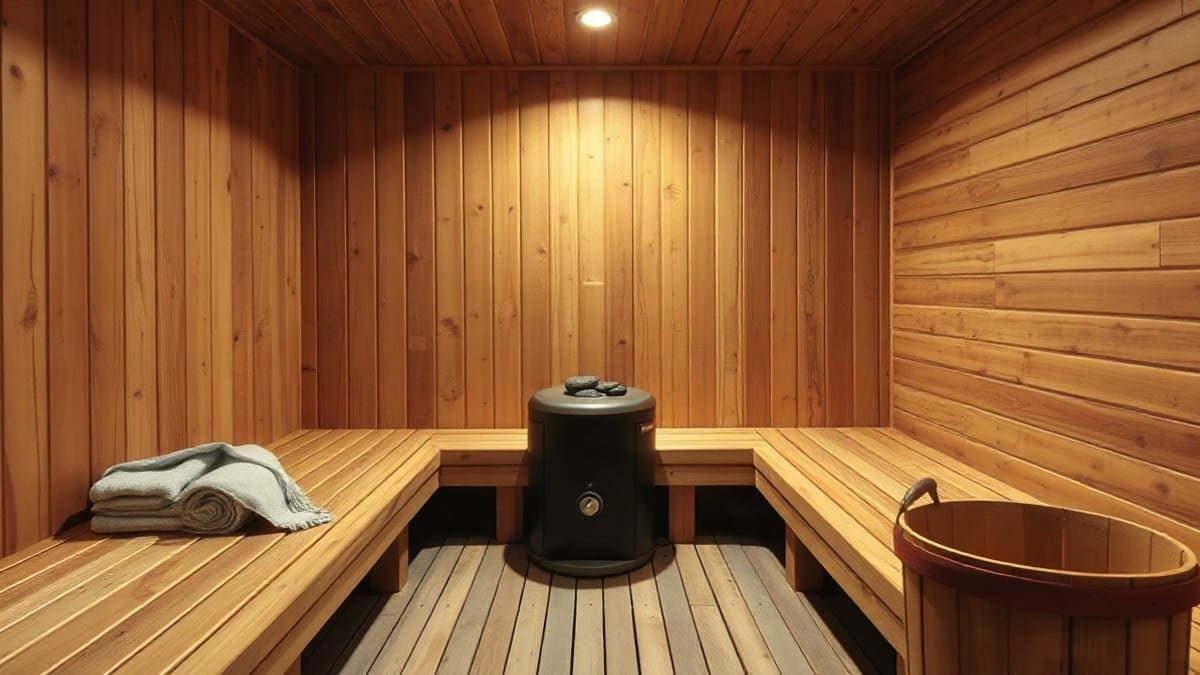
Set a traditional sauna to 150 to 170°F if you are new to heat, and add 5 to 10 degrees only when you feel fine.
Set it to 170 to 185°F if you already sit 10 to 15 minutes comfortably, the range Harvard Health and Cleveland Clinic frame as usual.
Go above 185°F only if your heater's manual allows it and you are healthy, and read how hot is too hot for a sauna first.
Neither if you want gentle heat: an infrared cabin at 110 to 135°F or a steam room at 100 to 120°F is the other option, and best home sauna compares the types.
Temperature is the setting people ask about most, and the sources give different numbers for the same room. Harvard Health puts the top of dry heat at about 185°F, and Finnish research describes rooms up to 212°F. This guide gives each range with its source, shows where the thermometer belongs and why the top bench reads hotter than the floor, and sizes a 6 kW heater for the time it needs. It then covers maker and UL 875 limits, pregnancy, heart, children and alcohol, with a doctor's advice where the evidence is thin, and ends on heaters and cabins built for these temperatures.
How hot is a sauna?
In two lines
A traditional sauna is 150 to 195°F (66 to 91°C) in the air, and the other types sit lower. Infrared is 110 to 135°F, and a steam room is 100 to 120°F depending on the source.
Cleveland Clinic gives the traditional and infrared ranges. A review of far infrared saunas by Beever in Canadian Family Physician (2009) says a traditional sauna heats the air to about 185°F (85°C) and an infrared one to about 140°F (60°C).
| Type | Air temperature | In °C | Humidity | Source |
|---|---|---|---|---|
| Traditional dry sauna | 150 to 195°F | 66 to 91°C | Usually under 20% | Cleveland Clinic |
| Traditional, water on the rocks | Same heater and air range | Same | Rises for a moment after each ladle | Our reading of the dry-sauna range |
| Infrared sauna | 110 to 135°F | 43 to 57°C | Dry | Cleveland Clinic |
| Infrared, maker caps | 140 to 170°F | 60 to 77°C | Dry | Maker pages, a maker value |
| Steam room (hammam) | 110 to 120°F or 100 to 110°F | 43 to 49°C or 38 to 43°C | Near 100% | WebMD, Medical News Today |
Makers publish the highest setting the cabin allows, and a clinic describes how people use it, so the two figures answer different questions. See infrared sauna temperature and steam room time and temperature.
How hot should a sauna be?
For a first session, 150 to 170°F; for regular use, up to about 185°F. That is our reading of Cleveland Clinic's 150 to 195°F range and Harvard Health's 185°F figure for dry heat. No trial has fixed one correct number, and the clinic says beginners can start with 5 minutes. A sauna set 10 degrees lower for twice as long does not give you a stronger session; it gives you the same heat stress spread out. The routine is in how to use a sauna.
What is the maximum sauna temperature a heater reaches?
Heaters stop at about 195 to 230°F, depending on the cabin and the control. A Harvia control unit manual lists a maximum setting of 110°C (230°F). Sun Home lists a maximum of 230°F for its Solaris cabins. Redwood Outdoors says its cabins reach 195°F in under an hour, and Backyard Discovery lists a 194°F top setting on its Paxton heater. Finnish sauna research describes 80 to 100°C (176 to 212°F), as the 2018 review by Laukkanen and colleagues in Mayo Clinic Proceedings puts it. Those are limits and research conditions, not targets.
What is the average sauna temperature?
About 150 to 185°F is where most sessions fall; no one publishes a measured average. One Harvia manual says normal bathing is roughly 65 to 85°C (149 to 185°F), and Cleveland Clinic's range tops out at 195°F. We found no survey of home saunas that reports a mean, so we give the range, and a figure like "170°F" elsewhere is a midpoint.
What temperature is a sauna in Fahrenheit, Celsius and Finland?
150°F is 66°C, 185°F is 85°C and 195°F is 91°C. Finnish-style bathing at 80 to 100°C is the same as 176 to 212°F. The table converts the numbers people search for.
| °F | °C | What it marks |
|---|---|---|
| 110 to 135 | 43 to 57 | Infrared cabin air (Cleveland Clinic) |
| 140 | 60 | Infrared air in Beever's review |
| 150 | 66 | Low end of traditional heat |
| 170 | 77 | Maker cap on some infrared cabins; a mid dry sauna setting |
| 185 | 85 | Dry heat top per Harvard Health; traditional air in Beever |
| 195 | 91 | High end of traditional heat; Redwood's reach in under an hour |
| 212 | 100 | Top of the Finnish research range |
| 230 | 110 | Control and maker maximum setting |
Celsius times 1.8 plus 32 gives Fahrenheit.
What is the best sauna temperature for health benefits?
In two lines
No study names one best temperature. The research is on Finnish saunas at 80 to 100°C (176 to 212°F), for 5 to 20 minutes, about 1 to 3 times a week.
That is how the Mayo Clinic Proceedings review by Laukkanen, Laukkanen and Kunutsor (2018) describes the practice it examined. The authors stress that the findings are associations from observational studies, and that long randomized trials are still needed. The big heart study, Laukkanen and colleagues in JAMA Internal Medicine, 2015, followed 2,315 Finnish men for a median of 20.7 years and linked more sauna sessions to fewer fatal cardiovascular events. It shows an association, not that heat caused the benefit.
So a hotter sauna is not a stronger dose of benefit. Harvard Health asks for no more than 15 to 20 minutes and 2 to 4 glasses of cool water afterward. People ask which temperature suits muscle recovery or weight loss; we found no study that ties a sauna air temperature to fat loss, and the weight you lose in a session is mostly sweat. The evidence by topic is in sauna health studies, and the heart question is in sauna and blood pressure.
Does sauna temperature matter?
Yes for comfort and safety, and unproven for benefit. Temperature decides how fast you warm up and how long you can stay. Your heater's manual sets the upper limit; your body sets the lower one. Time in the room matters as much, and how long to stay in a sauna and how often to use a sauna cover both. Best time of day to sauna covers timing.
Where do you measure sauna temperature?
In two lines
Read the thermometer at head height when you sit on the upper bench, about 39 in (1 m) above that bench and across from the heater.
That figure comes from sauna-builder guides, and we did not find a standard that fixes it. It is the spot where your head is, so it is the air you breathe. A reading at the door or near the floor is far lower than the top bench.
Where to place a sauna temperature sensor
Put the thermometer on the wall at head height of the top bench, away from the heater and out of the draft from the vent. If a control has a sensor, follow the maker.
Why is it hotter at the top than at the floor?
Hot air rises, so the ceiling is the hottest layer and the floor the coolest. Sources disagree on the size of the gap: one sauna-builder guide says 10 to 20°F in a typical cabin, another says the ceiling-to-floor difference can pass 50°C (90°F). Neither gives measurement data, so treat both as rough. What you can do is read your own cabin at two heights once and write the difference on the wall.
How do you measure sauna temperature, and which thermometer?
A wall thermometer or a thermo-hygrometer rated to at least 230°F does the job. Harvia sells a wooden thermo-hygrometer (item SAS92300, 130 x 240 x 30 mm) that shows temperature and humidity; its page does not print the range, so check the box before you rely on it. The choices are in sauna thermometer and hygrometer.
What humidity goes with the temperature?
In two lines
A traditional sauna is dry: Cleveland Clinic says usually under 20 percent, and sauna-builder guides say 5 to 20 percent. A steam room runs near 100 percent humidity at a far lower air temperature.
Throwing water on the stones lifts the humidity for a moment and makes the same air feel hotter. Sauna humidity covers the numbers, and dry vs wet sauna covers the feel.
How long does a 6 kW heater need to warm a cabin?
In two lines
A 6 kW heater needs about an hour to bring a well-insulated cabin to bathing temperature, by one Harvia manual. A retailer puts 120 V heaters of 1.7 to 1.9 kW at 30 to 45 minutes in a small room.
Almost Heaven says its 6 kW Harvia heater takes the Logan to 180°F in about an hour. These are best cases, and a cold yard adds time. How long does a sauna take to heat up goes through the factors.
Harvia's rule is 1 kW per cubic meter (about 35 cu ft), and glass or stone adds volume; resellers use 45 to 50 cu ft per kW. Our arithmetic for 6 kW is 210 cu ft by Harvia's rule and 270 to 300 cu ft by the resellers' rule.
| Heater | Power | Room range (cu ft) | Current at 240 V | Source |
|---|---|---|---|---|
| Harvia KIP60B | 6 kW | 170 to 300 | 25 A by our division | Harvia US page |
| Harvia KIP80B | 8 kW | 250 to 425 | 33.4 A minimum fuse | Harvia, dealers |
| Harvia Cilindro Half PC60 | 6 kW | 141 to 283 | 25 A | Harvia data sheet |
| HUUM Drop 6 | 6 kW | 177 to 318 | 30 A fuse | HUUM |
| HUUM Drop 9 | 9 kW | 283 to 460 | 50 A fuse | HUUM |
The full comparison is in best sauna heater. Wiring is an electrician's job; we report what the makers publish.
How do you set and raise the sauna temperature?
On a dial heater, start at the maximum and turn the dial back if it gets too hot, because small changes near the maximum matter a lot.
One Harvia manual says to begin at the maximum position and turn counter-clockwise if the temperature rises too high. The KIP60B has a temperature dial, an on/off dial, a delay timer of up to 8 hours and a 60 minute auto shut-off. To raise the heat safely, seal door gaps, preheat longer, add stones within the heater's rock limit or move to a larger heater. Never go past the heater's maximum setting. If a cabin will not get hot, see sauna heater not working.
What are the maker and standard limits on temperature?
In two lines
Makers publish a top setting, and the heater carries a separate high-limit cut-out. The highest setting in our table is 230°F, and the infrared cabins cap at 140 to 170°F.
UL 875, Electric Dry-Bath Heaters, is the US safety standard for these heaters; the current edition is dated July 2024, per the ANSI webstore. We did not read the standard, which is paid, so we cannot give its temperature limits. Heater manuals describe a high-limit switch as a safety device apart from the thermostat that shuts the heater off if the thermostat fails.
| Product | Listed top temperature | Heater | Note |
|---|---|---|---|
| Harvia control unit (C260 manual) | 110°C (230°F) setting | Control for Harvia heaters | Check your own model |
| Sun Home Solaris 4 and 6 | 230°F | 6 kW and 9 kW | Maker page |
| Redwood Outdoors cabins | 195°F in under an hour (claim) | 6 to 8 kW options | Brand-wide claim |
| Backyard Discovery Paxton | 194°F setting | 9 kW | Maker page |
| SunRay Galley | 170°F | Electric | Maker page |
| Almost Heaven Logan | 180°F in about an hour | 6 kW Harvia | Maker page |
| Peak Saunas indoor infrared | 150°F cap | Infrared | Maker page |
| Lifepro RejuvaCure 1-person | 140°F cap | Infrared | Maker page |
| JNH Joyous+ | up to 170°F | Infrared | Maker page |
A listed maximum is not a recommendation. Where is the line for a person? Read how hot is too hot for a sauna.
What sauna temperature is too hot, dangerous or unsafe?
There is no single line, because it depends on your health, the time and the humidity. Harvard Health calls 185°F the top of dry heat and asks for 15 to 20 minutes at most.
If you feel dizzy, nauseous or lightheaded, leave at once, whatever the thermometer says. People with a heart condition, low blood pressure, or on certain medications should set a lower temperature with their doctor.
What temperature should an infrared sauna be?
In two lines
An infrared sauna runs lower than a traditional one: 110 to 135°F per Cleveland Clinic, about 140°F in Beever's review, and maker caps of 140 to 170°F, which are limits and not targets.
The heat warms the body directly with light and does not need the air to be as hot. See infrared sauna temperature for the full range and infrared vs traditional sauna for the trade-offs.
What is the temperature of a steam room, and a cold plunge or ice bath?
In two lines
A steam room is 110 to 120°F per WebMD and 100 to 110°F per Medical News Today, at close to 100 percent humidity, and a cold plunge starts at 50 to 59°F per Cleveland Clinic.
The steam room benefits guide gives both and sauna vs steam room compares them with a dry sauna. A cold plunge or ice bath is the cold half of contrast therapy: Cleveland Clinic gives 50 to 59°F as a starting range and advises beginners to avoid water below 40°F. The temperature numbers by themselves are on cold plunge temperature, and the pairing is on cold plunge and sauna contrast therapy.
Does a sauna raise your body temperature?
In two lines
Yes, and the rise depends on the room: +1.4°C in one infrared trial at 65°C (149°F) and 0.0°C in an Oregon trial of far infrared at 45 to 65°C, against 0.4°C in a traditional sauna.
Harvard Health describes pulse rates climbing by 30 percent or more in a session, and the 2018 Mayo Clinic Proceedings review says an ordinary sauna bath resembles moderate exercise, with heart rate up to 120 to 150 beats per minute. For core temperature, Jenkins and colleagues (2026) measured +1.4°C rectal after 45 minutes at 65°C in 12 adults. Atencio and colleagues (2025) measured 0.0°C in a far infrared sauna and 0.4°C in a traditional one in 20 adults. These were healthy young adults, one session each, so they show how the body responds, not whether it is good for you. The infrared side is in infrared sauna temperature.
Is sauna temperature safe with pregnancy, heart problems, children or alcohol?
In two lines
Ask your doctor first. Sources disagree on pregnancy, and agree on alcohol and unstable heart disease. The table sets out what each source says for four situations.
This is general information, not medical advice.
| Situation | What the sources say | What to do |
|---|---|---|
| Pregnancy | Cleveland Clinic says to check with a provider if you are pregnant or trying. The Finnish Sauna Society says the Finnish consensus is that it is safe; the Hannuksela and Ellahham review calls it safe in uncomplicated pregnancy | Ask your doctor; keep the heat and time low |
| Heart disease, high or low blood pressure | Harvard Health says to check with your doctor; the 2001 review lists unstable angina, recent heart attack and severe aortic stenosis as contraindications | Ask your doctor before the first session |
| Alcohol | The 2001 review says to avoid it; the Finnish Sauna Society says up to half of sauna deaths involve intoxicated people in some studies | Do not combine |
| Children | Cleveland Clinic says to check first for children under 16; vendor guides differ | Ask a pediatrician; keep sessions short and supervised |
The Hannuksela and Ellahham review is a review of the sauna literature; its abstract finds sauna bathing safe in the uncomplicated pregnancies of healthy women. Many other health sites say to avoid it, so we leave the choice to you and your doctor. The page on sauna pregnancy safety goes deeper, and sauna benefits covers who gains.
Which session temperature fits your experience?
In two lines
Pick the range by how long you have used saunas, and cap the time at 15 to 20 minutes. First sessions start at 150 to 160°F for 5 minutes, and regular users stay at 175 to 185°F.
The numbers are our reading of Cleveland Clinic and Harvard Health, not a trial result, and your doctor's advice replaces them if the two differ. Drink water before and after, and sit on the lower bench if the top one is too much.
| Your experience | Start at | Time in the room | Check |
|---|---|---|---|
| First sessions | 150 to 160°F | 5 minutes, then add time | Leave if dizzy |
| Some experience | 160 to 175°F | 10 to 15 minutes | Drink water after |
| Regular use | 175 to 185°F | 15 to 20 minutes at most | Heart patients: ask your doctor |
| Past 185°F | Maker manual only | Shorter | Not for beginners |
Which heaters and saunas hold these temperatures?
In two lines
For a 150 to 195°F traditional room you need a 240 V heater of about 6 kW, a thermometer at the top bench and a cabin with solid insulation. The five below all start from 6 kW.
The heaters and cabins show the maker's own numbers. We have not tested any of them, and we print no prices; the buttons show the day's price.
| Model | Type | Heater | Room or seats | Circuit |
|---|---|---|---|---|
| Harvia KIP60B | Wall heater | 6 kW | 170 to 300 cu ft | 240 V |
| Harvia Cilindro Half 6 kW | Floor heater | 6 kW | 141 to 283 cu ft | 240 V |
| Redwood Outdoors Cabin 4-Person | Outdoor cabin | 6 kW base heater | 4 seats | 240 V |
| Almost Heaven Pinnacle | Barrel | 6 kW Harvia | 4 seats | 240 V, 30 A |
| Sun Home Solaris 4 | Pre-built cabin | 6 kW | 4 seats | 240 V, 30 A |
Harvia KIP60B: the 6 kW wall heater
Harvia lists it for 170 to 300 cu ft, UL listed, with a temperature dial, an on/off dial, an 8 hour delay timer and a 60 minute auto shut-off. It takes 44 lb of stones sold separately.
Best for: a 4 to 6 seat cabin with solid walls. Not for: a room with a big glass door that bleeds heat, or a buyer who needs Wi-Fi control. Check price
Harvia Cilindro Half 6 kW: more rock for softer steam
A floor-standing column for 141 to 283 cu ft that holds about 200 lb of stone, so it keeps heat longer. Best for: someone who pours water often. Not for: a small cabin where floor space is tight. Check price
Redwood Outdoors Cabin 4-Person, Almost Heaven Pinnacle and Sun Home Solaris 4
Redwood's cabin ships with a 6 kW Harvia KIP heater and claims 195°F in under an hour. The Pinnacle is a 6 ft barrel with a 6 kW Harvia on a 30 A cable. The Solaris 4 arrives pre-built with a 6 kW heater on 30 A and a listed maximum of 230°F. All three need an electrician for the 240 V circuit. More outdoor options are in best outdoor sauna, and the traditional field is in best traditional sauna.
Best for: a household that wants a real 150 to 195°F room outdoors. Not for: a renter without a 240 V run; take a portable sauna or best infrared sauna instead.
Check price Check price Check price
Check the heater's room range against your cabin's volume (length times width times height in feet) and add volume for any glass wall, as Harvia advises. An oversized heater cycles off sooner and holds a steadier temperature than an undersized one that runs flat out.
Pair the room with a thermometer or thermo-hygrometer; the Harvia one above lists its size but not its range, so we link no buy button for it. Other tools are in sauna accessories.
6 common mistakes with sauna temperature
In two lines
Most mistakes come from treating a maker maximum as a target or one thermometer reading as the truth. Each is cheap to fix and none needs a new heater.
1. Setting the dial to the heater maximum
A Harvia control lists 110°C (230°F) as its top setting, while Cleveland Clinic's traditional range ends at 195°F, 35 degrees lower. Start at 150°F and add 5 to 10 degrees only when you feel fine.
2. Reading the temperature at the door or the floor
Hot air rises, so the top bench is the hottest layer. One builder guide gives a 10 to 20°F gap and another says up to 90°F. Mount the thermometer at head height on the top bench.
3. Comparing 130°F infrared with 130°F stove air
Cleveland Clinic gives 110 to 135°F for infrared and 150 to 195°F for a traditional room. In Oregon, core temperature rose 0.0°C in a far infrared sauna and 0.4°C in a traditional one, so the numbers do not transfer.
4. Believing hotter means more benefit
No study ranks temperatures. The Finnish research covered 80 to 100°C rooms for 5 to 20 minutes, and Harvard Health caps a session at 15 to 20 minutes. Stay at the heat you can hold for 10 to 15 minutes.
5. Undersizing the heater
Harvia's rule is 1 kW per 35 cu ft, so 6 kW covers about 210 cu ft before glass or stone adds volume. A heater sized for 300 cu ft in a leaky room will not reach 185°F on a winter night.
6. Skipping water and the doctor
Harvard Health asks for 2 to 4 glasses of cool water afterward. Ask your doctor first if you have a heart or pressure condition, are pregnant or have been drinking.
FAQ
What temperature should a sauna be for a beginner?
Start at 150 to 160°F and stay 5 minutes, which is Cleveland Clinic's advice for newcomers to build up from. Add heat and time only if you feel fine. Leave if you feel dizzy.
Is it OK to use a sauna with a fever?
We found no study showing a sauna treats a fever, and heat adds load to a body already running hot. Wait until the fever is gone, and ask your doctor if you are unsure.
What sauna temperature is safe in pregnancy?
No source gives a number we can cite. Cleveland Clinic says to check with a provider, the Finnish Sauna Society calls it safe in Finland, and many health sites say to avoid it. Ask your doctor and read sauna pregnancy safety.
Can children use a sauna at 150°F?
Cleveland Clinic says to check with a provider first for children under 16. Vendor guides give lower temperatures and shorter times for young children, and they differ, so ask a pediatrician.
Is a 190°F sauna better than a 160°F sauna?
Not proven. The research is observational and does not rank temperatures. A hotter room only shortens the time you can stay. Pick the heat you can hold for 10 to 15 minutes.
Is 15 to 20 minutes the limit at these temperatures?
Cleveland Clinic and Harvard Health both say about 15 to 20 minutes at most. Beginners can start at 5 minutes. Read how long to stay in a sauna.
What is a normal temperature for a gym sauna?
We found no survey of gym saunas. They are traditional dry rooms, so the same 150 to 195°F range applies, and the venue can tell you its setting.
Do sauna blankets, pods and tents run hotter or cooler?
Cooler than a cabin. Lifepro lists 95 to 176°F for its RejuvaWrap blanket, and Sunlighten lists 150°F for its Solo dome. Those are settings on the device, not room air. See best portable sauna.
Can you add steam to a sauna without changing the temperature?
Pouring water on hot stones raises humidity for a moment and makes the heat feel stronger. A real steam room runs cooler and wetter. Read what a traditional dry sauna is.
Does a wood stove run hotter than an electric heater?
It can, depending on the stove and the cabin. Harvia's M3 wood stove is 16.5 kW for 212 to 459 cu ft. Read best wood burning sauna stove.
How we researched this page
In two lines
We read Cleveland Clinic, Harvard Health, three research papers, a 2001 review and 12 maker pages on November 17, 2026. We did not test any heater or cabin, and we list below what we could not confirm.
PubMed and some maker pages returned errors, so several figures come from search results and sister guides: the Redwood and Almost Heaven wait times, the Sun Home Solaris 230°F, and the Peak and Sunlighten caps. We did not read UL 875, which is paid, so we print no limits from it. The thermo-hygrometer page gives no measuring range. The top-to-floor gap rests on two builder guides without measurements. The amp figures and cubic-foot sizes for 6 kW are our arithmetic.
Sources
- Cleveland Clinic, Sauna benefits
- Cleveland Clinic, What to know about cold plunges
- Beever R., Do far-infrared saunas have potential health benefits? Canadian Family Physician, 2009
- Harvard Health, Saunas and your health, May 14, 2020
- Laukkanen T., Laukkanen J., Kunutsor S., Mayo Clinic Proceedings, 2018
- Jenkins E. et al., Experimental Physiology, 2026
- Atencio J. et al., Am J Physiol Regul Integr Comp Physiol, 2025
- Laukkanen T. et al., JAMA Internal Medicine, 2015
- Hannuksela M., Ellahham S., Benefits and risks of sauna bathing, American Journal of Medicine, 2001.
- Finnish Sauna Society, Sauna and health effects.
- Medical News Today, steam room and WebMD, as quoted on our steam room benefits page.
- ANSI webstore, UL 875 Electric Dry-Bath Heaters, 2024 edition.
- Harvia US, KIP60B, Harvia thermo-hygrometer SAS92300 and Harvia heater and control manuals.
Keep comparing
 Infrared Sauna BenefitsHeart failure, blood pressure, chronic pain, arthritis and recovery, what is not proven
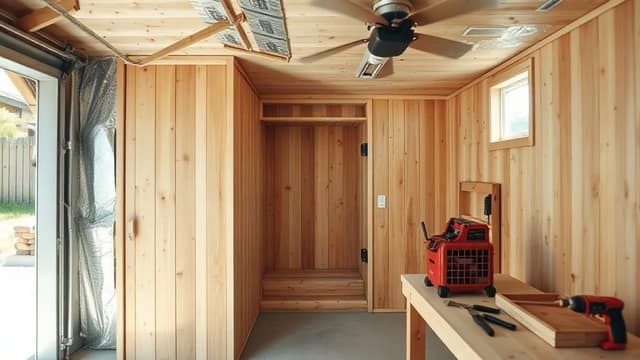 How to Build a SaunaRoom size in cu ft, 2x4 framing, R-13 and R-19 insulation, foil barrier, cedar lining, benches, vents
 How Much Does a Sauna Cost? Prices, Installation and ElectricityPurchase tier, delivery, electrician and wire size, pad for outdoor cabins, kWh per session and per month
 Sauna Heater Size Calculator (kW by Room Volume)Enter your cabin size, glass and stone area to get heater kW, amps and breaker, with the math
 Sauna, Sauna Blanket and Cold Plunge RecallsEvery sauna, sauna blanket and portable steam sauna recall in the CPSC database on November 17, 2026