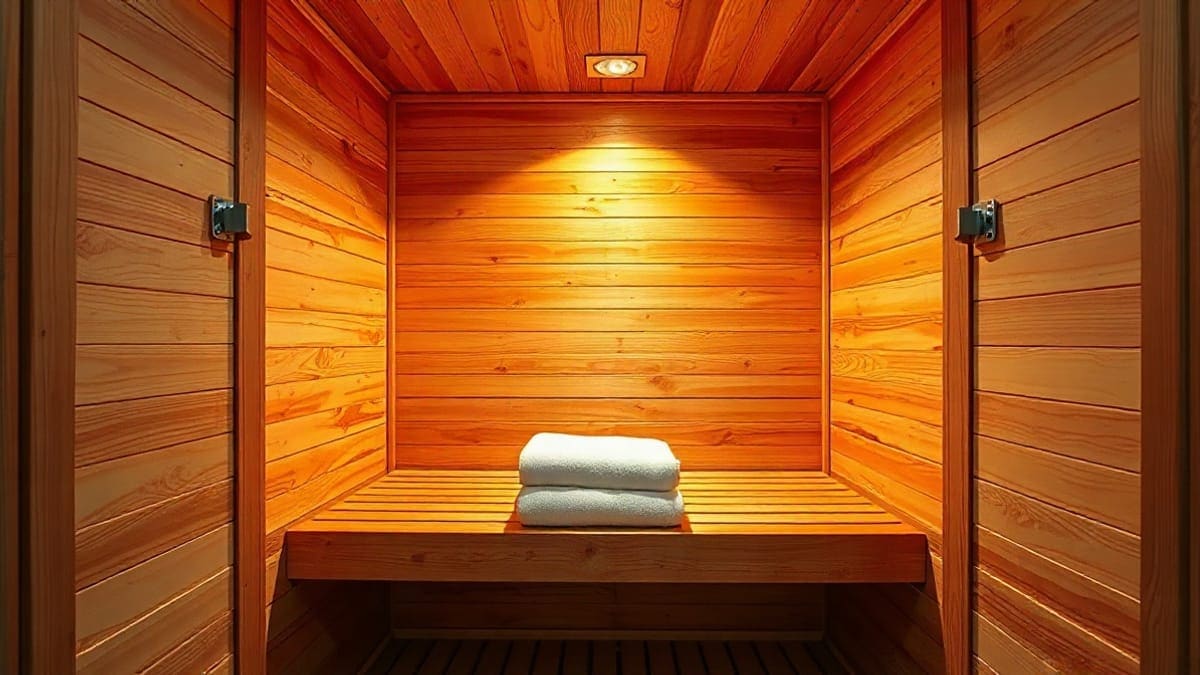
Try an infrared cabin for relaxation, soreness or stiff joints if your doctor has no objection and you accept that the proof is early.
Ask your doctor first if you have heart disease, low blood pressure, multiple sclerosis, a pregnancy, an implanted device or a daily medication. Heart failure patients in the studies were treated under medical supervision, not at home.
Every benefit below carries its study, the number of people and an honest strength rating. Most of the research is small, short and run in Japan or the Netherlands, and no study here tests a home cabin on healthy adults over months. We separate what a trial measured from what sellers claim: heart failure markers, pain, stiffness, recovery, detox, fat loss and cholesterol. A few cabins that fit the research close the page, with a doctor-first checklist before them, and no prices are printed. We give the 140°F of the studies next to the 110 to 135°F that Cleveland Clinic gives for cabins.
Are infrared saunas good for you, and are they healthy?
In two lines
For most healthy adults an infrared sauna is a low-heat, low-risk way to relax, with a few signals of real benefit and no proof of the big claims.
Cleveland Clinic lists infrared cabins at 110 to 135°F and says its doctors find "hotter doesn't necessarily mean better." Mild heat lifts the heart rate and makes you sweat, so the risk sits with the dehydrated, the pregnant and people with heart or blood pressure problems.
Think of it as a warm, quiet 20 to 30 minutes that may ease sore muscles and stress. The clinic notes that more research is needed, especially on infrared cabins, and nothing below says a cabin replaces exercise, medicine or a checkup. Our page on the best time of day to sauna covers sleep and evening use.
What are the benefits of an infrared sauna?
In two lines
The benefits with real studies behind them are cardiac function in heart failure, short-term pain and stiffness relief, and possibly recovery after endurance work, all from small trials.
Each row below is one study, read for design and size. The "strength" column is our reading of the study, not a medical grade.
| Benefit | Study | People | Result | Strength |
|---|---|---|---|---|
| Heart failure markers | Miyata 2008, Journal of Cardiology | 188 | BNP fell from 542 to 394 pg/ml in the Waon group | Moderate, short term |
| Advanced heart failure | Tei 2016, Circulation Journal | 149 | Better NYHA class, 6 minute walk and heart size | Moderate, short term |
| Heart failure overall | Källström 2018, Clinical Cardiology | 7 studies pooled | Lower BNP, better ejection fraction | Moderate to insufficient |
| Chronic pain | Masuda 2005, Psychotherapy and Psychosomatics | 46 | Pain fell in both groups | Fair, one trial |
| RA and AS pain | Oosterveld 2009, Clinical Rheumatology | 34 | Relief during sessions only | Weak, pilot |
| Training recovery | Mero 2015, SpringerPlus | 10 | Jump height 0.34 m vs 0.32 m | Very weak |
The table shows how few trials exist. The largest, Miyata 2008, used 188 patients with chronic heart failure, and these results tell a healthy adult little about long-term use at home. For the general sauna research read sauna health studies, and for the traditional sauna read sauna benefits.
Do infrared saunas have cardiovascular benefits?
For heart failure patients, yes in the short term, under medical care. The studies come from Waon therapy, a Japanese protocol: 15 minutes in a far infrared dry sauna at 140°F (60°C), then 30 minutes of bed rest under a blanket. Miyata and colleagues ran it daily for 2 weeks in 10 hospitals with 188 patients and reported a BNP drop from 542 to 394 pg/ml in the treated group. Tei and colleagues ran it for 10 days in 149 hospitalized patients with advanced heart failure at 19 institutes and reported better NYHA class, 6 minute walk distance and heart size, with no serious adverse events (Tei 2016).
The 2018 meta-analysis by Källström and colleagues pooled 7 of 9 eligible studies out of 1,444 screened. It linked the protocol to lower BNP and better ejection fraction, and found no change in systolic or diastolic blood pressure. The authors call the benefit short term and the evidence moderate to insufficient (Källström 2018).
That 140°F is above the 110 to 135°F Cleveland Clinic gives for a typical cabin. What this does not show: that a healthy person gets a stronger heart. It also does not show that a home cabin, often set above 140°F, matches a hospital protocol. Our page on sauna and blood pressure covers the pressure question for traditional saunas, and sauna heart health the wider heart studies.
Did infrared sauna sessions change blood pressure in the studies?
Maybe a little, and the evidence is limited. Beever's 2009 review in Canadian Family Physician (summarized by UBC News) found 9 human studies of far infrared saunas for heart and risk factor outcomes. It rated the blood pressure evidence as limited, with better support for systolic than diastolic pressure (Beever 2009). The 2018 meta-analysis of heart failure patients found no significant change in either pressure.
If you take blood pressure medicine or have low pressure, heat can lower it further and make you dizzy. Ask your doctor and sit up slowly.
Does an infrared sauna help chronic pain?
It may help some people, but the best trial cannot separate the sauna from the rest of the program. Masuda and colleagues (2005, Psychotherapy and Psychosomatics) split 46 chronic pain patients into two groups. Group A (24 people) got a hospital program of cognitive behavioral therapy, rehabilitation and exercise. Group B (22 people) got the same program plus a daily far infrared sauna and warming for 4 weeks. Pain, depression and anger fell in both groups, and the authors called the combination promising.
Cleveland Clinic says the same: some research suggests relief, but many studies are small. For a closer look at joints and inflammation read sauna for inflammation and pain.
Does an infrared sauna help arthritis and spondylitis?
It eased pain and stiffness during sessions in a pilot study, without making disease activity worse. Oosterveld and colleagues (2009, Clinical Rheumatology) put 17 patients with rheumatoid arthritis and 17 with ankylosing spondylitis through 8 infrared sessions over 4 weeks. Pain and stiffness improved significantly during each session, and the treatment was well tolerated with no flares. The change over the full 4 weeks was not statistically significant (Oosterveld 2009).
Several retailer pages call this pilot a randomized trial or proof of long-term benefit. It was neither. Treat it as a hint that warm sessions are tolerable in inflammatory arthritis, and ask your rheumatologist.
Does an infrared sauna help muscle recovery after a workout?
Not clearly. Mero and colleagues (2015, SpringerPlus) had 10 active men finish a strength or endurance session, then spend 30 minutes in a far infrared sauna, a traditional sauna or a chair. After endurance work, counter-movement jump height was 0.34 m after infrared bathing against 0.32 m after sitting. After strength work, infrared bathing made no measurable difference to sitting (Mero 2015).
Heart rate after the infrared session was lower than after the traditional one (71 against 92 beats per minute), but that traditional sauna was set at the same 35 to 50°C air, at 25 to 35% and then 60 to 70% humidity, not at a 180°F room. Cleveland Clinic says some people find an infrared session helps post-workout soreness. For timing around lifting and cardio, see sauna after workout.
Do infrared saunas have the same benefits as traditional saunas?
In two lines
Not proven either way: the big sauna studies tested traditional saunas, and the infrared studies are small. Infrared cabins also run cooler, at 110 to 135°F against 150 to 195°F.
The mortality research that makes headlines, Laukkanen and colleagues in JAMA Internal Medicine in 2015, followed 2,315 Finnish men for about 20 years and studied traditional saunas. No infrared study of that size exists in the sources we read. The two types also run at different heat.
| Infrared cabin | Traditional sauna | |
|---|---|---|
| Typical air temperature, Cleveland Clinic | 110 to 135°F | 150 to 195°F |
| Temperature in Beever's review | about 140°F (60°C) | about 185°F (85°C) |
| Maker maximum on pages we read | 140 to 170°F | not applicable |
| Main heat source | Radiant panels | Hot air from a stove |
| Humidity | Low, no steam | Low to moderate |
| Session people use | 20 to 30 minutes | 10 to 20 minutes |
| Mortality research | None found | Finnish cohorts, 2015 and later |
Beever notes that infrared users sweat at lower temperatures, which suits people who cannot stand a 190°F room. That is a comfort argument, not a proof of equal benefit. For a direct comparison read infrared vs traditional sauna, and for traditional-only benefits dry sauna benefits.
What infrared sauna claims are not proven?
In two lines
Detox, weight loss, cholesterol control and "deeper" heat are the four claims the studies do not back. Beever found evidence against a cholesterol effect, and a 2012 review found trace metals in sweat but no health gain.
Sellers repeat these claims often. The summaries below show what the evidence says instead.
| Claim | What the research says | Source |
|---|---|---|
| Detox | Sweat holds trace amounts of some metals, but studies are small and kidneys and liver do the work | Sears 2012 review |
| Weight loss | One 10 person study, inconsistent results | Beever 2009 |
| Lower cholesterol | Consistent fair evidence against | Beever 2009 |
| Deeper penetration | Stated in reviews, never measured in these trials | Beever 2009 |
| Cure for any disease | No study claims it | All |
Does sweating in an infrared cabin clear out toxins?
No study shows a health benefit from sweating out toxins. A 2012 systematic review of arsenic, cadmium, lead and mercury in sweat found these metals present in sweat, sometimes at levels above blood plasma in people with high exposure, but the studies were small, differed widely and often used sweat collection that can be contaminated (Sears 2012). That shows metals can appear in sweat. It does not show that sweating lowers your body burden or improves health. If you worry about a specific exposure, ask your doctor about testing.
Can infrared heat take off body fat?
Not in a way the studies prove. Beever found one obesity study of 10 people and called the evidence weak, with inconsistent results across papers. Sweat is mostly water, so a scale reading after a session mostly reflects fluid you will drink back. Our sauna weight loss page goes through the calories.
Does infrared light penetrate deeper into the body?
Reviews repeat the claim, but the trials we read measured symptoms, not tissue temperature. None of the studies above tested how deep the heat reaches in a person, so we do not use "deep penetration" as a selling point. Our far infrared sauna guide explains the wavelength bands, and the full spectrum guide covers near and mid infrared.
Does an infrared sauna lower cholesterol?
The review that checked found evidence against it. Beever reported that published data showed no drop in cholesterol or triglycerides. If a seller claims a cholesterol benefit, ask for the study.
What are the benefits of near infrared and far infrared saunas?
In two lines
Far infrared cabins heat the body with long wavelengths, and near infrared adds a shorter band that red light panels use. The heart failure, pain and arthritis studies above all used far infrared saunas.
We found no study of near infrared panels inside a sauna cabin as a combined treatment, and JNH says on its Arki page that its red light has not been evaluated in clinical trials. Harvard Health calls red light treatment photobiomodulation (Harvard Health). The red light sauna guide and red light therapy sauna cover that side.
What dose did the studies use: temperature, minutes and weekly sessions?
In two lines
Start at about 110°F for 5 to 10 minutes and build to 20 to 30 minutes, which is the range Cleveland Clinic gives. The research protocols were stricter: 140°F for 15 minutes, then 30 minutes of rest.
Nothing says longer is better.
| Question | Practical answer | Source or note |
|---|---|---|
| How hot should an infrared sauna be for health benefits? | 110 to 135°F for most adults | Cleveland Clinic |
| How hot in the heart failure studies? | 140°F (60°C) | Miyata 2008, Tei 2016 |
| How long to stay for benefits? | 20 to 30 minutes after a build-up | Cleveland Clinic |
| How long to see benefits? | Studies ran 2 to 4 weeks, 5 days a week | Källström 2018 |
| How often? | 3 to 5 times a week was common in studies; daily only if your doctor agrees | Study protocols |
The pages on how long to stay in an infrared sauna, how often to use an infrared sauna and infrared sauna temperature carry the details. To get the most from a session, drink water first, avoid alcohol, stay 20 to 30 minutes at most and shower after, as Cleveland Clinic advises.
What about EMF in an infrared sauna?
In two lines
Cabins differ widely in the magnetic field they give off, and makers publish figures from under 1 mG to "under 8 mG": Sun Home claims 0.5 mG seated and JNH 0.02 mG seated on its Arki line.
One sentence is enough here: the research above did not look at EMF, so read infrared sauna EMF explained before you choose, and the low EMF infrared sauna guide if it matters to you.
What are the risks, and who should ask a doctor first?
In two lines
The main risks are dehydration, dizziness and overheating, and the people who need a doctor first are the ones whose heart, blood pressure or pregnancy heat can strain.
The research found few adverse events: Oosterveld reported none in 34 patients, Tei reported no serious events in 149, and Beever noted none across the studies it reviewed. Those people were screened and supervised, so do not read their record as a guarantee for you.
| Group or situation | Concern | What to do |
|---|---|---|
| Pregnancy | ACOG says sauna use, especially early, can harm the fetus (via Cleveland Clinic) | Avoid, ask your doctor |
| Trying to conceive | Heat can temporarily lower sperm count | Avoid during that time |
| Heart disease, heart failure | Heat raises the heart rate | Ask your cardiologist, no home trial on your own |
| Low or medicated blood pressure | Heat can lower pressure further | Ask your doctor, rise slowly |
| Multiple sclerosis | Heat can worsen symptoms | Avoid if it does |
| Fever or infection | A sauna does not sweat out illness | Skip until well |
| Alcohol before a session | Adds dehydration and dizziness | Skip the session |
| Implants, pacemakers, metal in the body | We found no source in this review | Ask your doctor and the device maker |
| Daily medicines | Some change how you handle heat | Ask your doctor or pharmacist |
Leave the cabin at once if you feel dizzy or sick. Never use one when you are alone and unwell. The safety angle has its own page, infrared sauna safety, and the pregnancy rules are in sauna pregnancy safety. Nothing on this page is personal medical advice.
Which infrared sauna fits these uses?
In two lines
None of the cabins below has been proven to give a medical benefit; they differ in heat type, EMF claim and outlet need. The four run on 120 V at 1,700 to 2,050 W.
Specs come from the maker pages read for our best infrared sauna guide. Sun Home's help page lists 1,880 W for the Equinox 2-Person and 2,020 W for the 3-Person, and Peak lists the Fuji at 2,050 W on one page and 2,100 W on another. Confirm sizes and watts with the maker. For other heat types see the home sauna guide; for more sizes read best 2 person infrared sauna and the brand pages for Sun Home, JNH Lifestyles and Peak.
| Model | Heat type | Outside size | Power | EMF claim |
|---|---|---|---|---|
| Sun Home Equinox 2-Person | Far and full spectrum | 50.9 x 45.9 x 77.7 in | 1,880 W, 120 V, 20 A | 0.5 mG seated, maker claim |
| JNH Joyous+ 2-Person | Far infrared | 47.3 x 39.5 x 75 in | 1,700 W, 120 V, 15 A | Under 8 mG |
| JNH Arki Duo | Full spectrum plus red light | 47.3 x 39.5 x 75 in | 1,850 W, 120 V, 15 A listed | 0.02 mG seated per JNH |
| Peak Fuji | Full spectrum plus red light | 53 x 44 x 75 in | 2,050 W, 120 V, 20 A | Near zero, no reading |
Sun Home Equinox 2-Person: far infrared with a published EMF claim
The Equinox uses 4 far infrared and 2 full spectrum heaters in a 541 lb cabin and tops out well inside the range the research used. Sun Home cites a January 2025 Vitatech test at 0.5 mG seated, though we could not find the report, and its Equinox help page says only "virtually zero EMF". Best for: a couple who want far infrared heat and a documented EMF claim. Not for: anyone who wants red light in the same cabin. Read the Equinox review.
JNH Joyous+ 2-Person: the small far infrared cabin
The Joyous+ is 13.0 sq ft outside, weighs 303 lb and runs up to 170°F on a dedicated 120 V, 15 A outlet. JNH lists a 1 year warranty and under 8 mG EMF. Best for: a first far infrared cabin where floor space and an outlet limit you. Not for: a buyer who needs a low seated EMF number.
JNH Arki Duo: full spectrum with the lowest published EMF
The Arki Duo adds 7 red and near infrared emitters (630 to 850 nm) to 8 far and mid infrared heaters, and JNH cites 0.02 mG at the seat. It weighs 350 lb. JNH says the red light has not been evaluated in clinical trials, so treat it as a feature, not a treatment. At 1,850 W and 120 V the load is 15.4 A, above a 15 A rating, so check the outlet. Best for: buyers who put EMF first. Not for: anyone who buys for a medical claim.
Peak Fuji: the wide cabin with a red light panel
The Fuji has an interior of 49 x 40 x 67 in, 8 heating panels and 216 red light LEDs. Peak lists 2,050 W on one page and 2,100 W on another. Best for: a couple who want room and red light. Not for: a household where the outlet is shared, or anyone who wants a number for EMF.
6 common mistakes with infrared sauna benefits
In two lines
Six mistakes cost buyers most: copying a 140°F hospital protocol at home, reading a 34 patient pilot as proof, paying for detox, expecting a cholesterol or fat-loss effect, setting the dial to 170°F, and going daily without a long-term study.
1. Copying the Waon protocol at home
The heart failure results come from 188 and 149 hospital patients at 140°F for 15 minutes, then 30 minutes of rest, under medical care (Tei 2016).
2. Reading a pilot as proof
The arthritis study had 34 patients and no control group, and the 4 week change was not significant (Oosterveld 2009).
3. Paying for detox
Metals appear in sweat, but the 2012 review found small studies and collection that can be contaminated (Sears 2012).
4. Expecting cholesterol or fat loss
Beever found evidence against a cholesterol drop and one obesity study of 10 people (Beever 2009).
5. Setting the dial for a bigger effect
Cleveland Clinic gives 110 to 135°F for infrared cabins and says hotter does not necessarily mean better (Cleveland Clinic).
6. Going daily
The protocols ran 5 days a week for 2 to 4 weeks, and no long-term study covers healthy adults (Källström 2018).
How we researched this page
In two lines
We read 9 studies and reviews, the Cleveland Clinic pages on infrared saunas and four maker pages, and rated each benefit by study size and design. We did not test any cabin.
Studies were read for design, number of people and result. Two Japanese trials (Miyata 2008, Masuda 2005) are cited without a link. The strength column is our reading, not a medical grade, and cabin figures were read in November 2026 with conflicts flagged. No prices are printed.
FAQ
Can an infrared sauna do harm to a healthy adult?
For healthy adults using them briefly with water, infrared saunas have a good safety record in the studies we read, but dehydration and overheating are real. People with heart conditions, low blood pressure, a pregnancy or certain medicines should ask a doctor first. See the risk table above.
Is infrared heat healthy?
Mild infrared heat looks safe for most people and may help relaxation and some symptoms, but "healthy" is not proven by the trials we found. The strongest evidence is for heart failure patients under supervision. Healthy adults have no long-term infrared study.
Are infrared sauna benefits real?
Some are, in small studies: heart function in heart failure and short pain relief. Others are marketing. Detox, fat loss and cholesterol claims are not supported. Each row of the evidence table shows size and strength.
What does an infrared sauna do for your body?
It warms the skin a lot and makes you sweat, and it raises core temperature only when the air is hot: +1.4°C at 65°C (149°F) in one 2026 trial, 0.0°C in two Oregon trials. Jenkins 2026 measured the rise rectally (Jenkins 2026); Reed 2025 and Atencio 2025 found none (Reed 2025, Atencio 2025). Studies also tie the heat to short-term changes in heart failure markers and to pain relief during sessions. See infrared sauna temperature.
Can I use an infrared sauna every day?
Studies ran 5 days a week for 2 to 4 weeks, but there is no long-term safety study of daily use in healthy people. Ask your doctor if you want to go daily, and hold each session to 20 to 30 minutes. See how often to use an infrared sauna.
Which is better, traditional or infrared sauna?
Neither is proven better. Traditional saunas have the large Finnish mortality studies. Infrared cabins run cooler, at 110 to 135°F against 150 to 195°F, which some people tolerate better. The full comparison is in infrared vs traditional sauna.
Does an infrared sauna help skin?
We found no skin trial among the infrared studies above. Sellers claim a glow and fewer blemishes, but sweating and warmth are all the research supports. Our sauna for skin page reviews the evidence.
What is infrared sauna therapy?
It means repeated sessions in a far infrared dry sauna, such as the 140°F, 15 minute Waon protocol, for a health goal. It is a therapy only in the studies, which paired it with rest and medical monitoring. For the cabin itself read what is an infrared sauna.
Which cabin features matter if you buy for health?
Look for a stated heat range of 110 to 170°F, the heat type, a published EMF figure, the circuit it needs and a clear warranty. Do not pay for a medical claim. The best infrared sauna guide compares ten cabins on those checks.
Does Medicare cover far infrared sauna therapy?
We found no Medicare rule that covers a home infrared sauna. Ask Medicare or your plan directly and ask your doctor whether any supervised heat therapy is covered for your condition.
How long does it take to see infrared sauna benefits?
The heart failure studies measured changes after 2 weeks to 4 weeks of near-daily sessions, while pain and stiffness relief showed during sessions. No study shows a month-long gain in healthy adults. Expect a relaxed feeling first and judge anything more over several weeks.
Can you combine an infrared sauna with a cold plunge?
Some people do, but the heat and cold together strain the heart more, so ask your doctor if you have any heart condition. Order and timing live on cold plunge and sauna contrast therapy.
Sources
- Beever R., Far-infrared saunas for treatment of cardiovascular risk factors, Canadian Family Physician 2009;55:691-696.
- Källström M. et al., Effects of sauna bath on heart failure: a systematic review and meta-analysis, Clinical Cardiology 2018;41:1491-1501.
- Miyata M. et al., Beneficial effects of Waon therapy on patients with chronic heart failure, Journal of Cardiology 2008;52:79-85.
- Tei C. et al., Waon therapy for managing chronic heart failure, the WAON-CHF study, Circulation Journal 2016;80:827-834.
- Masuda A. et al., repeated thermal therapy for chronic pain, Psychotherapy and Psychosomatics 2005;74:288-294.
- Oosterveld F. et al., Infrared sauna in patients with rheumatoid arthritis and ankylosing spondylitis, Clinical Rheumatology 2009;28:29-34.
- Mero A. et al., Far-infrared sauna bathing and recovery from training, SpringerPlus 2015.
- Jenkins 2026, Experimental Physiology; Reed 2025, Journal of Applied Physiology; Atencio 2025, American Journal of Physiology.
- Sears M. et al., Arsenic, cadmium, lead and mercury in sweat, Journal of Environmental and Public Health 2012.
- Laukkanen T. et al., Sauna bathing and mortality, JAMA Internal Medicine 2015.
- Cleveland Clinic, Infrared sauna benefits.
- Maker pages for Sun Home, JNH Lifestyles and Peak Saunas.
Keep comparing
 Sauna Temperature GuideTraditional 150 to 195°F, infrared 110 to 135°F, steam room, where to measure, heat-up time by kW
 How to Build a SaunaRoom size in cu ft, 2x4 framing, R-13 and R-19 insulation, foil barrier, cedar lining, benches, vents
 What Is a Traditional (Dry) Sauna?A traditional dry sauna is a wood room heated by an electric or wood stove on stones
 How Long Should You Stay in a Sauna?Minutes by type and experience, rounds and rest, what the Finnish studies show, signs to leave
 How to Use a SaunaWhat to drink and wear, bench and water rules, shared sauna etiquette