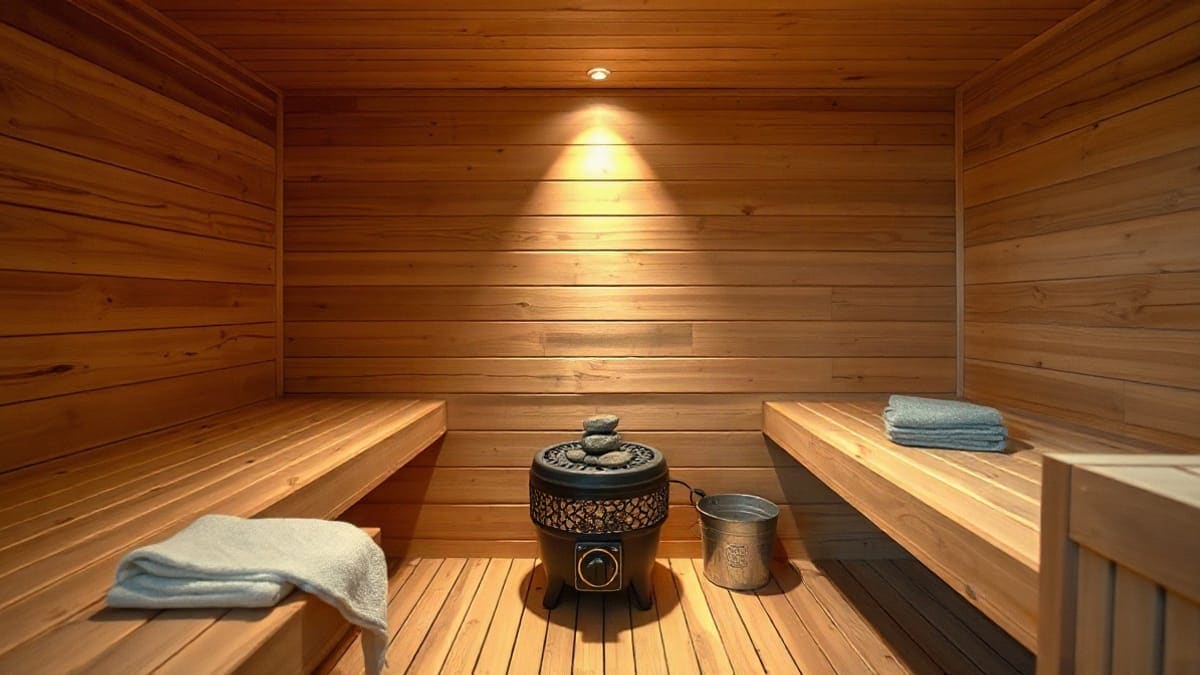
A first sauna feels easy until the heat is higher than you planned, and beginners ask the same things: what to drink, what to wear, where to sit, how much water to throw and when to leave. This guide gives the ten steps in order, then clothing, water on the stones, shared manners, home care, how infrared and steam rooms differ, and who needs medical advice first. Sourced numbers carry their source in the text, and our own practice tips say so. It closes with four home saunas that suit a first-time owner, from a plug-in cabin to a backyard stone sauna.
What are the steps of a sauna session?
In two lines
Drink water, shower, sit on a towel on the lower bench for 5 to 10 minutes, then cool down, rest and repeat once or twice. The same ten steps work in a stone-heater cabin, a gym sauna and an infrared cabin.
Only the water step changes. Each step answers a common question: how to work a sauna, how to do it correctly and how to use one for the first time.
- Drink first. Have about 8 to 16 fl oz (240 to 480 mL) of water before you go in, and more if you came from a workout. That figure is our practice tip; Cleveland Clinic says to drink before and after.
- Shower and dry off. Rinse off lotion, perfume and sweat. A dry body sweats cleanly and keeps the benches clean.
- Take a towel for the bench. Sit or lie on it so skin never touches the wood, and wipe sweat from your seat when you leave.
- Start on the lower bench. Let your body adjust for 5 to 10 minutes, the beginner range Healthline gives. Breathe through your nose and relax your shoulders.
- Move up if you want more heat. The upper bench is hotter. Skip it if you feel light-headed.
- Add steam if the sauna has a stove. One ladle at a time, see the next sections.
- Leave when you are uncomfortable, not when a timer says so. A sauna is not a contest.
- Cool down. Sit in fresh air, take a lukewarm or cool shower, or use a cold plunge if your doctor agrees. Cleveland Clinic's cold plunge guide starts beginners at 50 to 59°F. See sauna and cold plunge contrast therapy and how long to cold plunge.
- Rest and drink. Rest 10 minutes or more, and drink 2 to 4 glasses of cool water as Harvard Health advises.
- Repeat once or twice, then finish with a shower. How many rounds suit you depends on health and experience; see how often to use a sauna.
A rule that beats any number: if the heat starts to feel like effort, the session is over.
| Step | What you do | Typical time |
|---|---|---|
| Drink | Water before entering | 2 min |
| Shower and dry | Rinse, towel off | 3 to 5 min |
| Round 1 | Lower bench | 5 to 10 min |
| Cool down | Air, shower or plunge | 5 to 10 min |
| Round 2 | Lower or upper bench | 5 to 15 min |
| Rest | Sit, drink water | 10 min or more |
The times are common beginner ranges, not medical advice. Longer sessions are covered on the pages for how long to stay in a sauna and sauna temperature.
What should you wear in a sauna?
In two lines
Wear a towel, a swimsuit or nothing, depending on where you are, and leave metal jewelry, watches and glasses outside because they heat up. At home a towel under you is enough, and a plastic sweat suit has no place in a sauna.
A felt or wool sauna hat keeps the head and ears from overheating on long sessions, an old Finnish habit. Bring flip flops for wet floors, and a second towel to dry off. Cotton is fine for the towel; avoid synthetic robes that trap heat when you are done.
A "sauna suit" is a plastic sweat suit worn while exercising, and it traps heat on your body without cooling it. Skip it, and see sauna weight loss for what the studies say about water loss versus fat loss. Many gym saunas ban street clothes, shoes and phones, so read the sign on the door.
How do you use water and stones in a sauna?
In two lines
Start with one ladle, about a half cup (120 mL), on the hot stones and wait 30 seconds before adding a second. The steam lifts humidity for a moment, and an infrared cabin never takes water.
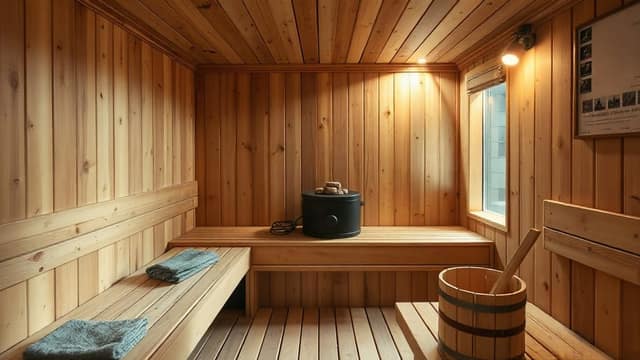
A traditional sauna lets you pour water on hot stones to make steam, called löyly in Finnish, and it makes the air feel hotter on your skin. Add a second ladle only if the heat feels comfortable. Pour slowly on the stones, not on the heater's electrical parts or the wood. Keep your face away from the first burst of steam, then step back, because steam rises fast.
| Cabin type | Water on stones? | What to know |
|---|---|---|
| Traditional stone heater | Yes, by the ladle | Follow the heater maker's limit on water and stone type |
| Far-infrared cabin | No | Built for dry air; water can damage the heaters and panel |
| Steam room | Not applicable | A generator makes steam; see sauna vs steam room |
| Wet or dry choice | Your pick | Dry vs wet sauna covers the difference |
A wooden bucket and ladle are the usual tools; the sauna accessories guide lists them. Add essential oil only if the heater maker allows it, and only diluted in the water, never dropped on the stones or wood. Heater manuals differ, so check yours.
What is sauna etiquette in a shared sauna?
In two lines
In a shared sauna, shower first, sit on a towel, keep your phone out, keep conversation soft and close the door behind you so the heat stays in. Ask before you pour water on the stones.
Some people dislike steam, so ask the room first. Leave space on the bench, and lie down only when the room is empty or the rules allow it. Do not stay in the doorway; the door lets the heat out, so open it only as fast as you pass through.
Local habits differ. In Germany and Finland, many saunas are used without clothing, and a swimsuit may even be unwelcome. In a US gym, a towel or swimsuit is the norm. If you are unsure, watch what others do or ask the staff. These are customs, not laws, so read the posted rules, and leave quietly if someone else is resting.
How do you prepare and clean up after a home session?
In two lines
Preheat before you shower: 20 to 45 minutes for a 2-person infrared cabin, and 60 minutes or more for an outdoor stone cabin below 40°F. Keep the vents open, wipe the benches and leave the door ajar to dry afterward.
Sun Home says to allow 20 to 30 minutes in a room at 68 to 75°F for its larger infrared cabins, and owners of the Equinox 3-Person report about 45 minutes to a good temperature. Outdoors in winter takes more: Sun Home states 60 minutes or more below 40°F for its Luminar. See how long a sauna takes to heat up for the full picture.
| Type | Power and circuit | Preheat to expect |
|---|---|---|
| 2-person infrared (Equinox) | 1,880 W, 120 V, 20 A | 20 to 45 min |
| Small infrared (Joyous+ 2) | 1,700 W, 120 V, 15 A | Maker gives no figure |
| Stone heater (Nova 3) | 6 kW, 240 V, 30 A | Maker gives no figure |
| Backyard cabin (Redwood Cabin) | 6 kW, 240 V, 30 A | Maker gives no figure |
Warm-up numbers above come from maker pages and owner reports; where a maker is silent, so are we. Your manual and electrician have the last word on wiring, under the National Electrical Code. Our sauna electrical requirements page explains circuits.
Heaters are rated by room volume. Harvia lists its 6 kW Cilindro for 141 to 283 cubic feet, so a heater far too small or too big for your room will never feel right. See sauna heater size calculator before buying.
Keep air moving. A cabin has vents set by the maker. Do not block them with towels or shelves, and do not seal the room shut. Crack the door a few minutes after a session so moisture escapes.
Clean after each session. Wipe the benches and backrest, leave the door ajar to dry, and mop the floor. Wash the towels. A monthly deeper clean is in how to clean a sauna.
How do you use an infrared sauna?
In two lines
Use it like the steps above with three changes: no water, a lower air temperature of 110 to 135°F, and a longer comfortable stay of 20 to 40 minutes on maker timers.
Cleveland Clinic gives that 110 to 135°F range, and makers list caps of 150 to 165°F, well below a stone heater cabin, so the heat comes from the panels warming your skin more than the air. Preheat 10 to 30 minutes, sit with your back against the wood, and keep the controller within reach. The full routine, with timings and dos and don'ts, is in the infrared sauna session guide. For how it compares, read infrared vs traditional sauna. Session counts and lengths have their own pages: how often to use an infrared sauna and how long in an infrared sauna. Brand routines differ, so follow the manual of a Clearlight or Sunlighten cabin. A Lifepro blanket or any portable sauna is used lying down.
What changes in a steam room?
In two lines
A steam room runs 100 to 120°F at close to 100 percent humidity, so the first minutes feel mild but sticky. The sauna steps still apply: shower, sit on a towel, drink water and stay 5 to 10 minutes.
WebMD and Medical News Today give different steam room ranges, so we show the span. A steam room is tiled and much cooler than a sauna. Never use steam and a sauna back to back without cooling between them. For the choice, see sauna vs steam room.
When is the best time to use a sauna?
In two lines
Pick a time when you are not hungry, not stuffed and not rushed, and wait at least 30 minutes after a heavy meal. The clock time itself has its own page.
Evening and after a workout are popular, and the evidence is thin, so best time of day to sauna lays out the trade-offs, and sauna after workout covers training days. Do not use a sauna right before a long drive, or when you are sick with a fever.
What does sitting in a sauna do for you?
In two lines
Sitting in a sauna raises your heart rate and warms you, and Finnish studies link frequent use with fewer fatal cardiovascular events. Those studies are observational, so they show an association and not proof that the sauna caused it.
In the 2015 JAMA Internal Medicine study, Laukkanen and colleagues followed 2,315 middle-aged Finnish men for about 20 years, and men who used a sauna four to seven times a week had lower rates of fatal cardiovascular events than men who used it once a week.
People use saunas to relax, to warm up, to ease sore muscles and as a social ritual. A systematic review of regular dry sauna use (Hussain and Cohen, 2018) reported effects on blood pressure and heart function but called for larger trials. The sauna benefits page goes through each claim and its study.
The sweat itself does not "detox" much. A small study of 20 people (Genuis and colleagues, 2011) found toxins in sweat, but nothing shows the amount matters for health. Weight lost in a sauna is mostly water and returns when you drink. More in sauna detox.
Who should not use a sauna, or should ask a doctor first?
In two lines
Ask your doctor before using a sauna if you have a heart condition, low blood pressure, are pregnant, take medication or drink alcohol. The table lists five groups and what to do for each.
This is general information and not medical advice. Sauna heat raises heart rate and widens blood vessels, which is why these groups need a professional's view.
| Group | What to do |
|---|---|
| Alcohol | Never drink before or in a sauna; it adds dehydration and low blood pressure risk |
| Medications | Ask your doctor, especially for blood pressure, heart or diuretic drugs |
| Pregnancy | Ask your doctor first; see sauna pregnancy safety |
| Children | Only with an adult, shorter stays, lower bench, cooler cabin, after asking a pediatrician |
| Heart and blood pressure | Ask your doctor first; see sauna and blood pressure |
Hannuksela and Ellahham (American Journal of Medicine, 2001) reviewed the benefits and risks of sauna bathing and listed alcohol, unstable heart disease and dehydration among the main hazards. Mayo Clinic lists dizziness, nausea and a weak, rapid pulse among the signs of heat exhaustion. Diabetes, a recent tattoo or Botox, a period and an acute illness are all cases to raise with your doctor rather than guess.
Never use a sauna alone if you are unwell. If symptoms continue, call a doctor or emergency services. More in sauna risks and safety.
What type of wood and power does a sauna use?
In two lines
Home saunas use soft, low-resin woods such as cedar, hemlock, spruce or aspen. An infrared cabin runs on a 120 V, 20 A circuit at 1,880 W, and a 6 kW stove heater needs a hardwired 240 V circuit.
Soft woods stay comfortable to the touch at high temperature, and our best wood for sauna page compares them. A dedicated 20 A circuit pulls up to 2,400 W at the breaker's limit, and Sun Home's electrical guide sets out circuits for its cabins. Electricity use per session is watts times hours, so a 1,880 W cabin used for one hour draws about 1.9 kWh. Your own rate decides what that costs; purchase questions sit on sauna cost, and lighting on sauna lights.
What room suits a home sauna?
In two lines
Choose a dry, level room you can wire and vent: a spare bedroom, a basement corner, a garage bay or a backyard pad. Check weight, since the Nova 3 weighs 772 lb and the Redwood Cabin 1,150 lb.
If bathroom space is all you have, read sauna in a bathroom and the best indoor sauna guide.
Which home saunas suit a first-time user?
In two lines
Choose for the outlet you have: a plug-in infrared cabin on 120 V is the easiest start, and a 240 V stone heater gives the classic experience. The four below run from 1,700 W on 15 A to 6 kW on 30 A.
The full field is in the best home sauna guide, and two-seat cabins are in best 2 person sauna.
| Model | Type | Size listed | Power | Best for |
|---|---|---|---|---|
| Sun Home Equinox 2-Person | Full-spectrum infrared | 50.9 x 45.9 x 77.7 in | 1,880 W, 120 V, 20 A | A simple first sauna for two |
| JNH Joyous+ 2-Person | Far infrared, low EMF | 47.3 x 39.5 x 75 in | 1,700 W, 120 V, 15 A | Small floor space |
| Sun Home Nova 3 | Traditional, stones | 64.9 x 57.1 x 82.7 in | 6 kW, 240 V, 30 A | Real steam indoors |
| Redwood Outdoors Cabin | Traditional, outdoor | 67 x 78 x 92.5 in | 6 kW, 240 V, 30 A | A backyard stone sauna |
Sun Home Equinox 2-Person: easiest plug-in start
Sun Home lists 120 V, 1,880 W and a dedicated 20 A circuit, an interior of 45.4 x 39.9 x 70.3 in and a weight of 541 lb. The maximum temperature is 165°F. The 3-person Equinox is the 2,020 W model.
Best for: first-time owners who want a dry, low-effort routine. Not for: anyone who wants steam from stones. Check price
JNH Joyous+ 2-Person: smallest footprint
The JNH product page lists 1,700 W on 120 V and 15 A, a 170°F ceiling, 8 mG of EMF, a 303 lb weight and a 47.3 x 39.5 x 75 in cabin. Our arithmetic: 1,700 W divided by 120 V is 14.2 A, so keep other loads off that line.
Best for: a small room or apartment. Not for: anyone who wants room to stretch out or add stones. Check price
Sun Home Nova 3: stones and steam indoors
The Nova 3 uses a HUUM 6 kW electric heater on 240 V and 30 A, weighs 772 lb and reaches 230°F, with 25.7 sq ft of floor.
Best for: people who want the ladle and steam routine at home. Not for: a home without a 240 V, 30 A line. Check price
Redwood Outdoors Cabin: backyard stone sauna
The Cabin is 67 x 78 x 92.5 in (width, depth, height; 5 ft 7 in by 6 ft 6 in by 7 ft 8.5 in) and weighs 1,150 lb. The base heater is a 6 kW Harvia KIP on 240 V, 30 A, and walls are 1.5 in heat-treated hemlock.
Best for: adults who sauna often and want to stand inside. Not for: a small yard or a pad that cannot carry 1,150 lb. Check price
For a thermometer, bucket and ladle, read sauna accessories. We list no accessory here because we found no maker sheet to verify.
6 common mistakes when you use a sauna
In two lines
Most mistakes come from going in too long, too dry or too hot for a first visit. Each costs nothing to avoid, and none needs new equipment.
1. Staying too long the first time
Cleveland Clinic says about 5 minutes for beginners and Healthline says 5 to 10. Leave when you are uncomfortable, and add a few minutes a visit.
2. Pouring too much water at once
Start with one ladle, about a half cup (120 mL), and wait 30 seconds. Never pour water inside an infrared cabin, where it can damage the heaters and panel.
3. Going in dry or after alcohol
Drink before you go in and take 2 to 4 glasses of cool water after, as Harvard Health advises. Alcohol adds dehydration and low blood pressure risk, so skip the session after drinking.
4. Skipping the preheat or blocking the vents
An infrared cabin needs 20 to 45 minutes, and an outdoor stone cabin 60 minutes or more below 40°F. Do not block vents with towels or seal the room shut.
5. Wearing a sweat suit, jewelry or glasses
A plastic sweat suit traps heat without cooling you, and metal jewelry, watches and glasses get hot against the skin. A towel or swimsuit is enough.
6. Overloading the circuit
A 1,880 W Equinox draws 15.67 A on a dedicated 20 A line, and a 1,700 W Joyous+ draws 14.2 A on a 15 A line. A 6 kW heater needs a hardwired 240 V circuit, which an electrician should set up.
FAQ
What do I do in my first sauna session?
Drink water, shower, sit on a towel on the lower bench, stay 5 to 10 minutes, then cool down and rest. Repeat once if you feel good. Leave at once if you feel dizzy.
How many times a week should you use a sauna?
Beginners often start with one to three sessions a week and add more if they feel well. The Finnish study that linked frequent use with fewer cardiovascular deaths looked at four to seven sessions a week in healthy men. See how often to use a sauna.
Is daily sauna use okay?
Many people do, and Finnish men in the study above did. Daily use should come with water, rest and a doctor's approval if you have any health condition. Stop if you feel unwell.
How do you use a sauna properly at the gym?
Shower, bring a towel, sit on it, keep your phone out, close the door behind you and follow the posted rules. Leave when you feel hot enough, not when others do.
What should you wear in a sauna?
A towel or swimsuit at a gym, and a towel at home. Avoid jewelry and glasses that heat up. A felt hat is optional. Skip plastic sweat suits.
Can you use a sauna while pregnant?
Ask your doctor first. Heat can raise body temperature, and the safe limit depends on your situation. More in sauna pregnancy safety.
Can kids use a sauna?
Only with an adult, for a short time, on the lower bench in a cooler room, and after asking a pediatrician. Never leave a child alone in a sauna.
Can you use a sauna with high blood pressure?
Ask your doctor. Heat changes blood pressure and heart rate, and medicines can change how you respond. See sauna and blood pressure.
How do you use a sauna and a cold plunge together?
Sit in the sauna, step out, cool down in cold water for a short time, then rest. Never plunge after alcohol and ask your doctor if you have heart problems. See contrast therapy.
How do you use an infrared sauna?
Preheat, sit with your back against the wood, stay for a comfortable session and drink water. No water on stones. The infrared sauna session guide has the details.
Do I put water on the stones in a dry sauna?
Only in a traditional stone heater cabin. Pour one ladle at a time. Infrared cabins are dry and should never get water poured inside.
How we researched this page
In two lines
We read Cleveland Clinic, Harvard Health, Healthline, two research papers, a 2001 review and four maker pages on November 17, 2026. We did not test any sauna, and we list below what we could not confirm.
The 8 to 16 fl oz of water, the half-cup ladle and the 5 to 10 minute first session are practice figures, and only the beginner minutes and the water advice have a source. The Sun Home 20 to 30 minute preheat and the 45 minute owner report come from Sun Home pages and owner reports that we did not re-read, and the Equinox page returned a rate limit error, so its figures come from the help center. Makers give no preheat for the Joyous+, the Nova 3 or the Redwood Cabin. The Cilindro room range is from the Harvia page, and the amp figures are our arithmetic.
Sources
- Laukkanen and colleagues, Association between sauna bathing and fatal cardiovascular and all-cause mortality events, JAMA Internal Medicine, 2015
- Hussain and Cohen, Clinical effects of regular dry sauna bathing: a systematic review, Evidence-Based Complementary and Alternative Medicine, 2018
- Hannuksela and Ellahham, Benefits and risks of sauna bathing, American Journal of Medicine, 2001
- Genuis and colleagues, sweat, blood and urine in 20 people, Archives of Environmental Contamination and Toxicology, 2011
- Cleveland Clinic, Sauna benefits
- Harvard Health, Saunas and your health
- Healthline, How long should you stay in a sauna?
- Sun Home Saunas, Equinox help center
- JNH Lifestyles, Joyous+ 2-Person
- Redwood Outdoors, Cabin 4-Person Outdoor Sauna
- NFPA 70, National Electrical Code
Keep comparing
 Infrared Sauna BenefitsHeart failure, blood pressure, chronic pain, arthritis and recovery, what is not proven
 How to Build a SaunaRoom size in cu ft, 2x4 framing, R-13 and R-19 insulation, foil barrier, cedar lining, benches, vents
 What Is a Traditional (Dry) Sauna?A traditional dry sauna is a wood room heated by an electric or wood stove on stones
 Sauna Heater Not Working or Not Heating UpSauna heater not working? Symptom table, reset steps from Harvia, Finnleo, HUUM and Saunum manuals
 Sauna, Sauna Blanket and Cold Plunge RecallsEvery sauna, sauna blanket and portable steam sauna recall in the CPSC database on November 17, 2026