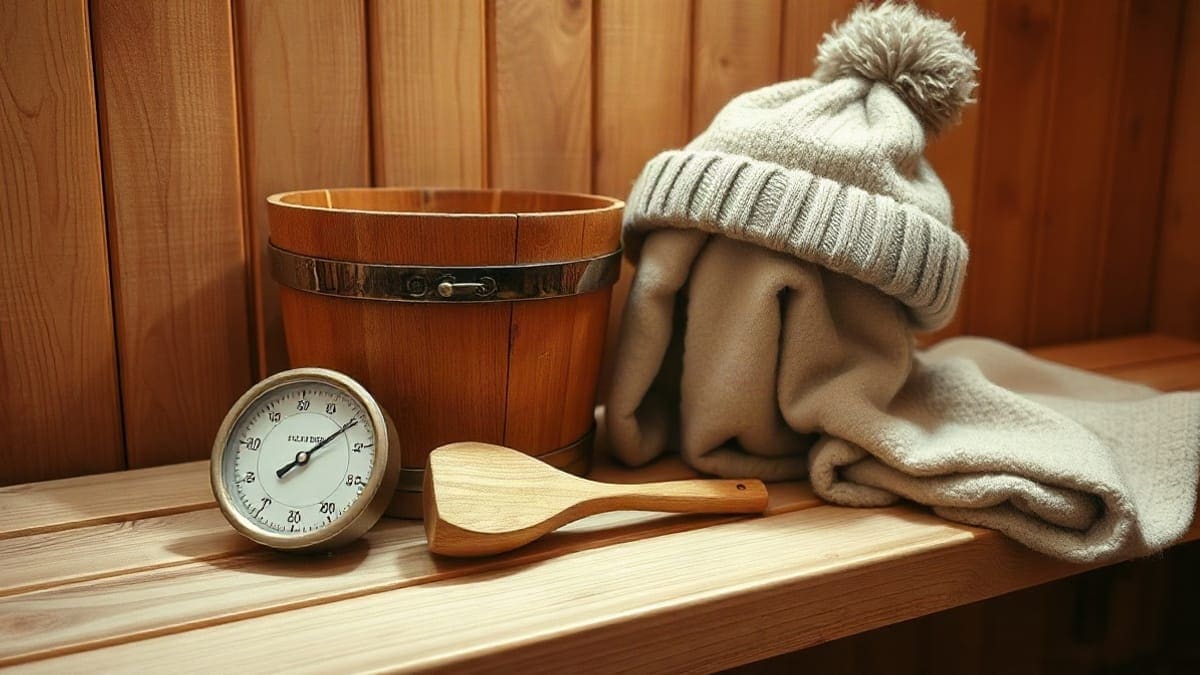
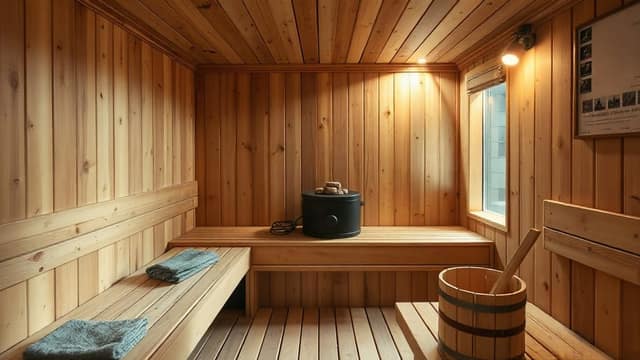
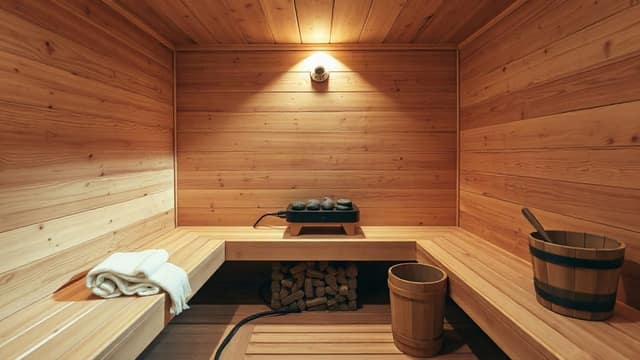
A traditional sauna is the original design: a wooden room, a stove and a pile of stones that hold heat. The stove can burn wood, run on gas or plug into a 240 V circuit, and the electric kind is what most homes get. You sit on benches in dry heat and can ladle water on the stones for a short wave of steam, called löyly. It differs from a steam room, which is wet, and from an infrared cabin, which warms you with light. This page defines each part, shows how the heat moves, lists what the room needs at home and names five stoves and cabins. We ran no tests, and we say where sources disagree.
What is a traditional dry sauna made of?
In two lines
It is a room with five parts: insulated walls, a stove, stones, benches and a way for air to move. Take one away and it stops being a sauna and becomes a hot closet.
| Part | What it does | Typical figure |
|---|---|---|
| Insulated wooden room | Keeps heat in; wood stays cool enough to touch | Maker walls of 1 3/8 in on the Almost Heaven Pinnacle |
| Stove or heater | Makes the heat | 6 kW electric, or 16.5 kW wood stove |
| Stones | Store heat and turn water into steam | About 44 lb in a Harvia KIP60B, about 200 lb in a Cilindro Half |
| Benches | Put you at the height you can stand | Upper bench is hottest |
| Vents and door | Bring in fresh air and let moisture out | Set by the maker |
The word "dry" refers to the air you breathe, not to the stones. In a room kept at 150 to 195°F, sweat evaporates fast, and that is why the heat feels bearable at temperatures that would be dangerous in wet air.
Why is it called "dry" if you can pour water on the stones?
In two lines
Because humidity stays under 20 percent for the room as a whole, per Cleveland Clinic, and the steam from a ladle fades within a minute or two. Löyly, the Finnish word for that steam, is part of the tradition.
Cleveland Clinic gives the under-20-percent figure for the dry room. UNESCO describes löyly as the spirit or steam released by casting water on heated stones, and lists the Finnish sauna tradition among its intangible heritage since 2020.
| Setup | Air temperature | Humidity | What you feel |
|---|---|---|---|
| Traditional, no water | 150 to 195°F | Usually under 20% | Pure dry heat |
| Traditional, ladle on stones | Same air | Spikes, then falls | A wave of heat on the skin |
| Steam room | 100 to 120°F | Near 100% | Heavy, wet warmth |
| Infrared cabin | 110 to 135°F | Dry | Light warms you, the air stays cooler |
Steam room temperatures differ by source, 110 to 120°F by WebMD and 100 to 110°F by Medical News Today, so the table shows the combined span. The cleanest way to hold the idea: a traditional sauna is dry by design and wet by choice. If you want to know how long water on the stones takes to settle, or how the feel changes, see sauna humidity and dry vs wet sauna, which settle that comparison.
How does the heat move around a traditional sauna?
In two lines
Hot air rises from the stove and stones, fills the room from the ceiling down, and the stones also radiate heat to bathers, so the top bench runs hottest and the floor coolest. Fresh air in and exhaust out keep that loop moving.
Where you sit sets how hot you are. Fresh air enters near the stove, the stove warms it, and it leaves through an exhaust vent. A sauna that is sealed shut stops that loop and feels stuffy.
The stones matter more than they look. They soak up heat while the heater runs and give it back evenly, which smooths the swings when the thermostat cycles. Harvia's published sizing rule, in its heater selection guide, is 1 kW per cubic meter of room (about 35 cu ft), with glass and stone adding volume. Resellers use 45 to 50 cu ft per kW. A 6 ft by 6 ft cabin 7 ft tall holds 252 cu ft. Our arithmetic: that is 7.2 kW by Harvia's rule and about 5 kW by the resellers' rule, so a 6 kW heater sits between the two. A heater sized by the sauna heater size calculator should match your own room.
How are traditional saunas heated?
Three ways: electric, wood-burning and gas. Electric is the home default, wood is for backyards and cabins, and gas is rare.
| Heater type | Power | Room range | Notes |
|---|---|---|---|
| Electric (Harvia KIP60B) | 6 kW, 240 V | 170 to 300 cu ft | Dial, 8 hour delay timer, 60 minute auto shut-off |
| Electric floor stove (Harvia Cilindro Half) | 6 kW, 240 V | 141 to 283 cu ft | About 200 lb of stone |
| Wood-burning (Harvia M3) | 16.5 kW | 212 to 459 cu ft | Needs a flue and a clear floor |
| Gas | Varies by model | Varies | Rare indoors; follow the maker |
The details and the models are on best sauna heater and best wood burning sauna stove. How long the room takes to reach temperature depends on the cabin: Almost Heaven says its 6 kW Harvia heater brings the Logan to 180°F in about an hour. See how long does a sauna take to heat up.
Does a stove cabin need vents?
Yes: manuals ask for fresh air in and exhaust out, and you should not block the vents with towels. The vent sizes and positions are set by each maker, so follow the manual for your own heater, such as Sun Home's ventilation guide, and ask a licensed installer to confirm. The reason is practical. A stove burns air if it is wood or gas, and bathers use it up and add moisture.
Where does the traditional sauna come from?
In two lines
It comes from Finland, where saunas are woven into daily life: UNESCO cites about 3.3 million saunas for 5.5 million people, and counts löyly, the steam from water on hot stones, as the center of the practice.
The same UNESCO page counts electric, wood-heated, smoke and infrared saunas as forms of the practice, but names löyly as its center. A smoke sauna has no chimney; the room fills with smoke while it heats and is aired out before bathing. The modern electric stove arrived later and is what most home buyers get.
For the full story, from smoke saunas to the electric heater, see history of the sauna. If you only want the umbrella view of all sauna types, what is a sauna and types of saunas cover it.
How does a dry sauna differ from a steam room and an infrared sauna?
In two lines
A steam room is wet heat near 100 percent humidity at 100 to 120°F, an infrared cabin warms your body with light while the air stays at 110 to 135°F, and the dry sauna runs hottest in the air at 150 to 195°F.
| Type | Heat from | Air temperature | Humidity | Power at home |
|---|---|---|---|---|
| Traditional dry sauna | Stove and stones | 150 to 195°F | Under 20% | 240 V, 6 kW and up |
| Infrared sauna | Light panels | 110 to 135°F | Dry | Often 120 V |
| Steam room | Steam generator | 100 to 120°F | Near 100% | 240 V generator |
For the two side-by-side comparisons, go to infrared vs traditional sauna and sauna vs steam room; those pages own the choice, so we keep it to one table here. A "wet" or "steam" sauna fed by a heater with a water tank is explained in wet sauna and traditional steam sauna.
What does a traditional sauna need in your home?
In two lines
It needs floor space, a 240 V circuit, a heater sized to the room volume and a way to vent. Plan around four numbers: 240 V, 6 kW for 170 to 300 cu ft, about 25 A and a 30 A breaker.
| Need | Figure | Source |
|---|---|---|
| Voltage | 240 V, hardwired | Harvia, Almost Heaven |
| Heater | 6 kW for 170 to 300 cu ft | Harvia KIP60B page |
| Current | 25 A for 6 kW at 240 V | Our division (6,000 W / 240 V) |
| Breaker | 30 A on the Almost Heaven Pinnacle cable | Maker page |
| Cabin footprint | 78 x 71 x 81.5 in on the Pinnacle | Maker page |
| Weight | 800 to 990 lb on the Redwood Cabin 4-Person, depending on the page | Maker page |
Wiring is an electrician's job, and the rules are in sauna electrical requirements. Floor load matters outdoors, where a pad has to carry the weight of a barrel or a cabin. For costs see sauna cost, and for building a room from scratch, how to build a sauna.
Can you put a traditional sauna indoors?
Yes, if the room has a level, protected floor, the clearances the maker lists and an exhaust path. Sun Home's Nova 3 is a traditional indoor cabin of 64.9 x 57.1 x 82.7 in with a 6 kW heater on 240 V and 30 A. A basement corner or a garage bay works; a bathroom needs extra care. Kits are compared in best indoor sauna and best sauna kits, and the outdoor side is in best outdoor sauna.
Do traditional saunas have EMF?
An electric heater produces some electromagnetic fields, and we found no maker figure in milligauss for a traditional heater. Infrared makers publish them; for example, JNH lists 0.32 mG at the surface of its heaters. If this matters to you, ask the heater maker for a reading, or measure with an EMF meter in the cabin. A wood stove has no electric field to speak of.
What does a dry sauna do for you, in one line?
In two lines
In a 2015 JAMA Internal Medicine study of 2,315 Finnish men followed a median of 20.7 years, more sauna sessions went with fewer fatal cardiovascular events. It is observational, so it shows an association, not a cause.
The study (Laukkanen 2015) looked at Finnish traditional saunas. The 2018 Mayo Clinic Proceedings review by the same group gives the usual practice as 80 to 100°C for 5 to 20 minutes. The full evidence and its limits are on dry sauna benefits and sauna health studies. sauna risks and safety lists the reasons to ask your doctor first. For blood pressure in particular, see sauna and blood pressure.
What does a session look like?
In two lines
You sit at a height you can hold for 5 to 20 minutes at a time and cool down between rounds; Cleveland Clinic and Harvard Health frame 15 to 20 minutes as the ceiling at these temperatures.
Harvard Health and Cleveland Clinic put a beginner at about 5 minutes. The step-by-step routine is in how to use a sauna, the time question in how long to stay in a sauna, the temperature setting in sauna temperature, and the frequency in how often to use a sauna. Cleaning a wood room, and whether bacteria can grow on the benches, is answered on how to clean a sauna, and Harvia's maintenance tips cover the stove.
Which traditional saunas and stoves fit this definition?
In two lines
Pick a stove for the room you have, then a cabin that fits it: five options run from a 6 kW wall heater to a 16.5 kW wood stove, on 240 V and 30 A for most and no wiring at all for the wood stove.
We print no prices; the buttons show the day's price. The values below come from maker pages read November 17, 2026.
| Model | Type | Heater | Size or range | Circuit |
|---|---|---|---|---|
| Harvia KIP60B | Wall heater | 6 kW | 170 to 300 cu ft | 240 V |
| Harvia M3 | Wood stove | 16.5 kW | 212 to 459 cu ft | None (wood) |
| Sun Home Nova 3 | Indoor cabin | 6 kW | 64.9 x 57.1 x 82.7 in | 240 V, 30 A |
| Redwood Outdoors Cabin 4-Person | Outdoor cabin | 6 kW base heater | 800 to 990 lb by page | 240 V |
| Almost Heaven Pinnacle | Barrel | 6 kW Harvia | 78 x 71 x 81.5 in | 240 V, 30 A |
Harvia KIP60B (6 kW wall heater). Best for a 4 to 6 seat cabin with solid walls, with a dial, an 8 hour delay timer and a 60 minute auto shut-off; stones of about 44 lb are sold separately. Not for a room with a big glass door that bleeds heat. Check price
Harvia M3 (wood stove). Best for a remote cabin without a 240 V line; 16.5 kW for 212 to 459 cu ft. Not for a small indoor room without a flue. Check price
Sun Home Nova 3 (indoor traditional cabin). Best for real stones and steam indoors on a 30 A circuit; it weighs 772 lb. Not for a renter with no 240 V outlet. Check price
Redwood Outdoors Cabin 4-Person. Best for a backyard pad and four seats; it ships with a 6 kW Harvia KIP, and Redwood's pages give its weight as 800 to 990 lb. Not for a patio that cannot take the weight. Check price
Almost Heaven Pinnacle (barrel). Best for a cedar barrel on a 30 A cable; the maker publishes no weight (715 lb comes from resellers). Not for anyone short of space. Check price
The wider list is in best traditional sauna and saunas for sale, and the rest of the field is in best home sauna.
5 common mistakes with a traditional dry sauna
In two lines
Most mistakes come from sizing a heater by price instead of room volume, or from treating the circuit and the vents as afterthoughts. Each is cheap to avoid before you order.
1. Sizing the heater to the price
A 6 ft by 6 ft cabin 7 ft tall holds 252 cu ft, which is 7.2 kW by Harvia's rule and about 5 kW by the resellers' rule. A KIP60B covers 170 to 300 cu ft (Harvia). Measure the room, glass and stone included, before you pick.
2. Leaving the circuit for last
A 6 kW heater draws about 25 A at 240 V and needs a 30 A line, as on the Almost Heaven Pinnacle. A 120 V outlet cannot run it. Book the electrician before you pay for the cabin.
3. Sealing the room shut
A sauna with no air path stops the loop of fresh air in and exhaust out and feels stuffy. Keep the vents the maker sets open, and do not block them with towels.
4. Reading "dry" as "no water"
Humidity stays under 20 percent for the room (Cleveland Clinic), but a ladle on the stones gives a wave of steam that fades in a minute or two. Water is allowed; a soaked room is not the design.
5. Staying in too long
Cleveland Clinic and Harvard Health put the ceiling at 15 to 20 minutes at 150 to 195°F. Start at about 5, drink water, and ask your doctor first with heart disease, low blood pressure or pregnancy.
FAQ
What is a dry sauna in simple terms?
A wood room heated by a stove on stones, at 150 to 195°F and under 20 percent humidity. The detail is above.
Is a dry sauna the same as a Finnish sauna?
A Finnish sauna is a traditional sauna with löyly, so the two overlap. UNESCO notes that Finnish saunas also include smoke, wood-heated, electric and infrared forms, so "Finnish" is a culture and "dry" is a humidity level.
Are saunas dry or wet?
Traditional saunas are dry, under 20 percent humidity, and you add a burst of steam with water on the stones. A steam room is the wet one. See dry vs wet sauna.
Is a dry sauna better than a steam room?
Neither is proven better. The two differ in heat and humidity, and the choice is yours. Sauna vs steam room lays them out.
Is an infrared sauna a dry sauna?
Both are dry in the air, but the heat source differs: a stove warms the air in a traditional sauna, and panels warm your body in an infrared one. Read infrared vs traditional sauna.
What air temperature does dry heat reach?
150 to 195°F per Cleveland Clinic. For settings, the top bench and maker caps, go to sauna temperature.
What is the time limit in dry heat?
Cleveland Clinic and Harvard Health say about 15 to 20 minutes at most, and 5 minutes for a beginner. See how long to stay in a sauna.
How do you build a dry sauna at home?
Frame an insulated room, add a vapor barrier and benches, and hire a licensed electrician for the heater. The order of work is in how to build a sauna.
How much does a dry sauna cost to run and to buy?
It depends on the heater and the cabin; we publish no prices. Power in kW times hours gives the energy, and sauna cost covers it.
Does a sauna dry out your skin?
We found no study that says it does or does not. You sweat and lose water, so drink before and after, and see sauna for skin.
Will the scale drop after a dry-heat session?
The weight you lose in a session is mostly sweat that returns when you drink. See sauna weight loss.
What happens inside you during dry heat?
Your pulse rises, and Harvard Health describes increases of 30 percent or more in a session. The benefits are on dry sauna benefits.
How we researched this page
In two lines
We read Cleveland Clinic, UNESCO, Harvard Health, one 2015 study, one 2018 review and the maker pages for Harvia, Sun Home, Redwood Outdoors and Almost Heaven on November 17, 2026. We ran no tests, and we list below what we could not confirm.
No milligauss figure is published for a traditional heater. Humidity under 20 percent is Cleveland Clinic's figure; constructors' guides give 5 to 20 percent, as on sauna temperature. The Pinnacle's 715 lb comes from resellers, and Redwood's own pages disagree on the Cabin's weight. The amp figures and the room-volume sums are our arithmetic.
Sources
- Cleveland Clinic, Sauna benefits: traditional 150 to 195°F, humidity under 20%, infrared 110 to 135°F.
- UNESCO, Sauna culture in Finland: löyly, 3.3 million saunas.
- Harvard Health, Saunas and your health
- Laukkanen: JAMA Internal Medicine 2015, Mayo Clinic Proceedings 2018
- Harvia: KIP60B, M3, heater selection
- Makers: Sun Home Nova 3, Redwood Cabin, Almost Heaven Pinnacle and Logan
- WebMD and Medical News Today for steam room temperatures; NFPA 70
Keep comparing
 Sauna BenefitsHeart, blood pressure, stroke, dementia, muscles, sleep, mood, skin, plus detox myths
 Infrared Sauna BenefitsHeart failure, blood pressure, chronic pain, arthritis and recovery, what is not proven
 Sauna Heater Not Working or Not Heating UpSauna heater not working? Symptom table, reset steps from Harvia, Finnleo, HUUM and Saunum manuals
 Sauna, Sauna Blanket and Cold Plunge RecallsEvery sauna, sauna blanket and portable steam sauna recall in the CPSC database on November 17, 2026
 Home SaunaInfrared, outdoor cabin, barrel and blanket, with real watts, amps, dimensions and EMF