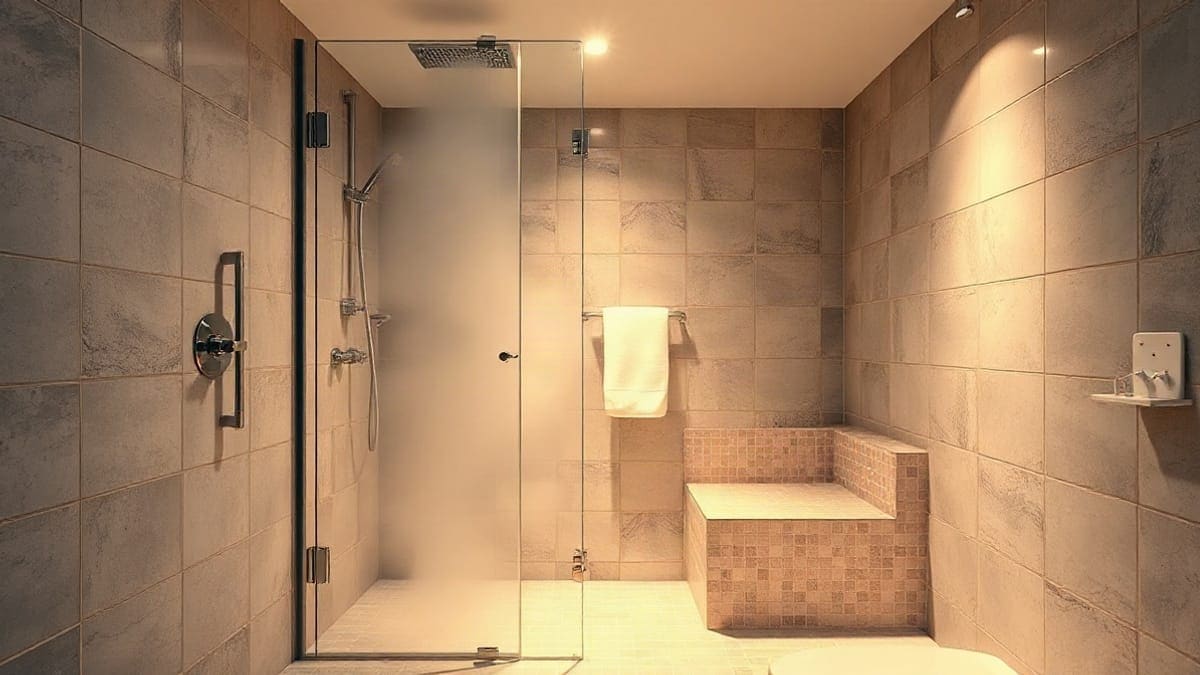
Most of the stronger research comes from dry saunas, and almost no trial tests a steam room itself. This guide sorts each claim by the study behind it, its size and the strength of the proof. It then covers the risks, who needs a doctor before the first session, and three ways to get steam at home. Every number comes from a study abstract or a maker sheet consulted on November 17, 2026. It is written for adults weighing a steam room at a gym, a hotel or at home, so read it before you spend money on a generator, a cabin or a tent. For dry heat, start with best home sauna.
What is a steam room, and what is it used for?
In two lines
A steam room is a sealed, tiled room filled with steam from a generator, usually at 100 to 120°F and close to 100 percent humidity. A dry sauna runs far hotter, at 160 to 220°F, but the air holds very little water.
Sources differ on the heat. WebMD says steam rooms run around 110 to 120°F, while Medical News Today says 100 to 110°F.
People use a steam room for three things: unwinding, easing a stuffy nose and loosening muscles after exercise. At a gym it is usually a room beside the pool or locker area. At home it is a sealed shower stall or small room with a generator and a drain. A "steam sauna" or "wet sauna" is the same idea under another name. Our home steam room guide covers what the room itself needs.
| Feature | Steam room | Dry sauna |
|---|---|---|
| Air temperature | 100 to 120°F | 160 to 220°F |
| Humidity | Near 100 percent | Low |
| Heat source | Steam generator | Electric or wood heater |
| Typical session | 5 to 10 minutes | 10 to 20 minutes |
| Walls | Tile, glass or acrylic, sealed | Wood |
The table shows why the two rooms feel different at a similar comfort level. Wet air hands heat to your skin quickly, so 115°F feels hot, while a dry sauna at 170°F lets sweat evaporate. If you are choosing between them, the full comparison is on sauna vs steam room.
What are the benefits of a steam room?
In two lines
Eight benefits get claimed, and the research backs them to very different degrees: only congestion has a pooled trial, 6 trials with 387 people, and relaxation has no study at all.
The table rates each by the best study we found, not by how often the claim is repeated.
| Claimed benefit | Best study found | Size | Strength of evidence |
|---|---|---|---|
| Relief from congestion | Singh, Cochrane, 2017 | 6 trials, 387 people | Low quality, uncertain |
| Better lung function | Cox, Arch Phys Med Rehabil, 1989 | 12 men, dry sauna | Small, short-term |
| Fewer respiratory diseases | Kunutsor, Eur J Epidemiol, 2017 | 1,935 men, 25.6 years | Observational, dry sauna |
| Lower blood pressure | Iwase, Int J Biometeorol, 2014 | 6 men, mist sauna | No change found |
| Less muscle soreness | Petrofsky, J Clin Med Res, 2013 | 100 people, moist heat | Moderate, heat packs |
| Better skin | Hannuksela, Am J Med, 2001 | Review, dry sauna | No steam trial found |
| Toxin removal | Genuis, Arch Environ Contam Toxicol, 2011 | 20 people | Measured sweat only |
| Relaxation and mood | None found | None | Unmeasured in steam rooms |
The sections below take each row in turn.
Do steam rooms help with congestion and your lungs?
They may feel better for a while, and the proof that steam treats a cold is weak. The Cochrane review by Singh and colleagues pooled 6 trials with 387 participants who inhaled heated water vapor. The fixed-effect analysis favored steam (odds ratio 0.30, 95 percent interval 0.16 to 0.56, 149 people). The random-effects analysis did not (0.22, interval 0.03 to 1.95). The authors graded the evidence as low quality and called the benefit uncertain. Viral shedding did not differ. Some people reported nose irritation.
A steam room is not the device used in those trials, which were small face-mask treatments. So a steamy room may loosen mucus, as WebMD says, and the studies cannot confirm it. For asthma triggered by humid air or mold, a steam room can make breathing worse, so ask your doctor.
On the lung question, a 1989 study by Cox and colleagues tested 12 men with obstructive lung disease in a sauna. Forced vital capacity rose from 3.22 to 3.60 after the program, and the authors saw no bronchoconstriction. It was a dry sauna and a very small group. The larger Kunutsor cohort followed 1,935 Finnish men aged 42 to 61 for a median of 25.6 years. Compared with 1 session a week or fewer, the hazard ratio for respiratory disease was 0.73 at 2 to 3 sessions a week and 0.59 at 4 or more. It is an association in one group of middle-aged men, and the saunas were dry.
Is a steam room good for your skin?
We found no steam room trial on skin, so treat the claim as unproven. The popular idea is that steam opens pores and hydrates the skin. The research behind it is thin. The Hannuksela and Ellahham review says sauna bathing does not dry the skin and may even help people with psoriasis. It also warns that sweating can increase itching in people with atopic dermatitis.
That review covers saunas, not steam rooms. If you have eczema or sensitive skin, test a short 5-minute session and rinse off in lukewarm water afterward. A skin condition is a reason to ask your doctor or dermatologist first. We do not claim a steam room clears acne or slows aging, because no source we read shows it.
Are steam rooms good for your heart and circulation?
Not shown for steam, and a heart condition is a reason to ask first. The best-known evidence is for dry Finnish saunas. A 2018 Mayo Clinic Proceedings review by Laukkanen and colleagues links regular sauna bathing with better vessel function, lower arterial stiffness and lower blood pressure, and says the picture is mostly observational. Read our sauna and blood pressure page for that side.
For steam, the only trial we found is small. Iwase and colleagues put 6 healthy young men in a mist sauna for 10 minutes at 40°C (104°F) and 100 percent humidity. Blood pressure, skin blood flow and sweat rate did not differ between conditions. Lohman and colleagues found that moist heat plus vibration raised lower-leg skin blood flow to 450 percent of baseline in 10 older adults. That was a heat pad on the leg, not a whole-body steam bath, and the group was tiny.
Do steam rooms help with muscle soreness after a workout?
Moist heat may ease soreness, and a steam room is a plausible way to get it. In a trial of 100 young adults by Petrofsky and colleagues, people did 15 minutes of squats. Heat applied right afterward, dry for 8 hours or moist for 2 hours, preserved quadriceps strength about equally. The greatest pain reduction came from immediate moist heat. The authors concluded that moist heat matched dry heat with 25 percent of the application time.
Two limits apply. The study used chemical heat packs, not a steam room, and it followed soreness for 3 days only. A steam room warms the whole body, so the effect may differ. Timing after training, and how it fits with a sauna or a cold plunge, is covered in sauna after workout and cold plunge and sauna contrast therapy.
Does a steam room help you relax?
Most people say yes, and no study we read measures it in a steam room. The warmth, the quiet and a set time away from screens are the likely reasons. We will not give a number for mood, because we have none to cite. If relaxation is your main goal, a 5 to 10 minute session at the low end of the heat range is a fair trial, and you can judge the result yourself.
Does a steam room detox your body?
Sweat carries some trace elements, and no study shows that a steam room cleanses you or improves your health. The Genuis blood, urine and sweat study tested 20 people (10 healthy, 10 with health problems) for about 120 compounds. Many toxic elements appeared to leave preferentially in sweat, and some showed in sweat but not in blood. The authors call induced sweating a "potential method" for elimination.
Read that with care. It measured what sweat contains, not whether anyone became healthier, and 20 people is a small sample. It also does not show that a steam room does more than ordinary sweating. A steam room is a fine place to sweat. Treat "detox" as a marketing word, and ask your doctor if you worry about a specific exposure.
Does a steam room help you lose weight?
It makes you lose water, not fat. A study of 674 students by Podstawski and colleagues used two 10-minute dry sauna sessions with a 5-minute break and found the greatest body mass loss in overweight and obese people. The authors warn that this group is at higher risk of dehydration and must replace fluids. The weight returns when you drink. A steam room does not substitute for diet or exercise.
Are steam rooms good for you, or bad?
In two lines
For most healthy adults, a short session is considered low risk, and the benefits are modest. The key is dose and health status: alcohol, heart conditions and low blood pressure raise the risk.
Hannuksela and Ellahham conclude that sauna bathing is well tolerated by most healthy adults and children, and that very few heart attacks and sudden deaths occur in saunas. Their review also warns that drinking alcohol in a sauna raises the risk of low blood pressure, arrhythmia and sudden death.
Public steam rooms add a germ issue. A 2025 review by Kutlu and colleagues lists athlete's foot, warts, molluscum and Pseudomonas folliculitis as infections tied to communal Turkish baths. The authors add that, with frequent disinfection, bath-related infections are uncommon. Wear sandals, sit on a towel and shower afterward. A home steam room avoids shared germs, though it needs its own cleaning, covered in how to clean a sauna.
What is a steam sauna, and is it good for you?
"Steam sauna" is another name for a wet sauna or steam room, and the health picture is the same. Some brands sell a steam sauna as a small tent with a portable steamer, and others as a wooden cabin with a steam generator. Either way, wet heat at about 100 to 130°F is the common thread. A traditional cedar sauna that pours water on hot rocks makes brief steam, as in wet sauna and traditional steam sauna. The benefits and cautions in this guide apply to all of them.
Who should not use a steam room?
In two lines
People with heart or blood pressure problems, pregnant people and anyone drinking alcohol should talk to a doctor first. The table below lists nine groups and situations, from heart disease to a cold in a public room.
The groups come from the sources we read. None of it is medical advice for your case.
| Group or situation | Why it matters | What to do |
|---|---|---|
| Heart disease, unstable angina, recent heart attack | Heat raises heart rate and strains circulation | Ask your doctor, skip until cleared |
| Severe aortic stenosis | Named as a contraindication in the 2001 review | Ask your doctor |
| Low blood pressure, stroke or TIA history | Heat widens vessels and can cause fainting | Ask your doctor |
| Heart rhythm problems | WebMD advises a doctor first | Ask your doctor |
| Pregnancy | Sources disagree: the review calls uncomplicated pregnancy safe, MNT lists it as unsuitable | Ask your doctor |
| Epilepsy, some medicines, stimulants | Medical News Today lists them as unsuitable | Ask your doctor or pharmacist |
| Alcohol in the last hours | Raises risk of low blood pressure and arrhythmia | Skip the session |
| Skin infection or a cold (public rooms) | Spreads germs to others, says WebMD | Stay out until it clears |
| Children and older adults | Lose or gain heat differently | Medical advice first |
How long and how hot should a steam room be?
In two lines
Sources advise 5 to 10 minutes at a time in a room at 100 to 120°F: WebMD says to limit a session to 5 to 10 minutes, and Medical News Today says no more than 10.
Start at 5 minutes, step out, drink water, and go back only if you feel fine. The full timing, frequency and temperature rules are on steam room time and temperature, and the dry-heat equivalents are on how long to stay in a sauna.
Steam room or sauna: which has the better benefits?
In two lines
The strongest studies are on dry saunas, which have the long-term heart and respiratory associations; a steam room is gentler and wetter, with comfort and a possible edge for a stuffy nose.
Sauna vs steam room sets out the difference, and dry sauna benefits and sauna benefits cover the heat side of the research. If you can only have one, pick the one you will use twice a week.
Which home steam setup fits these benefits?
In two lines
For a gentle 5 to 10 minute session at home, you need steam at 100 to 120°F in a sealed space and a circuit that carries the load: 21 to 25 A at 240 V for a generator, about 13 A at 120 V for a tent.
The table shows three ways to get it. Specs are from the maker pages we read on November 17, 2026, and a plumber and electrician should confirm anything built into a house.
| Setup | Steam source | Room it serves | Power | Warranty (listed) |
|---|---|---|---|---|
| Mr. Steam MS 90E | 5 kW generator | Up to 71 cu ft (about 100 adjusted for tile) | 240 V, 21 A, 10 AWG | Limited lifetime generator |
| Mr. Steam MS 150E | 6 kW generator | 72 to 107 cu ft (about 100 to 150 adjusted for tile) | 240 V, 25 A, 8 AWG | Limited lifetime generator |
| SaunaBox SmartSteam XL | 3.6 L steamer, 1,600 W | Pop-up tent, 2 people | 110 V outlet | 1 year |
The generators are for a tiled shower or small room, and the tent is for renters or a trial run. Whether to build a room, buy a cabin or use a kit is covered in steam shower generator, steam shower kit and steam shower installation and cost. Our best steam shower guide compares complete cabins.
Mr. Steam MS 90E: the small shower stall
Mr. Steam lists the MS 90E for rooms up to 71 cubic feet; our calculation is that its 40 percent tile adjustment turns that into about 100, the rating on best steam shower. It is a 5 kW unit that draws 21 A on a 240 V single-phase circuit with 10 AWG wire. Our calculation: 21 A times 1.25 for a continuous load is about 26 A, which points to a 30 A breaker. An electrician must confirm that. Stone, glass and marble walls count as extra volume under the maker's sizing method, so a larger stall may need the next model up. Mr. Steam says the generator carries a limited lifetime warranty in the US and Canada, and commercial use voids it.
Best for: a single-person shower stall of about 3 by 3 feet with a 7.5 foot ceiling, which is 67.5 cubic feet.
Not for: a room with glass or stone walls on several sides, or anyone without a free 240 V circuit.
Mr. Steam MS 150E: the roomier shower or small room
The MS 150E is the next step. Mr. Steam lists it for 72 to 107 cubic feet at 6 kW, 25 A on 240 V with 8 AWG wire. A 3 by 4 foot stall with a 7.5 foot ceiling measures 90 cubic feet, inside that range before wall adjustments. Our calculation: 25 A times 1.25 is about 31 A, so expect a 40 A breaker. That is a bigger electrical job than the MS 90E, and the 8 AWG wire is thicker and harder to run. The generator has the same limited lifetime warranty.
Best for: a two-person shower or a small room of 72 to 107 cubic feet, where the smaller unit would struggle to reach temperature.
Not for: a panel with no spare capacity, or a renter who cannot open a wall.
SaunaBox SmartSteam XL: the portable trial
SaunaBox lists a 3.6 liter steam reservoir, a 1,600 W heater and a 60-minute timer, with steam up to 130°F. It sits on a regular household outlet. Our calculation: 1,600 W divided by 120 V is about 13 A, so it should have a circuit to itself. It seats up to 2 people, sets up in minutes and carries a 1-year warranty. The maker describes the heat levels differently from some resellers, so check the control scale at purchase. The numbers are the maker's own.
Best for: renters and first-time steam users who want to try 5 to 10 minute sessions before building anything.
Not for: anyone who wants a plumbed, permanent room, or who needs a doctor's approval first.
If you are weighing a portable tent against a built room, read best portable steam sauna and steam room vs sauna combo at home. Women who are planning around pregnancy or cycle should also read sauna benefits for women.
6 common mistakes about steam rooms
In two lines
The costliest mistakes are about expectations and safety: steam does not treat a cold, alcohol raises the risk of low blood pressure and arrhythmia, and sessions run 5 to 10 minutes, not an hour.
1. Expecting steam to treat a cold
The Cochrane review pooled 6 trials with 387 people and graded the evidence low quality. A steam room is not the device used in those trials, so keep expectations to comfort.
2. Going in after alcohol
Hannuksela and Ellahham link alcohol in a sauna to low blood pressure, arrhythmia and sudden death. Skip the session instead.
3. Staying too long
WebMD says 5 to 10 minutes and Medical News Today no more than 10. Step out, drink water and go back only if you feel fine.
4. Skipping water
Heat makes you lose water, and the weight on the scale afterward is water, not fat. Drink before and after.
5. Going barefoot in a public room
Kutlu and colleagues list athlete's foot, warts and Pseudomonas folliculitis tied to communal baths. Wear sandals and sit on a towel.
6. Believing the detox claim
The Genuis study measured what 20 people's sweat contains, not whether anyone became healthier. Treat "detox" as a marketing word.
How we researched this page
In two lines
We read 14 studies and reviews, mostly through their PubMed abstracts, plus WebMD, Medical News Today and the maker pages for the three home setups, on November 17, 2026. Nothing here is hands-on.
We did not open the studies in full text, so the Cox 1989 figure for forced vital capacity is printed without a unit, which the abstract does not give. Where WebMD and Medical News Today disagree on the heat, or on pregnancy, we show both and send you to a doctor. The Mr. Steam sizing comes from its 2024 catalog as read through search, not from the page itself, and an older sheet lists 100 and 101 to 150 cu ft for the same units.
FAQ
Are steam rooms good for your health?
For most healthy adults, a short session is considered low risk, and the benefits are mostly comfort. The proof for medical results is limited. Ask your doctor first if you have heart disease, low blood pressure or you are pregnant.
What does a steam room do for you?
It warms your body with wet heat at about 100 to 120°F, which makes you sweat and relax. It may loosen a stuffy nose for a while and ease sore muscles. It does not treat illness.
Are steam rooms healthy for your lungs?
Possibly for comfort, with weak proof. Steam trials in colds were inconclusive, and the lung data come from dry sauna studies. If humid air triggers your asthma, a steam room can make symptoms worse, so ask your doctor.
Is a steam room good when you are sick?
It may feel soothing for a stuffy nose, and a Cochrane review found the evidence uncertain. Skip public steam rooms while sick, since WebMD says you may pass the virus on to others. At home, rest and fluids matter more.
Are steam rooms good after a workout?
They may help, based on a 100-person moist heat study that found less pain right after exercise. Drink water first, and keep the session to 5 to 10 minutes. Our sauna after workout page covers timing.
Are steam rooms bad for you?
They can be, for the wrong person or in the wrong amount. The main risks are dehydration, low blood pressure, heart strain and, in public rooms, skin infections. Alcohol makes it worse.
Are steam rooms good for your heart?
Not shown. The heart evidence is for dry Finnish saunas, and a mist sauna trial of 6 men found no blood pressure change. A heart condition is a reason to ask your doctor before any steam session.
Why use a steam room instead of a sauna?
Some people find wet heat at 100 to 120°F easier to tolerate than a 170°F dry room. The sauna has the better long-term research. See sauna vs steam room.
What is the point of a steam room at home?
Comfort, convenience and no shared germs. You choose the schedule, and you control hygiene. The price is plumbing, waterproofing and a dedicated circuit for a generator, covered on our steam shower installation and cost page.
How many times a week is a steam room session reasonable?
No source we read gives a proven weekly dose. Many people use one 2 to 3 times a week for 5 to 10 minutes, which is a habit and not a prescription. Our steam room time and temperature page sets out the choices.
Does a steam room clear your skin?
No study we found shows it. A sauna review says heat does not dry the skin and may help psoriasis, and it warns that sweat can increase itching in atopic dermatitis. See a dermatologist for a skin condition.
What is the difference between a steam sauna and a dry sauna?
A steam sauna is wet and about 100 to 130°F. A dry sauna is hot and dry at 160 to 220°F. Read dry vs wet sauna for the detail.
Sources
- Singh and colleagues, Heated, humidified air for the common cold, Cochrane Database of Systematic Reviews, 2017
- Cox and colleagues, Sauna to transiently improve pulmonary function in patients with obstructive lung disease, Archives of Physical Medicine and Rehabilitation, 1989
- Kunutsor, Laukkanen and Laukkanen, Sauna bathing reduces the risk of respiratory diseases, European Journal of Epidemiology, 2017
- Laukkanen, Laukkanen and Kunutsor, Cardiovascular and other health benefits of sauna bathing: a review of the evidence, Mayo Clinic Proceedings, 2018
- Iwase and colleagues, Effects of isotonic and isometric exercises with mist sauna bathing, International Journal of Biometeorology, 2014
- Lohman and colleagues, A comparison of whole body vibration and moist heat on lower extremity skin temperature and skin blood flow, Medical Science Monitor, 2012
- Petrofsky and colleagues, Moist heat or dry heat for delayed onset muscle soreness, Journal of Clinical Medicine Research, 2013
- Hannuksela and Ellahham, Benefits and risks of sauna bathing, American Journal of Medicine, 2001
- Genuis and colleagues, Blood, urine, and sweat (BUS) study, Archives of Environmental Contamination and Toxicology, 2011
- Podstawski and colleagues, Sauna-induced body mass loss in young sedentary women and men, The Scientific World Journal, 2014
- Kutlu and colleagues, Turkish bath-associated infectious dermatoses, Sisli Etfal Hospital Medical Bulletin, 2025
- Medical News Today, Steam room: benefits, risks, and differences to sauna, updated December 7, 2023
- WebMD, Health benefits of steam rooms, medically reviewed November 25, 2024
- Mr. Steam, residential steam shower generators and warranty
- SaunaBox, SmartSteam XL specifications
Keep comparing
 Home SaunaInfrared, outdoor cabin, barrel and blanket, with real watts, amps, dimensions and EMF
 Infrared SaunaTen infrared saunas compared from 1 to 4 seats, indoor and outdoor, by size in inches, amps, kWh
 Outdoor SaunaCabins, barrels, cubes and infrared, with real weights, heaters, circuits
 Portable Saunas for HomeEight real models compared on size, watts, amps, top heat and weight, with the Lifepro blanket recall
 Red Light and Near Infrared SaunaNine home saunas with red or near infrared LEDs compared on wavelength in nm, published mW/cm2, size