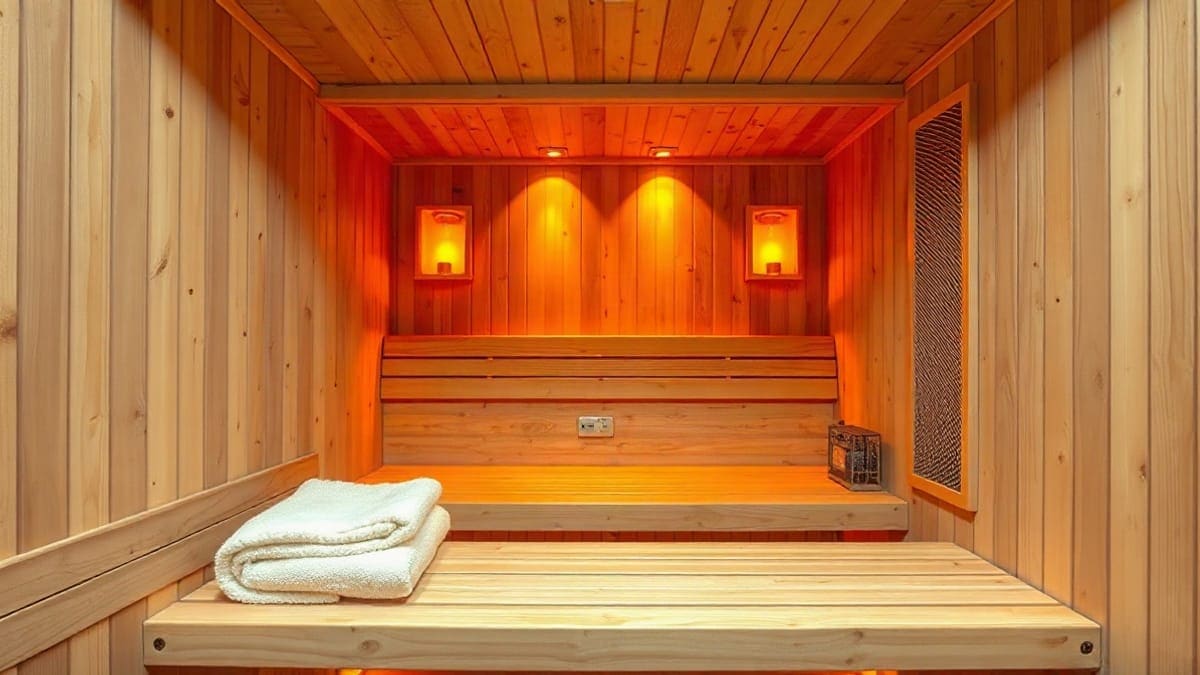
Infrared versus traditional is mostly a question of wiring and heat, not of health. Searches for infrared sauna vs regular sauna, or vs a Finnish or dry sauna, all land on this one choice. This page sets both types side by side on air temperature, warm-up, circuit, kilowatt-hours per session, floor space, weight, EMF and the studies behind each, and every figure comes from a clinic, a paper or a maker page we read in November 2026. We ran no tests, and where a number is our own arithmetic we say so. A verdict by household, with the heart and pregnancy cautions, closes the comparison.
How do an infrared sauna and a traditional sauna differ?
In two lines
A traditional sauna heats the air to 150 to 195°F, while an infrared sauna heats your body directly with panels at 110 to 135°F, according to Cleveland Clinic.
Cleveland Clinic says infrared saunas use lamps or panels to warm the body directly, while traditional saunas heat the air with a wood-burning, gas or electric heater. The air is therefore cooler in an infrared cabin: 110 to 135°F against 150 to 195°F in the same clinic's ranges.
That one difference drives the rest of the page. The what is an infrared sauna page covers the panel types, and what is a traditional dry sauna covers the stove, stones and benches.
How does each type heat you?
An infrared cabin sends radiant heat into the skin at a lower air temperature; a traditional heater warms every surface and the air you breathe. Cleveland Clinic quotes a doctor who says there is "no external heat that's generated, only heat that's generated in the body from the infrared light." In a traditional room the heater warms rocks, the rocks warm the air and the air warms you.
Beever's 2009 review in Canadian Family Physician puts typical air at about 140°F (60°C) for far infrared and about 185°F (85°C) for a traditional sauna, and notes that infrared users start to sweat at lower air temperatures.
Is a regular sauna the same as a traditional sauna?
Yes. "Regular sauna," "dry sauna," "conventional sauna" and "Finnish sauna" all mean a traditional room with an electric, wood or gas heater. A traditional sauna is dry at under 20 percent humidity, per Cleveland Clinic, until you pour water on the stones. Dry vs wet sauna covers that step, and infrared vs steam sauna covers the wet side.
Infrared vs traditional sauna: the side-by-side table
In two lines
Fourteen rows compare the two types on heat, warm-up, power, circuit, size, weight, EMF and evidence, for example 1,880 W on 120 V for the Equinox against 6 kW on 240 V for the Pinnacle.
Where the sources differ, the cell says so. Model figures come from maker pages for the cabins listed at the end of this page.
| Point | Infrared cabin | Traditional sauna |
|---|---|---|
| Air temperature (Cleveland Clinic) | 110 to 135°F | 150 to 195°F |
| Maker cap | 140 to 170°F | 194 to 230°F on cabins we read |
| How heat arrives | Radiant panels warm the body | Heater and stones warm the air |
| Humidity | Dry, no water on a heater | Under 20% until water hits the stones |
| Warm-up | 20 to 30 min (Sun Home Eclipse); about 45 min reported for the Equinox | About 60 min for a 6 kW Harvia (Almost Heaven Logan manual) |
| Session length | 20 to 30 min (Cleveland Clinic) | 15 to 20 min (Cleveland Clinic, Harvard Health) |
| Power, 2 to 4 seats | 1,700 to 2,250 W | 6,000 W for a 4-seat cabin |
| Circuit | 120 V, 15 to 20 A plug | 240 V, 30 A hardwired |
| Energy per hour at full draw | 1.70 to 2.25 kWh | 6 kWh |
| Floor space | About 4 x 3.3 to 4.3 x 4 ft for 2 seats | 6 x 6 ft barrel for 4 seats |
| Weight | 303 to 541 lb | 715 to 990 lb |
| EMF | Maker claims from under 0.5 mG seated to under 8 mG | No independent reading found; retailers conflict |
| Upkeep | No stones; wipe benches and panels | Rocks checked yearly, crumbled ones replaced |
| Evidence base | Trials of 34 to 188 patients | Cohort of 2,315 men, 20.7 years |
Warm-up, weight and size figures are maker values for specific models; your room and winter weather change them.
Does infrared or traditional come out ahead?
In two lines
Neither is better in every case; the better one is the one that fits your wiring, your room and the heat you will sit in twice a week.
Cleveland Clinic's Dr. Zack says that for dry versus wet heat there is "no clear indication that one is better than another." Its infrared page adds that infrared saunas "tend to be gentler and more comfortable" and that hotter does not necessarily mean better.
Are infrared saunas as good and as effective as traditional saunas?
For relaxation and sweating, yes in the sense that both warm you and raise your heart rate; for proven long-term outcomes, traditional has far more research. Cleveland Clinic says both types can make you sweat and produce similar effects. The big mortality study used traditional saunas. No infrared study of that size appears in the sources we read, so "as effective" is an open question, not a verdict.
Which is healthier, infrared or traditional?
In two lines
Neither has proof of being healthier for a healthy adult: traditional has a 2,315 man Finnish cohort, and infrared has small trials of 34 to 188 patients.
This is general information, not medical advice.
What's the healthiest sauna?
No type is proven the healthiest. The best-studied is traditional, at 80 to 100°C, 4 to 7 sessions a week, in Finnish men, and that evidence is observational. Infrared has small trials of 34 to 188 patients.
Do the two types give the same benefits?
They overlap on heat, sweat and heart rate, but they are not proven equivalent. Mero and colleagues (SpringerPlus, 2015) put 10 active men in a far infrared sauna and in a traditional-style sauna for 30 minutes each. Heart rate right after bathing was 71 beats per minute after infrared and 92 after the other. The study ran both rooms at 35 to 50°C (95 to 122°F), so it says little about a 180°F Finnish room. For infrared-only research see infrared sauna benefits, and for the traditional side read sauna benefits.
Which type has the stronger studies?
Traditional has the bigger and longer one; infrared has the more targeted but smaller ones. The table grades three studies by size and design. The grade is our reading, not a medical rating.
| Study | Type | People | Result | Our reading of strength |
|---|---|---|---|---|
| Laukkanen, JAMA Internal Medicine, 2015 | Traditional | 2,315 men, median 20.7 years | 4 to 7 sessions a week vs once: sudden cardiac death HR 0.37 (95% CI 0.18 to 0.75) | Observational, large, men only |
| Miyata, Journal of Cardiology, 2008 | Infrared (Waon) | 188 heart failure patients, 112 on the sauna and 76 controls | BNP fell from 542 to 394 pg/ml on the sauna, 440 to 358 in controls | Moderate, short term, patients |
| Källström, Clinical Cardiology, 2018 | Infrared (Waon) | 7 studies pooled | Lower BNP, better ejection fraction | Moderate to insufficient |
Is infrared better for pain, recovery or detox?
Not proven for any of the three. Masuda and colleagues (2005) added a daily far infrared sauna to a hospital pain program for 22 patients, with 24 more on the program alone; both groups improved. Oosterveld and colleagues (2009) found pain and stiffness eased during sessions in 34 people with arthritis or spondylitis, but not over four weeks.
For detox, Sears and colleagues (2012) found metals such as lead and mercury in sweat in small studies of mixed quality. That does not show that sweating improves health. See sauna detox and sauna for skin. We found no head-to-head trial for pain, recovery or detox.
Does infrared heat penetrate deeper than a traditional sauna?
Reviews say so, but the one trial that measured it found the heating shallow: muscle warmed 3.0°C at 1.4 cm and 1.1°C at 3.4 cm. Beever writes that infrared heat penetrates more deeply than warmed air. A 2025 University of Oregon study put probes into the thigh muscle of 10 adults for 45 minutes and called the heating "only superficial" (Reed 2025). We found no trial that measured a traditional room the same way, so "deeper" stays a claim, not a comparison. The far infrared sauna guide explains the wavelength bands.
Do infrared saunas burn more calories or take off more weight?
No source we read says so. Cleveland Clinic says there is no clear evidence that a sauna helps you burn fat or lose weight. A session mostly sheds water you drink back; see sauna weight loss.
How hot does each type get?
In two lines
A traditional sauna reaches 150 to 195°F; an infrared cabin runs 110 to 135°F by clinic ranges, and maker pages list caps of 140 to 170°F.
A clinic describes how people use the cabin, and a maker publishes the highest setting it allows. Full ranges: sauna temperature and infrared sauna temperature.
Do infrared saunas get as hot as traditional saunas?
No. Air in an infrared cabin runs 40 to 60 degrees cooler at the clinic ranges (110 to 135°F against 150 to 195°F), and most cabins cap at 140 to 170°F. An infrared cabin will not give you 190°F air and a ladle of water on the stones.
What is the downside to an infrared sauna?
The main downsides are air that tops out at 140 to 170°F with no steam, small studies and EMF claims you cannot check. A 2-person cabin also takes 78 to 94 percent of a 20 A line.
Does infrared sauna age skin?
No source we read shows that it does. Northwestern Medicine warns that long exposure can leave a mottled rash (erythema ab igne), so keep skin off the panels. See sauna for skin.
Are infrared saunas gentler or safer than traditional saunas?
Gentler, yes; proven safer, no. Cleveland Clinic says infrared saunas tend to be gentler and more comfortable. We found no trial comparing injury rates. Dehydration is the main risk for both. The checklist is in infrared sauna safety.
Which costs less, and which uses less electricity?
In two lines
Infrared uses about a third of the electricity per hour, 1.7 to 2.25 kWh against 6 kWh for a 6 kW traditional heater, and we print no cabin prices.
Energy is power times hours: 1.88 kW for one hour is 1.88 kWh, and 6 kW is 6 kWh. Thermostats cycle heaters, so the table shows a ceiling for a full warm-up plus a 30 minute session, our calculation.
| Model | Power | Current | Warm-up plus 30 min at full draw (ceiling) |
|---|---|---|---|
| JNH Joyous+ 2-Person | 1,700 W, 120 V | 14.2 A on a 15 A line | 1.70 kWh (30 min warm-up) |
| Sun Home Equinox 2-Person | 1,880 W, 120 V | 15.67 A on a 20 A line | 1.88 kWh (30 min warm-up) |
| Clearlight Sanctuary 2 | 2,250 W, 120 V | 18.75 A on a 20 A line | 2.25 kWh (30 min warm-up) |
| Almost Heaven Pinnacle 4-Person | 6,000 W, 240 V | 25 A on a 30 A cable | 9.00 kWh (60 min warm-up) |
Warm-up lengths are our assumptions from maker statements: about 20 to 45 minutes for infrared, about 60 minutes for a 6 kW heater. Multiply kWh by the rate on your own bill, or by the average residential rate in EIA table 5.6.A, to get cost.
Do infrared saunas use less electricity than traditional saunas?
Usually yes, by about 4 to 5 times per session at the ceiling: 1.7 to 2.25 kWh against 9 kWh. The gap shrinks in real use, because a traditional heater cycles off once the room is hot.
Are infrared saunas cheaper than traditional saunas?
Not always at purchase, and usually yes to run. Compare the same seat count, and add the wall: a 240 V, 30 A circuit for a traditional heater is an electrician's job. For totals see sauna cost and infrared sauna cost; for wiring, sauna electrical requirements.
Why are traditional saunas more expensive than infrared?
Often they are not; the extras add up. The heater, stones, heavier wood shell, 240 V wiring and, outdoors, the pad and roof all count.
How much space, weight and upkeep does each need?
In two lines
A 2-person infrared cabin fits about 4 x 4 feet; a 4-person traditional barrel wants 6 x 6 feet and weighs more than twice as much.
The Equinox measures 50.9 x 45.9 x 77.7 in outside and weighs 541 lb (Sun Home). The Joyous+ is 47.3 x 39.5 x 75 in and 303 lb (JNH). The Pinnacle ships at 715 lb on a 6 x 6 ft footprint (Almost Heaven), and Redwood lists its 4-person cabin at 800 to 990 lb depending on the page.
Put a 541 lb cabin on a hard, level floor. Best indoor sauna and best outdoor sauna compare placement.
Upkeep favors infrared. There are no stones to replace and no steam to dry out. A traditional heater needs its rocks checked once a year, as Finnleo's heater guide says, with crumbled ones replaced. How to clean a sauna gives the routine. No maker prints a heater lifespan, so compare warranties: 1 year on the Joyous+, 7 years on the Equinox page, a limited lifetime on the Clearlight.
Is EMF a difference between the two types?
In two lines
It can differ, but no independent test compares them: Sun Home claims 0.5 mG seated for the Equinox and JNH lists under 8 mG for the Joyous+.
Sun Home cites a January 2025 Vitatech test at 0.5 mG seated for the Equinox, a report we could not find, and claims 0.3 to 0.9 mG at 3 ft for some models. JNH lists under 8 mG for the Joyous+ (JNH EMF levels). Retailer pages disagree on traditional heaters, with figures from 0 to 2 mG to 5 to 30 mG. Distance and measuring point differ, so the numbers do not line up.
If EMF matters, ask for the test report, distance and measuring point. Read infrared sauna EMF explained and low EMF infrared sauna before buying.
What about hybrid and combo saunas?
In two lines
A hybrid puts infrared panels and a traditional heater in one room, so one household can use both; the trade is a 240 V circuit and a bigger cabin.
The options are on best hybrid sauna.
Should you buy an infrared or a traditional sauna?
In two lines
Match the type to your outlet and room first: a 120 V, 20 A outlet suits an infrared cabin like the Equinox, and a 240 V, 30 A line suits a traditional cabin like the Pinnacle.
| Your situation | Choose | Why, in numbers |
|---|---|---|
| Renter or apartment with a spare outlet | Infrared (or a portable infrared sauna) | 120 V, 15 to 20 A plug, no wiring work |
| Couple, spare bedroom, 20 A outlet on its own breaker | Infrared 2-person | Equinox uses 78% of a 20 A line; Clearlight uses 94% |
| Only a 15 A outlet | Joyous+ class cabin | 14.2 A is 94% of 15 A, so nothing else on that circuit |
| Backyard, family of four, electrician available | Traditional barrel or cabin | 6 kW at 240 V is 25 A on a 30 A line, or 83% |
| You want 170 to 195°F air and water on stones | Traditional | Infrared caps at 140 to 170°F |
| You want the heat the large cohort studied | Traditional | Finnish studies used 80 to 100°C (176 to 212°F) |
| Cold climate, outdoor use | Traditional, 8 kW option | Redwood lists 8 kW as the upgrade; Sun Home Luminar infrared also runs outdoors on 240 V |
Two worked examples. A couple with a 20 A bedroom outlet: the Equinox needs 15.67 A, so it fits. A family with a 240 V, 30 A garage feed: the Pinnacle's 6 kW heater is 25 A, so it fits, but ask the electrician which load rule of the National Electrical Code applies to a sauna.
For more by seat count, see best 2 person sauna; for the infrared field alone, best infrared sauna; for the traditional field, best traditional sauna. The overall guide is best home sauna.
Who should ask a doctor first?
In two lines
Anyone with heart disease, low or medicated blood pressure, multiple sclerosis, pregnancy or a plan to conceive should ask a doctor before using either type, and sessions stay at 15 to 20 minutes.
Cleveland Clinic lists these for infrared and says anyone with a medical condition should consult a provider.
Sessions run 15 to 20 minutes for traditional (Harvard Health) and 20 to 30 for infrared; drink water before and after. See how long to stay in a sauna and sauna and blood pressure.
Which infrared and traditional models should you compare?
In two lines
Three 2-person infrared cabins (Sun Home Equinox, JNH Joyous+, Clearlight Sanctuary 2) and three traditional options (Almost Heaven Pinnacle, Redwood Cabin, Harvia KIP60B) give a fair starting field.
Figures come from maker pages and our own arithmetic, and the buttons show the day's price.
Sun Home Equinox 2-Person: the infrared cabin with a documented EMF claim
The Equinox runs 1,880 W with four far infrared and two full spectrum heaters, and weighs 541 lb. Sun Home lists a 7 year warranty on the product page and a maximum of 165°F on most pages, 155°F on one. Best for: two adults on a dedicated 20 A circuit who want a published EMF claim. Not for: steam or air above 165°F. See the Sun Home Equinox review.
JNH Joyous+ 2-Person: the small cabin for a 15 A line
The Joyous+ is 303 lb, 47.3 x 39.5 x 75 in, and runs up to 170°F on a dedicated 120 V, 15 A outlet. JNH lists 1,700 W, a 1 year warranty and under 8 mG EMF. Best for: a first infrared cabin where floor space and an outlet limit you. Not for: a buyer who needs a low published EMF reading or a long warranty. More in JNH Lifestyles saunas.
Clearlight Sanctuary 2: the longest warranty of the three
The Sanctuary 2 lists 2,250 W at 120 V and 18.75 A on a NEMA 5-20P plug, 450 lb, and a limited lifetime warranty. Its 94 percent load on a 20 A line is the highest here, and its low EMF claim is unchecked. Best for: buyers who rank warranty first. Not for: a shared circuit. See Clearlight saunas.
Almost Heaven Pinnacle 4-Person: the cedar barrel on a 6 kW heater
Retailers list the Pinnacle with a 6 kW Harvia KIP60B heater on a 240 V, 30 A hardwired cable, a 715 lb shipping weight and a light on a separate 110 V, 15 A plug. Best for: a four-person backyard barrel with real dry heat. Not for: a yard with no hardwire run. See Almost Heaven saunas.
Redwood Outdoors 4-Person Cabin: the room for a household
The base kit has a 6 kW Harvia KIP heater, 240 V, with 8 kW Wi-Fi upgrades. Redwood's pages disagree on weight, 800 to 990 lb: confirm it before pouring a pad. Best for: a hot, humid backyard sauna for up to four. Not for: a pad with a hard weight limit. See Redwood Outdoors saunas.
Harvia KIP60B: the heater if you build your own room
Harvia lists the KIP60B at 6 kW, 240 V, UL listed, for a 170 to 300 cu ft room, with a dial, an 8 hour delay timer and a 60 minute auto shut-off. Best for: a custom room with solid insulation. Not for: a room with a large glass wall. See best sauna heater and Harvia saunas and heaters.
5 common mistakes when choosing between infrared and traditional
In two lines
Most mistakes come from comparing the wrong number: the air temperature instead of the dose, or the cabin instead of the circuit behind it. Each is cheap to avoid before you order.
1. Expecting infrared to feel like a Finnish room
Infrared air runs 110 to 135°F and most dials stop at 140 to 170°F, 40 to 60 degrees under a 150 to 195°F stove sauna. For 190°F and a ladle of water, buy a traditional room.
2. Sizing the circuit last
An infrared cabin at 15.67 A on a 20 A line uses 78 percent of it, and a 2,250 W cabin uses 94 percent. A 6 kW heater is 25 A on a 30 A, 240 V line. Ask an electrician first.
3. Assuming the big study covers infrared
The 2,315 man Finnish cohort used traditional saunas at 80 to 100°C. No infrared study that size exists in our sources.
4. Reading one kWh figure as your bill
Our 9 kWh ceiling for a 6 kW heater assumes it never cycles. Real use is lower.
5. Skipping the doctor on heart, pressure or pregnancy
Heat stresses the heart and lowers blood pressure. Check first and keep to the session times above.
FAQ
Is it better to pick infrared over a traditional sauna?
Neither is proven better for health, so pick by fit. Infrared suits a 120 V outlet and gentle heat of 110 to 135°F. Traditional suits a 240 V line and 150 to 195°F air with steam from the stones.
Are the saunas in Finland infrared or traditional?
Traditional. Laukkanen and colleagues in JAMA Internal Medicine (2015) and the 2018 Mayo Clinic Proceedings review, describes traditional bathing at 80 to 100°C (176 to 212°F). We found no Finnish cohort of infrared use.
Which is better for heart health?
Traditional has the large cohort; infrared has short trials in heart failure patients. Neither shows that a home cabin protects a healthy heart.
Can you add steam to an infrared sauna?
No, not by design. An infrared cabin has no stove or stones, and water on a panel is a hazard. For steam, read infrared vs steam sauna.
Does an infrared sauna need to be as hot as a traditional one?
No. It is built to work at lower air heat. Cleveland Clinic gives 110 to 135°F; beginners can start at 110°F for 5 to 10 minutes.
Is the full spectrum infrared sauna different from far infrared?
Full spectrum cabins add near and mid infrared bands to far infrared, and often red light. Read best full spectrum infrared sauna and red light therapy sauna.
How long does each take to warm up?
About 20 to 45 minutes for infrared and about an hour for a 6 kW traditional heater, by maker statements. See how long a sauna takes to heat up.
Which type is better for a small apartment?
Infrared, because it needs a 120 V plug and about 4 x 4 feet of floor. A 4-seat traditional barrel needs 6 x 6 feet and a 240 V line. For smaller still, see best portable sauna.
Which one is easier to keep clean?
Infrared, since there are no stones or water. A traditional heater needs its rocks checked yearly.
Can you use either type outdoors?
Yes, with models built for it. Traditional cabins and barrels such as the Redwood Outdoors cabin are made for the yard, and so is the Sun Home Luminar Outdoor 2-Person infrared (240 V, 20 A, 170°F maximum). See best outdoor sauna.
How we researched this page
In two lines
We read two Cleveland Clinic articles, eleven papers or abstracts and six maker pages on November 17, 2026, and we ran no tests. Warm-up, EMF and weight figures are maker statements we could not confirm.
The PubMed abstracts for Laukkanen 2015 and 2018, Miyata 2008, Masuda 2005, Mero 2015, Sears 2012, Hannuksela 2001 and the Oregon trial were read, with Beever's review in full. Preheat times come from sister pages. We found no independent EMF reading for a traditional heater, and the Sun Home Vitatech report is not public. The kWh and circuit percentages are our arithmetic.
Sources
- Cleveland Clinic, infrared sauna benefits and sauna benefits
- Harvard Health, saunas and your health
- Laukkanen: JAMA Internal Medicine 2015, Mayo Clinic Proceedings 2018
- Beever 2009, Miyata 2008, Källström 2018, Mero 2015, Reed 2025
- Masuda 2005, Oosterveld 2009, Sears 2012, Hannuksela 2001
- Makers: Sun Home Equinox, JNH Joyous+, Almost Heaven Pinnacle, Redwood Cabin, Harvia KIP60B; Clearlight Sanctuary 2 from the maker's FAQ
- NFPA 70, EIA table 5.6.A
Keep comparing
 How to Build a SaunaRoom size in cu ft, 2x4 framing, R-13 and R-19 insulation, foil barrier, cedar lining, benches, vents
 How to Use a SaunaWhat to drink and wear, bench and water rules, shared sauna etiquette
 Sauna Heater Not Working or Not Heating UpSauna heater not working? Symptom table, reset steps from Harvia, Finnleo, HUUM and Saunum manuals
 Sauna Heater Size Calculator (kW by Room Volume)Enter your cabin size, glass and stone area to get heater kW, amps and breaker, with the math
 Sauna, Sauna Blanket and Cold Plunge RecallsEvery sauna, sauna blanket and portable steam sauna recall in the CPSC database on November 17, 2026