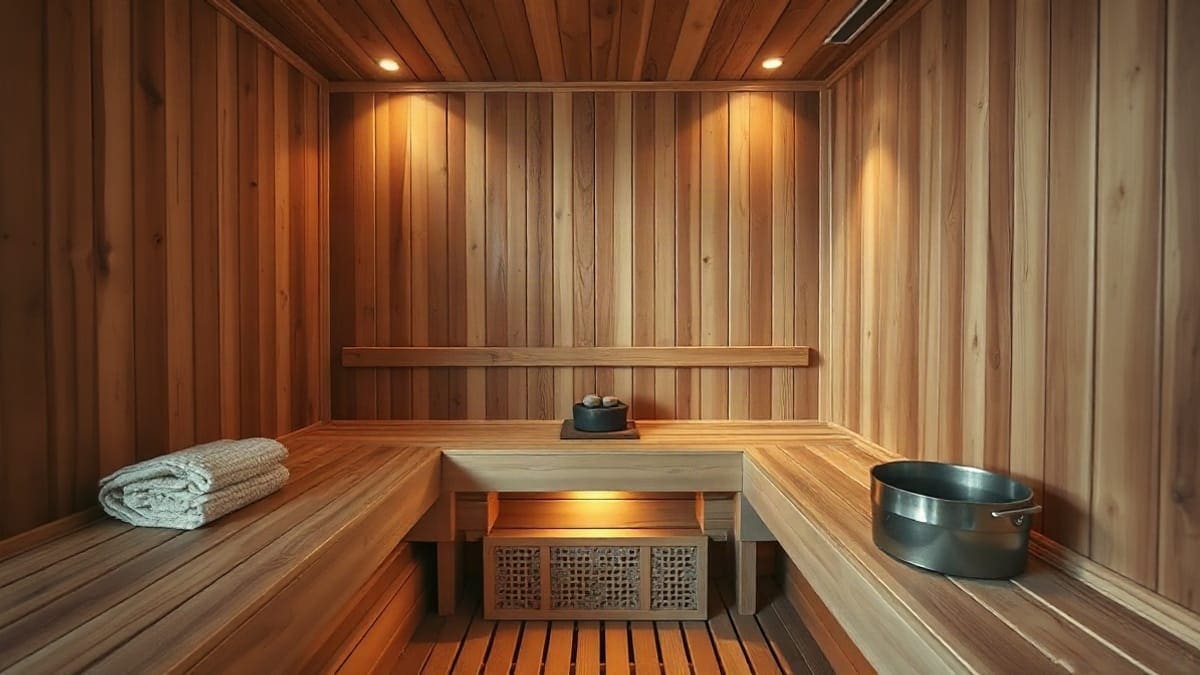
Stay 15 to 20 minutes if you are healthy, used to heat and in a traditional room at 150 to 185°F. Cut to 5 to 10 minutes in your first weeks, in a steam room or whenever the day has been hard.
Stay longer, 20 to 40 minutes, only in an infrared cabin, where the air is cooler at 110 to 135°F and the maker's timer sets the limit. Our infrared sauna session guide covers it.
Do not time yourself against a friend if you have a heart condition, low blood pressure, are pregnant, take medicine or have been drinking. Ask your doctor first. A warm bath or a shorter session may suit you better.
How many minutes is right depends on the heat, on how used to it you are and on your health. This guide gives minutes by sauna type, a first-month plan for beginners, what the one large Finnish study on session length found, how many rounds to take and how long to rest, and the signs that mean leave now. It also covers the people who need medical advice before choosing a time, and five timed saunas and blankets that help you hold your limit. Every figure comes from a source we read in November 2026, and the rest we mark as our own practice tips.
How long should a sauna session be?
In two lines
Aim for 15 to 20 minutes in a traditional sauna once you are used to it. Harvard Health and Cleveland Clinic stop at 20, Healthline allows 20 to 30, and a 150°F room is gentler than a 185°F one.
Harvard Health tells readers to limit each stay to roughly 15 to 20 minutes and to cool off gradually afterward. Cleveland Clinic says the safe time depends on the heat and type of the room you are in.
Healthline says not to stay more than 20 to 30 minutes at a time. When in doubt, take the lower number. A session that ends while you still feel good is a better habit than one that ends in a dizzy walk to the door.
Two things set your personal number: the temperature, with 185°F about the top that Harvard Health mentions for a dry sauna, and how used to heat you are. Read sauna temperature before you set the clock, and how to use a sauna for the full routine.
Most home saunas have a timer or an automatic shutoff. Use it: it protects you on days when the heat makes you lose track of time. The section on timed models lists five.
How long should a beginner stay in a sauna?
In two lines
Start with 5 to 10 minutes, and add a few minutes each visit over several weeks. Cleveland Clinic says about 5 minutes for beginners, Healthline says 5 to 10, and the plan below reaches 15 to 20 minutes by week 4.
Both Cleveland Clinic and Healthline ask you to listen to your body over the clock.
A simple first-month plan is a reasonable way to apply that. It is our practice tip, not a study result.
| Week | Visits | Minutes per visit | Water before and after |
|---|---|---|---|
| 1 | 2 | 5 to 8 | 1 glass before, 2 glasses after |
| 2 | 2 to 3 | 8 to 10 | Same |
| 3 | 2 to 3 | 10 to 15 | Same |
| 4 | 2 to 3 | 15 to 20 | Same |
The glass counts follow Harvard Health, which says to drink two to four glasses of cool water after each session. Skip a step up if you felt lightheaded the visit before. Sit on the lower bench first, since heat rises. How often to use a sauna has the weekly pattern.
Is there a minimum sauna time for health benefits?
In two lines
The one large study that looked at session length found a link with 19 minutes and up, and it does not prove that longer sessions cause anything.
Laukkanen and colleagues followed 2,315 men aged 42 to 60 from eastern Finland for a median of 20.7 years. The 2015 JAMA Internal Medicine paper sorted men by how long a typical session lasted.
| Session length | Adjusted hazard ratio, sudden cardiac death | 95 percent interval |
|---|---|---|
| Under 11 min | 1.00 (reference) | Not applicable |
| 11 to 19 min | 0.93 | 0.67 to 1.28 |
| Over 19 min | 0.48 | 0.31 to 0.75 |
A hazard ratio of 0.48 means about half the rate of the reference group over the study. The 11 to 19 minute group showed no clear difference, since its interval crosses 1. The authors report similar patterns for fatal coronary heart disease and fatal cardiovascular disease, but not for all-cause mortality.
Read the limits before you copy the number. All the men were Finnish, middle-aged and used to saunas. Session length was self-reported at baseline, and the saunas were traditional rooms, 176 to 212°F in the Finnish research per our sauna benefits guide. Frequency mattered as well: 4 to 7 sessions a week went with lower risk than 1. Sessions over 19 minutes sit near the 20 minute ceiling, so the study does not argue for going past it.
No source we read gives a separate number of minutes for goals such as muscle growth, growth hormone or cortisol. For the studies behind each claim, see sauna health studies and sauna and blood pressure. The Mayo Clinic Proceedings review by Laukkanen and colleagues calls the evidence promising and mostly observational.
Is 15 minutes of sauna a day enough?
In two lines
Yes for comfort, and it sits inside every range above, but no study proves 15 minutes a day is the right dose. It is the low end of Harvard Health's 15 to 20 minute advice.
Healthline says doctors suggest about 15 to 20 minutes, 3 to 7 times a week, for the most benefit.
Healthy people in Finland sauna daily, and the studies counted 4 to 7 sessions a week as the top group. If you are new, start with two or three visits and build. The weekly plan is in how often to use a sauna, and the clock time is in best time of day to sauna. Here the point is only the length: 15 minutes is a fair target, and 10 is fine on a tired day.
How long is too long in a sauna?
In two lines
Past 20 minutes you are above the advice of Harvard Health and Cleveland Clinic, and past 30 you are above even the most generous source. The risk of too long is mostly dehydration and overheating, not a fixed minute count.
Cleveland Clinic names dehydration as the main risk, and Mayo Clinic lists extreme thirst, dizziness and confusion among its signs. Heat also widens blood vessels and can lower blood pressure, which is why dizziness on standing is a warning. The 2001 review by Hannuksela and Ellahham found that sauna bathing is well tolerated by most healthy adults and children, and that very few heart attacks and sudden deaths occur in saunas. It adds that alcohol raises the risk of low blood pressure, rhythm trouble and sudden death.
Online claims that a sauna can "kill you" after a set number of minutes have no source we could find. The real risk is staying when your body tells you to leave, mixing alcohol with heat, or having a heart or blood pressure condition. Put a number on your ceiling before you go in: 20 minutes if healthy, less if not, and always less than what your timer allows.
A session of an hour is outside every guideline we found, and falling asleep in a hot room is a hazard, so a timer with automatic shutoff is cheap protection.
How many rounds should you do, and how long should you rest between them?
In two lines
One session is enough, and two or three short rounds with a cool-down between them is the common pattern. Our plans run from 15 to 20 minutes in one session to 34 to 56 minutes in three rounds.
The sources do not fix the number of rounds. Harvard Health says to cool down gradually after a session, and Healthline says to give your body a break and take a quick shower between a sauna and another heat session.
A sensible pattern, based on those sources and our reading, looks like this.
| Round plan | Minutes in the heat | Rest between | Total time |
|---|---|---|---|
| One session | 15 to 20 | Not applicable | 15 to 20 min |
| Two rounds | 10 to 15 each | 5 to 10 min, seated, with water | 25 to 40 min |
| Three rounds | 8 to 12 each | 5 to 10 min each | 34 to 56 min |
The rest times are our practice tip. Cool air, a seat and a glass of water are all you need. A study of 674 students by Podstawski and colleagues used two 10-minute dry sauna sessions with a 5-minute break. The authors found the greatest body mass loss in overweight and obese people and warned that this group is at higher risk of dehydration and must replace fluids. The weight lost is water. If you want that side, read sauna weight loss.
With a cold plunge between rounds the timing changes: see cold plunge and sauna contrast therapy for the order and rounds, and how long to cold plunge for the cold side.
Does the type of sauna change how long you can stay?
In two lines
Yes: the hotter the air, the fewer the minutes, and the cooler the cabin, the longer the session. Traditional rooms run 15 to 20 minutes, infrared cabins 20 to 40 and steam rooms 5 to 10.
| Type | Air temperature | Common session | Where to read more |
|---|---|---|---|
| Traditional (dry) | 150 to 195°F | 15 to 20 min | This page |
| Infrared cabin | 110 to 135°F | 20 to 40 min | How long in an infrared sauna |
| Steam room | 100 to 120°F | 5 to 10 min | Steam room time and temperature |
| Sauna blanket | 95 to 176°F | 30 to 45 min | Best portable sauna |
| Wet or steam sauna | 100 to 130°F | 5 to 15 min | Wet sauna and traditional steam sauna |
Cleveland Clinic gives 150 to 195°F with humidity under 20 percent for a traditional room, and 110 to 135°F for an infrared one. Sun Home's help center lists a 10 to 40 minute session on its Equinox cabin, with a top setting of 165°F, so a maker's printed limit matters more than a generic rule. Steam rooms run 100 to 120°F per WebMD and Medical News Today. A cooler cabin feels milder, but dehydration and low blood pressure still apply. If you are weighing the two types, infrared vs traditional sauna lays out the difference, and what is a traditional dry sauna explains the heater and stones.
What are the signs you should leave the sauna?
In two lines
Leave when you feel dizzy, weak, short of breath or unwell, even if the timer has minutes left. Then sit, sip cool water and let your heart rate settle for 5 to 10 minutes.
Cleveland Clinic says to exit and seek medical help if you feel unwell, dizzy or weak, have trouble breathing or discomfort. Harvard Health says to leave right away if you feel unwell during a session.
Common signs to watch:
- Dizziness or a pounding head, especially on standing.
- Nausea or a sick feeling.
- Chest tightness or an uneven heartbeat.
- Muscle cramps, which Mayo Clinic lists among the signs of heat exhaustion.
- A dry mouth with no sweat, or confusion.
- A skin rash or itching that gets worse in the heat. Hannuksela and Ellahham note that sweating may increase itching in people with atopic dermatitis.
After you leave, Harvard Health advises two to four glasses of cool water after each session. Do not go straight into a hot shower or a hard workout, and call a doctor if symptoms continue.
Who should stay shorter or skip the sauna?
In two lines
People with heart disease, blood pressure problems, pregnancy, epilepsy or regular medicines should ask a doctor before they pick a session length. The table lists 12 groups and what to do for each.
None of this is medical advice for your case, and rules differ by condition.
| Group or situation | Why it matters | What to do |
|---|---|---|
| Recent heart attack or stroke | Cleveland Clinic says to avoid saunas | Skip, ask your doctor |
| Unstable angina, severe aortic stenosis | Named as contraindications in the 2001 review | Ask your doctor |
| Heart disease, heart failure | Heat strains circulation | Ask your doctor first |
| High or low blood pressure | Heat widens vessels; Harvard flags uncontrolled high pressure | Ask your doctor first |
| Alcohol before or after | Raises risk of low blood pressure, rhythm trouble | Skip the session |
| Pregnancy or trying to conceive | Sources disagree on risk | Ask your doctor |
| Over 65 or under 16 | Cleveland Clinic advises a provider check | Ask your doctor |
| Epilepsy or another neurologic condition | Cleveland Clinic lists it | Ask your doctor |
| Regular medicines | Some impair sweating or cause overheating | Ask your doctor or pharmacist |
| Cold, fever or illness | Harvard says not to use a sauna when sick | Wait until you are well |
| Asthma or breathing conditions | Healthline says to check first | Ask your doctor |
| Skin conditions such as eczema | Sweat may increase itching | Start with 5 minutes |
On pregnancy, the 2001 review calls sauna bathing safe in uncomplicated pregnancies of healthy women, while Cleveland Clinic and Healthline say to check with a doctor first. We give no minutes for pregnancy. See sauna and pregnancy safety and sauna risks and safety for the longer discussion.
Children have no reliable minute count. Hannuksela and Ellahham say most healthy children tolerate a sauna, and Cleveland Clinic says to check with a provider under 16, so a pediatrician should set time and temperature.
Which sauna timer or sauna fits a timed routine?
In two lines
For a 15 to 20 minute routine, pick a model whose timer or shutoff you trust and that matches the room you have. Five options follow, from a 6 kW stove heater to a 400 W blanket.
Specs come from maker pages and guides we read on November 17, 2026, and some came through searches, as the notes mark. Check the live page before you buy.
| Model | Type | Timer or shutoff | Power | Fit |
|---|---|---|---|---|
| Sun Home Equinox 2-person | Infrared cabin | 24-hour programmable timer; session 10 to 40 min | 120 V, 1,880 W, 20 A circuit | Two people, spare room |
| Harvia KIP60B | 6 kW stove heater | Delay start up to 8 hours; auto shutoff after 60 min | 240 V, 6,000 W | Build or upgrade a room |
| SunRay Galley | Barrel, 6 kW Harvia heater | Sand timer in the box | 220 to 240 V, 30 A circuit | Outdoor, 721 lb |
| Lifepro RejuvaWrap | Infrared blanket | 5 to 60 min timer | 110 V, 600 W | Renters, no floor space |
| Lifepro CozyWrap | Infrared blanket | 30 to 90 min timer | 400 W | Low power, longer lying sessions |
A 15 to 20 minute routine wants a timer that stops there. For a broader view, see best home sauna, best infrared sauna and best sauna heater. A sand timer or a wall clock also helps: sauna accessories lists them, and sauna timer and hourglass goes deeper.
Sun Home Equinox 2-person: a timer you can schedule
Sun Home's help center lists a programmable 24-hour timer, which sets when the cabin starts heating, a session of 10 to 40 minutes and a top temperature of 165°F. The 2-person cabin runs at 120 V, 1,880 W and 15.67 A on a dedicated 20 A circuit (Sun Home electrical guide) and weighs 541 lb. The 3-person Equinox is the 2,020 W model.
Best for: two adults who want a plug-in cabin and a preset session. Not for: anyone who wants red light, which this model lacks, or a place where a 20 A outlet is missing. See the Sun Home Equinox review and Sun Home saunas.
Harvia KIP60B: shutoff and a delayed start
Harvia's KIP60B page lists dial controls and a delay timer of up to 8 hours so the room is hot when you arrive. Guides for KIP heaters say it shuts off by itself after one hour, while a Harvia support article describes a 0 to 4 hour on-time, so confirm it in the manual. At 6,000 W and 240 V the load is 25 A by our arithmetic, and the National Electrical Code governs the circuit, so hire an electrician.
Best for: someone building a cabin or replacing a heater, who wants a pre-heat. Not for: someone who wants a plug-in cabin, since the heater needs a 240 V circuit. See best sauna heater and best sauna kits.
SunRay Galley: a barrel with a sand timer
The Galley is a Western red cedar barrel measuring 72 x 72 x 76 in outside, shipping at 721 lb. Its 6 kW Harvia heater needs a dedicated 30 A circuit at 220 to 240 V, and the box holds a sand timer, which is a plain way to keep to 15 minutes.
Best for: a backyard sauna where you want the timer in the box. Not for: a small patio or anyone without a 240 V line. See best sauna kits for its page.
Lifepro RejuvaWrap: a short timer for a blanket
The RejuvaWrap is a 71 x 71 in far-infrared blanket at 600 W and 110 V, weighing 14.7 lb, with nine heat levels from 95 to 176°F and, per Lifepro's help article, a timer of 5 to 60 minutes. Sun Home's blanket guide suggests 30 to 45 minutes, so start well under that.
Best for: a first try on a small budget with no floor space. Not for: people who want to sit up in a room, or who cannot lie still. See Lifepro saunas and best portable sauna.
Lifepro CozyWrap: longer sessions at low power
The CozyWrap is 31.5 x 71 in, weighs 6.6 lb and draws 400 W, about 3.3 A at 120 V. Its timer runs 30 to 90 minutes and its range is 90 to 180°F. The 30 minute minimum is longer than most beginners should stay, so use it once you tolerate heat.
Best for: a gentle long session at lower power. Not for: a beginner who wants a 10 minute timer.
Which other sauna timing questions have their own guide?
In two lines
Timing around a workout, a massage, a shower or a warm-up each has its own page, and the minutes above still apply inside the room.
Sauna after workout answers when to go and how long to stay after training, and sauna before or after a swim or massage covers those two. Heat-up time is separate from session time, and how long a sauna takes to heat up gives it by type. Rinsing off is in should you shower after a sauna, and the sweat and toxin question in sauna detox.
6 common mistakes with sauna time
In two lines
Most mistakes come from copying a minute count without checking the heat, the type or your own day. Each costs nothing to fix and needs no new gear.
1. Starting at 20 minutes
Cleveland Clinic says about 5 minutes for beginners and Healthline says 5 to 10. A first month that rises from 5 to 8 minutes in week 1 to 15 to 20 minutes in week 4 is a safer climb.
2. Copying the 19-minute study
Sessions over 19 minutes went with a hazard ratio of 0.48 for sudden cardiac death in 2,315 Finnish men, and 11 to 19 minutes showed 0.93 (0.67 to 1.28), no clear difference. It is observational, so it is not a target.
3. Using one number for every heat
Traditional rooms run 15 to 20 minutes, infrared cabins 20 to 40 on maker timers, steam rooms 5 to 10 and blankets 30 to 45 per Sun Home. A beginner should sit well under each.
4. Staying when the body says leave
Dizziness, nausea, chest tightness or cramps mean leave now, even with minutes left on the timer. Alcohol raises the risk of low pressure and rhythm trouble, so skip the session after drinking.
5. Skipping the water
Harvard Health advises 2 to 4 glasses of cool water after each session. In 674 students, two 10-minute sessions cost body mass that was water, so drink to replace it.
6. Ignoring the timer, or sleeping in the heat
Set the timer below your limit, not at it. Falling asleep in a hot room removes your warning signs, and an hour is outside every guideline we found.
FAQ
Is 20 minutes in a sauna too long?
No for most healthy adults. Twenty minutes is the top of the 15 to 20 minute advice from Harvard Health and Cleveland Clinic. If you feel dizzy, leave earlier, and if you have a heart or blood pressure condition, ask your doctor first.
Can you stay in a sauna for 30 minutes or an hour?
Thirty minutes is above two of the four sources we read, and Healthline treats 20 to 30 minutes as the limit. An hour is outside every guideline. In an infrared cabin at 110 to 150°F, a 30 minute session is common on maker timers. In a traditional room, split it into rounds with rests.
Is it better to do one long session or several short ones?
The studies do not compare them. Several short rounds of 10 to 15 minutes with a cool-down let you leave sooner and drink between rounds. One 15 to 20 minute session is simpler, and it is the pattern Harvard Health describes.
Should you set a timer in the sauna?
Yes. A timer or a sand glass stops you from losing track of time in the heat. Many home saunas and heaters have one built in, such as the Harvia KIP60B's automatic shutoff and the SunRay Galley's sand timer. Set it below your limit, not at it.
Can you fall asleep in a sauna?
You should not. Sleep removes your warning signs and the heat can keep rising. Blanket makers advise using the timer and never sleeping in one, and the same logic applies to cabins. Use a timer with shutoff and tell someone where you are.
How long can kids stay in a sauna?
We found no reliable minute count. The 2001 review says sauna bathing is well tolerated by most healthy children, and Cleveland Clinic says anyone under 16 should check with a provider. Children overheat faster, so ask a pediatrician about time and temperature.
How long should you wait to eat before or after a sauna?
No source we read sets a waiting time. Drink water first, avoid a heavy meal right before, and eat when you feel normal afterward. Harvard Health advises drinking two to four glasses of cool water after each session.
Is a sauna safe when you are sick?
Harvard Health says not to use a sauna when you are sick. Wait until a cold or fever clears, and drink water. If you have a chronic condition, ask your doctor about heat before you go back.
What timer setting suits a sauna blanket?
Sun Home's blanket page suggests 30 to 45 minutes. Lifepro timers run 5 to 60 minutes on the RejuvaWrap and 30 to 90 on the CozyWrap. Start well below those, at 15 to 20 minutes, keep a layer between you and the lining, and never sleep in one. See best portable sauna.
Do men and women need different sauna times?
We found no sex-specific minute count in the sources we read. The Laukkanen cohort included men only, so its numbers say nothing separate about women. The general 15 to 20 minute advice applies to both, with the same medical cautions. Pregnancy is a separate question for your doctor.
How we researched this page
In two lines
We read Harvard Health, Cleveland Clinic, Healthline, two Finnish research papers, a 2001 review and five maker pages on November 17, 2026. We did not test any sauna, and we list below what we could not confirm.
The Laukkanen interval values come from the Europe PMC abstract, not the full text. The Harvia KIP60B 60-minute shutoff is read in guides for KIP heaters, not in the KIP60B manual, and one Harvia article gives 0 to 4 hours, so we show the conflict. The Sun Home Equinox figures come from its help center, because the product page returned a rate limit error. The first-month plan, the rest times between rounds and the 25 A figure are our own practice tips and arithmetic. We found no source for a minute count for children, pregnancy or older adults, so we give none.
Sources
- Laukkanen T, Khan H, Zaccardi F, Laukkanen JA. Association between sauna bathing and fatal cardiovascular and all-cause mortality events. JAMA Internal Medicine, 2015
- Laukkanen T, Kunutsor SK, Kauhanen J, Laukkanen JA. Cardiovascular and other health benefits of sauna bathing: a review of the evidence. Mayo Clinic Proceedings, 2018
- Hannuksela ML, Ellahham S. Benefits and risks of sauna bathing. American Journal of Medicine, 2001
- Podstawski R et al. Sauna-induced body mass loss in young sedentary women and men. The Scientific World Journal, 2014
- Cleveland Clinic, Sauna benefits, session length, risks and who should check first
- Harvard Health, Sauna health benefits: are saunas healthy or harmful?
- Healthline, How long should you stay in a sauna?
- Sun Home Saunas, Equinox help center
- Harvia, KIP60B electric heater page
Keep comparing
 Infrared Sauna BenefitsHeart failure, blood pressure, chronic pain, arthritis and recovery, what is not proven
 How to Build a SaunaRoom size in cu ft, 2x4 framing, R-13 and R-19 insulation, foil barrier, cedar lining, benches, vents
 How Much Does a Sauna Cost? Prices, Installation and ElectricityPurchase tier, delivery, electrician and wire size, pad for outdoor cabins, kWh per session and per month
 Sauna Heater Not Working or Not Heating UpSauna heater not working? Symptom table, reset steps from Harvia, Finnleo, HUUM and Saunum manuals
 Sauna Heater Size Calculator (kW by Room Volume)Enter your cabin size, glass and stone area to get heater kW, amps and breaker, with the math