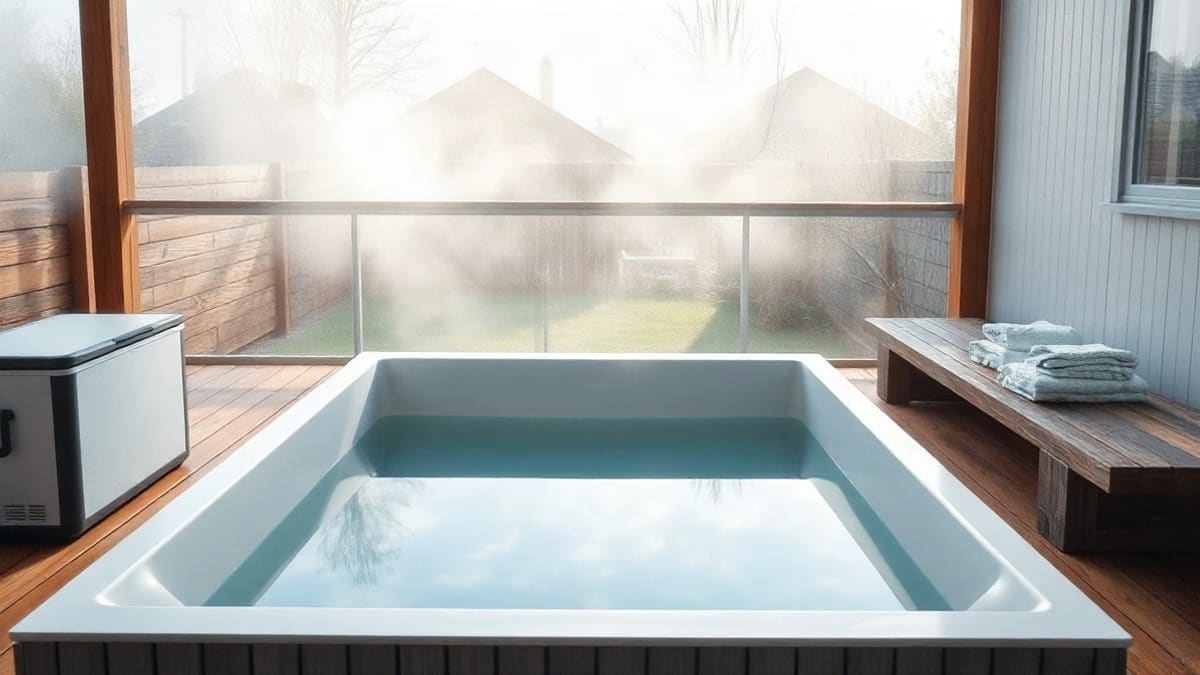
Plunge for recovery if you train hard and want less soreness for the next session, and your doctor has no objection.
Plunge for mood or sleep if you accept that the evidence is early, and you start at 50 to 59°F for 1 to 2 minutes.
Cold-water claims travel faster than the evidence behind them. This guide goes through eight of them one at a time, naming the study, the number of people and how strong the result really is, so you can separate a solid finding from a slogan. It also sets out who should skip a plunge, what an honest first session looks like and which tubs suit a routine that the research can support. For the heat side, best home sauna is the page to read, and a longer tub comparison follows near the end. Every claim links to its source so you can check it yourself.
What is a cold plunge?
In two lines
A cold plunge is a short dip in water cold enough to make you gasp, usually 40 to 59°F, for 1 to 5 minutes, in anything from a chilled tub to a bathtub with ice.
A cold plunge tub or tank is the equipment. A cold plunge pool is the same thing built in place.
People use it for three things: recovering after exercise, waking up or calming down, and making a daily habit of discomfort. An ice bath is the same idea cooled with bags of ice. The difference between the two is covered in our best cold plunge tub guide.
What are the benefits of a cold plunge?
In two lines
Eight benefits get claimed, and the studies back them to very different degrees: soreness has the firmest support, while inflammation, mood, sleep and fat loss rest on weak or mixed results.
The table rates each one by what the best available study actually found, not by how often it is repeated online.
| Claimed benefit | Best study | Size | Strength of evidence |
|---|---|---|---|
| Less muscle soreness | Bleakley, Cochrane, 2012 | 17 trials, 366 people | Moderate, low study quality |
| Lower inflammation | Cain, PLoS One, 2025 | 11 studies, 3,177 people | Weak, mixed |
| More muscle gain | Roberts, J Physiol, 2015 | 21 men | Evidence of harm, not benefit |
| Better mood and stress | Schepanski, Front Physiol, 2026 | 13 studies, 4,105 people | Weak, high bias |
| Dopamine and norepinephrine rise | Srámek, Eur J Appl Physiol, 2000 | Small group of men | Real blood change, 1 hour at 57°F |
| Brown fat activation | van Marken Lichtenbelt, NEJM, 2009 | 24 men | Lab finding, no weight-loss proof |
| Better sleep | Cain, PLoS One, 2025 | 11 studies | Preliminary |
| Fewer sick days | Buijze, PLoS One, 2016 | 3,018 people | Moderate for sick leave, cold showers |
The sections below take each row in the order people ask about them. Where a benefit has its own page on this site, we give the number here and the link.
Does a cold plunge reduce muscle soreness?
Yes, probably, for the next 1 to 4 days, and the effect is modest. The Cochrane review of cold-water immersion for muscle soreness pooled 17 small trials with 366 participants. Immersion in water under 59°F (15°C) beat rest at 24 hours (standardized mean difference -0.55), 48 hours (-0.66), 72 hours (-0.93) and 96 hours (-0.58). Study quality was low, the trials differed in temperature and duration, and the results were uneven.
A 2026 umbrella review of 15 reviews, by Berjisian and colleagues, agrees on soreness up to 96 hours and on lower creatine kinase between 24 and 72 hours. It found no significant change in C-reactive protein or interleukin-6 up to 72 hours. A second umbrella review, by Liang and colleagues, rated the confidence in the 14 reviews it covered as low or critically low. Its authors call soreness the most consistent result and say the clinical importance is uncertain.
A 2026 meta-analysis by Zhu and colleagues found lower soreness scores (Hedges g -0.58) but no meaningful effect on maximal strength, and it graded the certainty very low. So a plunge may feel better the next morning, and it does not make you stronger. When to plunge around a session is on cold plunge before or after a workout.
Does a cold plunge reduce inflammation?
The evidence does not show a clear effect on inflammation markers. Cain and colleagues reviewed 11 randomized trials with 3,177 participants, using water from 45 to 59°F (7 to 15°C) for 30 seconds to 2 hours. Inflammation markers were higher immediately after immersion (standardized mean difference 1.03) and showed no significant change at 1, 24 or 48 hours.
Tipton and colleagues reviewed the field in 2017 and concluded that the evidence behind different claims varies, and that some rests on anecdote. Treat "anti-inflammatory" as an open question, and see your doctor for any inflammatory condition such as arthritis.
Does an ice bath hurt muscle gain?
It can, if you take it right after lifting weights. Roberts and colleagues had 21 active men strength-train 2 days a week for 12 weeks. One group sat in cold water for 10 minutes after each session, and the other did active recovery. The active recovery group gained more strength and muscle mass. Their type II muscle fibers grew 17 percent in cross-section, and the cold group's did not.
A 2026 narrative review by Tornero-Aguilera and colleagues puts the effect on strength gains at about -0.23 for 10 to 15 minutes at 50 to 59°F, and says endurance adaptations seem less affected. Cleveland Clinic says plunging within 4 hours of a strength workout may interfere with gains. If muscle is your goal, wait several hours, or plunge on rest days.
Does a cold plunge improve mood and mental health?
It may lift mood in the short term, and long-term mental-health claims are not proven. The best overview is the 2026 meta-analysis of cold-water exposure by Schepanski and colleagues: 13 studies, 4,105 participants. Pooled results leaned toward less depression, less stress and better mood, but the confidence intervals were wide and many shrank when only controlled studies were counted. Anxiety showed little consistent benefit, and most studies carried a high risk of bias.
A survey by Czarnecki and Mokros compared 732 regular cold-water swimmers with 501 non-swimmers. The swimmers reported better mental health and shorter colds, and the best results appeared at up to 2 sessions a week, with worse results beyond. It was self-reported and cross-sectional, so it shows an association and not a cause. People who enjoy cold water may already be healthier. If you live with depression or anxiety, a plunge does not replace care, so ask your doctor.
Does cold water raise dopamine?
Yes, in one controlled study, but that study used 1 hour at 57°F, not a plunge. Srámek and colleagues measured young men during 1-hour head-out immersions. At 57°F (14°C), plasma norepinephrine rose 530 percent, dopamine 250 percent and metabolic rate 350 percent. At 68°F (20°C), metabolic rate rose 93 percent.
Two cautions. The men stayed in for 60 minutes, which is 12 to 60 times longer than a typical plunge, and the study did not measure mood. A hormone rise in the blood is not the same as feeling better. It is the best-measured result in the field, and the reason the "cold plunge dopamine" claim exists.
Does a cold plunge burn fat or turn on brown fat?
Cold turns on brown fat, and that has not been shown to lower body weight. van Marken Lichtenbelt and colleagues scanned 24 men, lean and overweight, at 72°F (22°C) and again during mild cold at 61°F (16°C). Brown fat was active in 23 of the 24 men during the cold. That is mild air-and-water cooling, not an ice bath, and the study did not follow weight loss.
So the claim "a plunge burns fat" overreaches. A cold session raises energy use while you shiver, as the 350 percent figure above shows, and a short plunge does not add up to a diet. Calories, plunging frequency and the best temperature for each goal are covered on cold plunge weight loss and recovery.
Does a cold plunge help you sleep?
A little, according to preliminary data. The Cain review reported better sleep quality and quality of life after cold-water immersion, and no gain in mood. Schepanski and colleagues call sleep data sparse but generally favorable. Cleveland Clinic lists better sleep among the possible benefits and rates the evidence as mixed.
Timing matters more than the water. A very cold plunge close to bedtime wakes some people up. Try it 2 or more hours before bed and note how you sleep for 2 weeks. If you already use a sauna, our cold plunge and sauna contrast therapy page covers the order and the gap between rounds.
Does a cold plunge boost your immune system?
It may cut sick days at work, and it does not prove stronger immunity. In the Buijze trial, 3,018 adults aged 18 to 65 took a hot-to-cold shower for 30, 60 or 90 seconds every day for 30 days, then used cold at their own discretion for 60 more days. Sickness absence from work fell 29 percent (incidence rate ratio 0.71). Illness days did not differ. No serious adverse events were reported.
Two limits apply. The people took showers, not plunges, and they reported their own sick days. The Cain review found no significant immune-function change at 0 or 1 hour. A well-known study by Kox and colleagues gave 12 men 10 days of cold exposure, breathing exercises and meditation, and 12 men nothing. The trained group had a milder response to an injected bacterial toxin, but the cold cannot be separated from the breathing, so it says little about a plain plunge.
Do cold plunges benefit women?
In two lines
The research is mostly in men, so women should read the women-specific page first. Hormones, cycle timing and pregnancy change what is sensible, and Cleveland Clinic lists pregnancy as a reason to ask a provider.
Cold plunge benefits for women gathers the data we found. Keep the pregnancy line in the risk table below in mind.
How cold and how long do you need to cold plunge for benefits?
In two lines
For most benefits, studies and clinics use water at 50 to 59°F for 1 to 5 minutes, 1 to 2 times a week at first.
There is no proven best dose, and the studies differ so much that one protocol does not exist. The table lines up what each source used.
| Source | Water temperature | Time | How often |
|---|---|---|---|
| Cleveland Clinic, beginners | 50 to 59°F | 1 to 2 minutes | 1 to 2 times a week |
| Cleveland Clinic, limit | Not below 40°F | Never over 5 minutes | Some people tolerate daily |
| Cain review, trials pooled | 45 to 59°F | 30 seconds to 2 hours | Varied |
| Tornero-Aguilera review, recovery | 50 to 59°F | 10 to 15 minutes | After sessions |
| Czarnecki survey, best results | Not reported | Not reported | Up to 2 times a week |
| Buijze trial, cold shower | Tap water | 30, 60 or 90 seconds | Daily for 30 days |
The numbers do not agree on time, because the research asks different questions. Recovery studies use 10 minutes or more, while Cleveland Clinic caps a plunge at 5. For a real protocol, use our pages on cold plunge temperature and how long to cold plunge. Start at the warm and short end, and stop if you cannot control your breathing.
How long do cold plunge benefits last?
Soreness relief lasts up to about 96 hours in the Cochrane data, and the other effects have not been shown to last. The Berjisian review found lower soreness up to 96 hours and lower creatine kinase from 24 to 72 hours. Inflammation markers in the Cain review were back to baseline by 1 hour. Mood effects after a single plunge are studied in the first hours, and no study read for this page shows them lasting for days.
What are the risks, and who should skip a cold plunge?
In two lines
Cold water is a stress on the heart, so the risk groups matter more than any single benefit. Heart disease, high blood pressure, Raynaud's, diabetes and pregnancy all call for a doctor's answer first.
The cold-shock response is a gasp, a racing heart and a sudden rise in blood pressure. Shattock and Tipton report that cold-water submersion can cause a high incidence of heart rhythm problems in healthy volunteers, and propose that "autonomic conflict" between the fight-or-flight and diving responses may explain some sudden deaths in water. The 2017 Tipton review covers cold-water immersion as a precursor to drowning, cardiac arrest and hypothermia.
| Group or risk | Why it matters | What to do |
|---|---|---|
| Heart disease, arrhythmia | Cold raises heart rate and blood pressure fast | Ask your doctor before any plunge |
| High blood pressure | Same stress on the circulation | Ask your doctor, never plunge alone |
| Raynaud's | Cold is a main trigger for attacks | Ask your doctor, skip full immersion |
| Pregnancy | Cleveland Clinic lists it as a group to consult first | Ask your doctor |
| Diabetes, neuropathy, poor circulation | Numb or poorly perfused skin hides cold injury | Ask your doctor first |
| Children and older adults | Smaller or frailer bodies lose heat faster | Medical advice first |
| Anyone alone, or after alcohol | Gasping and faintness in water are dangerous | Never plunge alone or after drinking |
MedlinePlus names cold temperatures and sudden cold exposure as triggers of Raynaud's attacks. Cleveland Clinic lists heart disease, high blood pressure, diabetes, pregnancy, peripheral neuropathy, poor circulation, venous stasis and cold agglutinin disease as reasons to speak to a provider first. None of this is medical advice for your case. Our are cold plunges safe guide goes deeper on warning signs, exit rules and supervision.
Do ice baths and cold plunges have different benefits?
In two lines
No, the benefits come from the temperature and the time, not from the name. The studies used water at a set temperature, which a chiller tub copies better than an ice bath that drifts warmer as it melts.
A tub with a chiller holds 37°F with no ice, so each session is the same dose. An ice bath starts colder and warms as the ice melts, so your dose changes through the session.
If you are still choosing, our cold plunge with chiller and best inflatable cold plunge pages compare the two routes. A plain cold shower is a cheaper first step, and the cold plunge vs cold shower page puts the two side by side.
Which cold plunge tub fits these benefits?
In two lines
For the recovery and routine benefits the evidence supports, pick a tub that holds 50 to 59°F and that you will use twice a week.
Four tubs cover the range. Specs are from the maker pages we read on November 17, 2026, and the full comparison with nine tubs is on the our best cold plunge tub guide.
| Tub | Cooling | Lowest temperature | Capacity | Power |
|---|---|---|---|---|
| Plunge All-In | Built-in 0.75 HP chiller | 37°F | 105 gal | 120 V, 15 A |
| Redwood Alaskan All-In-One | Built-in 1.5 HP chiller and heater | 37°F | 104 gal | 120 V, 12 A max |
| Ice Barrel 500 | None, chiller-ready | 37°F with chiller | 94 gal | None without chiller |
| Lifepro NordPod Plus | None, ice only | Ice only | 102 gal | None |
What a tub costs to buy and run is on cold plunge cost.
Plunge All-In: the set-and-plug pick
The Plunge All-In holds 105 gallons and cools to 37°F with a 0.75 HP chiller. It weighs about 1,150 lb filled and runs on one dedicated 120 V, 15 A outlet. Onboard ozone cleans the water, so you can keep a steady 50 to 59°F with no ice runs. Plunge sells it for residential use with a 1-year warranty.
Best for: a steady routine of 2 plunges a week at a set temperature.
Not for: a floor that cannot take 1,150 lb, or anyone who needs a doctor's approval first.
Redwood Alaskan All-In-One: chiller and heater in a wood-sided tub
Redwood Outdoors lists 104 gallons, 37 x 57 x 44 inches and 1,227 lb filled. A 1.5 HP unit cools to 37°F or heats to 104°F, so one tub serves a plunge and a warm-up. It runs on 120 V at 12 A maximum and carries a 1-year limited warranty. Damage from use below 32°F ambient air is not covered. The Redwood Alaskan cold plunge review goes further.
Best for: buyers who also own a Redwood sauna and want contrast sessions in one yard.
Not for: a freezing climate where the tub would run with the air under 32°F.
Ice Barrel 500: no plug, start with ice
The Ice Barrel 500 holds 94 gallons, weighs 104 lb empty and about 900 lb filled, and has a limited lifetime warranty. It needs no power, and you add ice to cool it. Its chiller-ready ports let you add a 1/2 HP chiller later, which Ice Barrel lists at 115 V with a 15 A fuse.
Best for: someone who wants to try short sessions before spending on a chiller.
Not for: anyone who will not buy ice regularly.
Lifepro NordPod Plus: the trial run
The inflatable NordPod Plus holds about 102 gallons, is 3.05 ft wide and 2.46 ft tall, and weighs 6 lb empty. Lifepro lists about 770 lb filled, 37 to 107°F and fits for people up to 6 ft 7 in. It needs ice and has no chiller. Lifepro lists a 2-year warranty in its feature list. Our Lifepro saunas page covers the brand.
Best for: renters and first-time plungers who want a month of trial before a bigger purchase.
Not for: daily summer use with no chiller, or anyone with heart disease who has not asked a doctor.
6 common mistakes when chasing cold plunge benefits
In two lines
The six mistakes are plunging right after lifting, staying in too long, going below 40°F, expecting fat loss, treating a cold shower study as proof for a plunge and skipping the doctor.
1. Plunging right after lifting
In the 12-week Roberts trial, 21 men who sat in cold water after each strength session gained less strength and muscle than the active recovery group. Cleveland Clinic says to wait at least 4 hours, or plunge on rest days.
2. Staying in as long as the studies did
Recovery trials used 10 to 15 minutes, and the Srámek study used a full hour. Cleveland Clinic caps a plunge at 5 minutes and suggests 1 to 2 for beginners. The durations are on how long to cold plunge.
3. Going below 40°F to get more
No study read for this page shows that colder is better. Cleveland Clinic advises against water below 40°F, and the pooled trials in the Cain review used 45 to 59°F.
4. Expecting fat loss
Cold activates brown fat in the lab, and no study read here shows a plunge lowering body weight. See cold plunge weight loss and recovery.
5. Treating a shower study as proof for a plunge
The Buijze trial of 3,018 adults tested a 30 to 90 second cold shower, and the 29 percent drop was in sick days at work, not illness days. It says little about a 37°F tub.
6. Skipping the doctor
Cold-water submersion caused a high incidence of heart rhythm problems in healthy volunteers in the Shattock and Tipton report. Ask first if you have heart disease, high blood pressure, Raynaud's, diabetes or are pregnant.
FAQ
Is cold plunging actually good for you?
It has real short-term effects, such as less soreness for 1 to 4 days, and weaker evidence for mood, sleep and immunity. The long-term health claims are not proven. The risks are real for people with heart conditions, so the answer depends on your health and your doctor.
How many plunges a week does it take to see results?
Cleveland Clinic suggests 1 to 2 times a week for beginners, and says some people tolerate daily plunges. In the Czarnecki survey, results were best at up to 2 sessions a week. More is not shown to be better.
How many minutes does a plunge need to last to work?
Cleveland Clinic suggests 1 to 2 minutes for beginners and never more than 5 minutes. Recovery studies used 10 to 15 minutes at 50 to 59°F, which is longer than that advice. A 3-minute plunge is inside that 5-minute cap, but beginners are advised 1 to 2 minutes. Start short. Our how long to cold plunge page sets out the choices.
How cold should a cold plunge be for benefits?
Beginners start at 50 to 59°F (10 to 15°C), and Cleveland Clinic advises against water below 40°F (4°C). Most studies pooled in the Cain review used 45 to 59°F. Colder is not proven to be better.
Do cold plunges help with weight loss?
Not by themselves. Cold activates brown fat in the lab, and no study read for this page shows a plunge lowering body weight. See cold plunge weight loss and recovery.
Do cold plunges reduce inflammation?
The evidence is mixed. Inflammation markers were higher right after immersion in the Cain meta-analysis and showed no change at 1, 24 or 48 hours. Do not treat a plunge as a medical anti-inflammatory.
Are ice baths good for muscle recovery?
For soreness, yes, a little. For muscle growth, no: cold water after lifting reduced gains in a 12-week trial of 21 men. Wait several hours after strength work, or plunge on rest days.
Do cold plunges boost the immune system?
A 30-day cold shower trial of 3,018 adults cut sick days off work by 29 percent. Illness days did not change, and plunges were not tested. Treat it as an early signal.
Do cold plunges benefit women?
The research is mostly in men. The page on cold plunge benefits for women covers cycle, hormones and pregnancy.
Can a cold plunge be dangerous?
Yes. Cold water can trigger heart rhythm problems even in healthy people, and it can lead to hypothermia. Ask your doctor first if you have heart disease, high blood pressure, Raynaud's, diabetes or are pregnant, and never plunge alone.
What is a cold plunge used for?
People use it after exercise for soreness, in the morning for alertness, and as a mood and stress habit. A tub with a chiller holds the temperature, and an ice bath relies on ice.
Is a sauna then a cold plunge better than either alone?
There are no strong trials comparing the two. Heat and cold together is a popular routine, and the order and timing are on cold plunge and sauna contrast therapy. Both need the same medical caution.
How we researched this page
In two lines
We read 16 studies and reviews plus the Cleveland Clinic article in November 2026, and we did not test any tub. Each study is listed with its size, and we say below what we could not check.
Full texts were not open to us, so the study numbers come from published abstracts and summaries. The Cleveland Clinic thresholds (50 to 59°F, 1 to 2 minutes, a 40°F floor, a 5-minute cap) come from a summary of its article and are worth rechecking on the page. The Raynaud's wording from MedlinePlus is paraphrased. Tub specs come from maker pages read on November 17, 2026, and a few NordPod figures were carried over from our own guides.
Sources
- Bleakley and colleagues, Cold-water immersion for preventing and treating muscle soreness after exercise, Cochrane Database of Systematic Reviews, 2012
- Roberts and colleagues, Post-exercise cold water immersion attenuates acute anabolic signalling and long-term adaptations in muscle to strength training, Journal of Physiology, 2015
- Srámek and colleagues, Human physiological responses to immersion into water of different temperatures, European Journal of Applied Physiology, 2000
- van Marken Lichtenbelt and colleagues, Cold-activated brown adipose tissue in healthy men, New England Journal of Medicine, 2009
- Buijze and colleagues, The effect of cold showering on health and work, PLoS One, 2016
- Kox and colleagues, Voluntary activation of the sympathetic nervous system and attenuation of the innate immune response in humans, PNAS, 2014
- Tipton and colleagues, Cold water immersion: kill or cure?, Experimental Physiology, 2017
- Shattock and Tipton, Autonomic conflict: a different way to die during cold water immersion?, Journal of Physiology, 2012
- Cain and colleagues, Effects of cold-water immersion on health and wellbeing, PLoS One, 2025
- Czarnecki and Mokros, Inverted u-shaped association of cold-water immersion frequency with mental health and upper respiratory tract infection, Brain, Behavior, and Immunity - Health, 2025
- Schepanski and colleagues, Cold-water exposure and psychological outcomes in adults, Frontiers in Physiology, 2026
- Berjisian and colleagues, Strategic application of post-exercise cold-water immersion, umbrella review, Sports Medicine - Open, 2026
- Liang and colleagues, Cold-water immersion for post-exercise recovery: an overlap-aware umbrella review, Sports Medicine - Open, 2026
- Zhu and colleagues, Temporal dynamics of muscle strength recovery following acute cold-water immersion, PeerJ, 2026
- Tornero-Aguilera and colleagues, The cold-water immersion recovery-adaptation paradox, Experimental Physiology, 2026
- Cleveland Clinic, What to know about cold plunges
- MedlinePlus, Raynaud's disease
- Tub specifications: Plunge All-In, Redwood Outdoors Alaskan All-In-One, Ice Barrel 500, Lifepro NordPod Plus, read November 17, 2026
Keep comparing
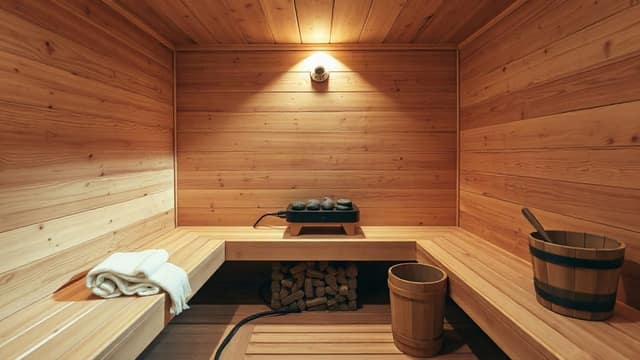 Home SaunaInfrared, outdoor cabin, barrel and blanket, with real watts, amps, dimensions and EMF
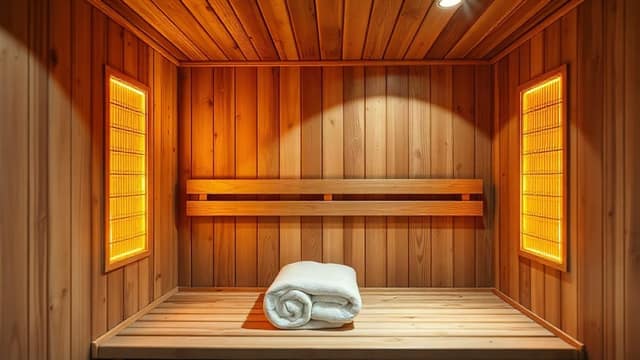 Infrared SaunaTen infrared saunas compared from 1 to 4 seats, indoor and outdoor, by size in inches, amps, kWh
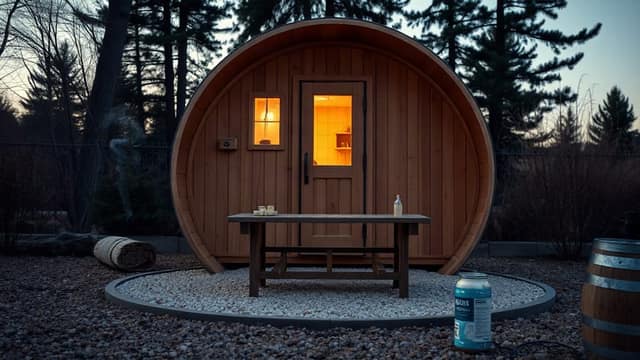 Outdoor SaunaCabins, barrels, cubes and infrared, with real weights, heaters, circuits
 Portable Saunas for HomeEight real models compared on size, watts, amps, top heat and weight, with the Lifepro blanket recall
 Red Light and Near Infrared SaunaNine home saunas with red or near infrared LEDs compared on wavelength in nm, published mW/cm2, size