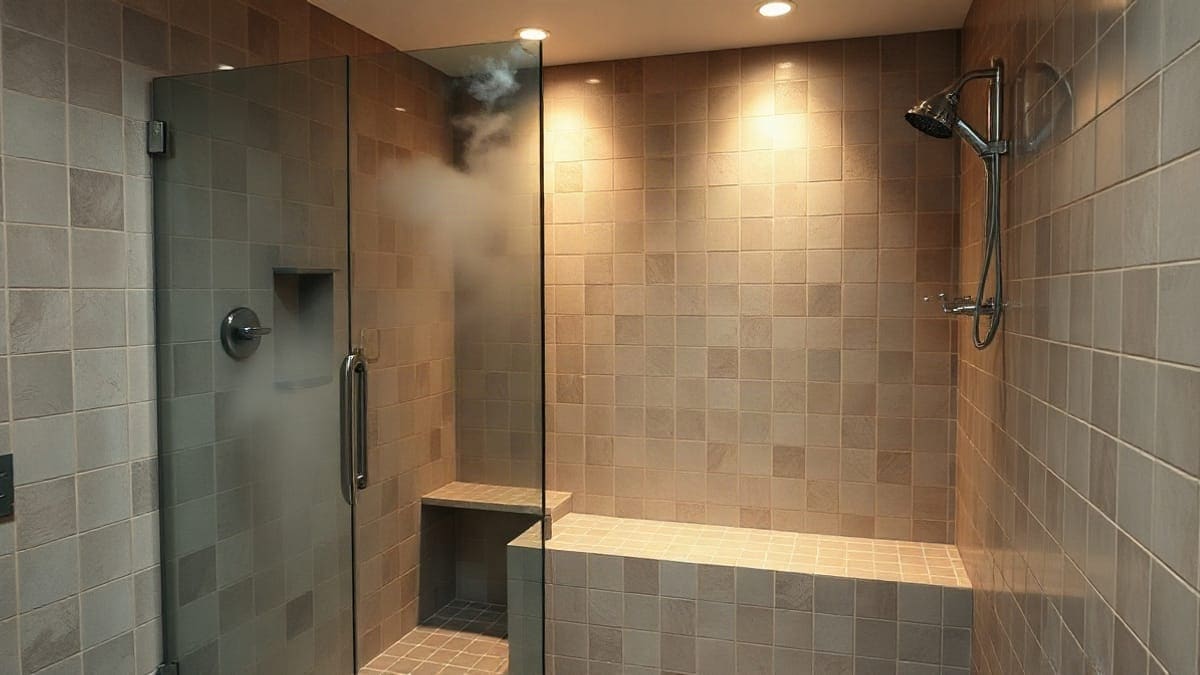
A sauna is a hot, dry room at about 150 to 195°F, and a steam room is a sealed, wet room at about 100 to 120°F with humidity near 100 percent. Neither has a proven medical edge: the long studies are on dry saunas, and steam rooms are barely studied.
The gap in heat and humidity changes how long you stay, what the room demands at home and what you must clean. Below, heat, humidity, power, space, upkeep and risk are laid out for both rooms, followed by a pick by profile and six home models, three dry and three wet. The figures come from study abstracts, a health service page and maker sheets dated November 2026; none of it is hands-on. Each section opens with its answer in one bold line, so you can stop there. If a heart or blood pressure condition applies to you, see a doctor before either room.
Sauna or steam room: how do they differ side by side?
In two lines
A sauna heats dry air with a stove or panels, and a steam room fills a sealed room with vapor from a generator. The sauna runs 150 to 195°F at under 20 percent humidity, the steam room 100 to 120°F near 100 percent.
Columbia University's health service describes the Finnish sauna as 176 to 212°F (80 to 100°C) at 10 to 20 percent humidity, and the steam room as about 122°F (50°C) at 100 percent. Both warm the whole body. The difference is how the heat reaches you and how much of it your sweat can shed.
Pour water on the hot rocks of a traditional sauna and you get a brief puff of steam, as Medical News Today notes. That is still a dry room. A steam room never dries out, which is why the walls are tile, glass or acrylic and not wood.
The face-off below uses published ranges, and where makers differ we say so.
| Measure | Sauna | Steam room |
|---|---|---|
| Air temperature | 150 to 195°F traditional; 110 to 135°F infrared (Cleveland Clinic) | 100 to 110°F (Medical News Today); 110 to 120°F (WebMD) |
| Humidity | Under 20 percent | Near 100 percent |
| Heat source | Electric or wood stove; carbon or ceramic panels | Steam generator or kettle-style steamer |
| Typical session | 15 to 20 minutes; 5 minutes for beginners | 5 to 10 minutes; 10 at most |
| Warm-up | About 1 hour to 180°F (Almost Heaven Logan) | Steam in about 5 minutes (Mr. Steam); 15 to 20 minutes to full heat |
| Home power | 6 kW, 240 V, 30 A (Pinnacle); 1,880 W, 120 V (Equinox 2) | 5 kW, 21 A (Mr. Steam MS 90E); 3 kW, 20 A breaker (Mesa WS-300A) |
| Floor space | 38.5 sq ft (Pinnacle); 12.6 sq ft interior (Equinox 2) | 11.4 sq ft (Mesa WS-300A cabin) |
| Walls | Wood | Tile, glass or acrylic, sealed |
| Upkeep | Wipe benches, air it out | Flush generator every 2 months, dry the room |
| Research | Long Finnish cohorts, observational | Small trials, mostly moist heat |
| Main risks | Dehydration, low blood pressure, fainting | Same, plus mold and germs in shared rooms |
Read the table as a map, not a score; the product figures come from maker pages read on November 17, 2026. Our what is a traditional dry sauna page explains the dry side, and wet sauna and traditional steam sauna covers the middle ground.
How hot is a sauna compared with a steam room?
In two lines
A traditional sauna is about 50 to 80°F hotter than a steam room, and an infrared cabin at 110 to 135°F sits in between. The ranges differ by source, so each one is named below.
How hot is a steam room?
Medical News Today puts a steam room at about 100 to 110°F. WebMD gives 110 to 120°F. Columbia's service gives about 122°F. The three do not agree, and none of them tests real rooms. For a home build, the generator's thermostat and your own comfort decide, and Mr. Steam advises starting at a low setting and raising it. Our steam room benefits page keeps the same range and the same caveat, and steam room time and temperature takes the dial settings.
Where does a sauna sit on the heat scale?
Cleveland Clinic says a traditional sauna runs 150 to 195°F (65 to 90°C) with humidity under 20 percent, and an infrared sauna 110 to 135°F. Columbia lists infrared at 113 to 140°F (45 to 60°C). Almost Heaven lists its Logan one-person barrel as reaching 180°F in about an hour. A maker's top figure is a ceiling and not a setting you must use, and sauna temperature shows how to pick a lower one.
Why does 115°F steam feel as hot as 170°F dry air?
Wet air hands heat to your skin faster, and your sweat cannot evaporate to cool you. Columbia's health service says humidity changes sweat rates, so sweating benefits seen in saunas cannot be assumed for steam rooms. In a 100 percent room, sweat mostly rolls off. In a 15 percent room, it evaporates and carries heat away, which is why you can sit in air hot enough to scald a wet hand.
You still sweat in a steam room, and a 2014 trial by Iwase and colleagues measured sweat rate in 6 young men in a mist sauna at 104°F and 100 percent humidity. The sweat did not differ from a dry condition in that small group.
Which is better for your health, a sauna or a steam room?
In two lines
Neither has been proven better. The sauna has far more research, and almost all of it is observational: men who used saunas more often had fewer events later, which does not show the sauna caused it.
The table sets each claim beside the best study we found for each room.
| Claim | Sauna evidence | Steam room evidence |
|---|---|---|
| Heart and vessels | Laukkanen 2015: 2,315 Finnish men, median 20.7 years; 4 to 7 sessions a week had about half the fatal cardiovascular risk of once a week | No steam study found; Iwase 2014, 6 men, mist sauna, no blood pressure change |
| Lungs | Kunutsor 2017: 1,935 men, 25.6 years; hazard ratio 0.73 at 2 to 3 sessions a week, 0.59 at 4 or more | Not shown for a steam room |
| Colds and congestion | None strong | Cochrane 2017: 6 trials, 387 people, inhaled steam, low-quality evidence, uncertain |
| Muscle soreness | Mixed | Petrofsky 2013: 100 people, moist heat packs, less pain right after exercise |
| Skin | Hannuksela 2001 review: heat does not dry the skin, may help psoriasis | No steam room trial found |
| Weight | Podstawski 2014: 674 students, loss was water | Medical News Today: no evidence for weight loss |
| Male fertility | Garolla 2013: 10 men, 2 sessions a week for 3 months | No steam study found |
On dose, sessions longer than 19 minutes did better than shorter ones in the Laukkanen cohort, which fits the 15 to 20 minute advice. No dose study exists for steam rooms, so the 5 to 10 minute limit rests on caution from WebMD and Medical News Today, not on trial results.
A fair reading is that the sauna has the stronger, longer-term signals, and the steam room has comfort and a possible short-term help for a stuffy nose.
The 2015 JAMA Internal Medicine study by Laukkanen and colleagues is the best known. Their later 2018 Mayo Clinic Proceedings review calls the signals promising and mostly observational. Our sauna health studies page lists them in full, and sauna and blood pressure takes the one most readers ask about.
On steam, the Cochrane review by Singh and colleagues looked at inhaled heated air in colds, not a steam room, and could not say the benefit is real. If you have a stuffy nose, a steam room may feel good for a while. If a sinus infection is the question, ask your doctor, because no trial tested a steam room for it.
The Garolla study put 10 men in a Finnish sauna at 176 to 194°F (80 to 90°C) for 15 minutes twice a week for 3 months. Sperm count and motility fell, and the changes reversed by 6 months after the men stopped. Cleveland Clinic still lists male infertility as a reason to check with a provider before regular sauna use.
For the full steam-side rundown, see steam room benefits. For the dry-heat side, see sauna benefits, dry sauna benefits and infrared sauna benefits.
What are the risks of each, and who should skip them?
In two lines
The risks overlap: heat strains the heart, drops blood pressure and dries you out, in either room. "Ask your doctor" is the rule for every row of the table below.
The table pulls together what Cleveland Clinic, Medical News Today and Columbia's health service say. None of it is medical advice for your case.
| Situation | Sauna | Steam room | What to do |
|---|---|---|---|
| Heart disease, recent heart attack or stroke | Avoid until cleared (Cleveland Clinic) | Avoid (Medical News Today) | Ask your doctor |
| High or low blood pressure | Check first | Check first | Ask your doctor |
| Pregnancy or trying to conceive | Check first | Sources disagree; one review calls uncomplicated pregnancy low risk, another says avoid | Ask your doctor |
| Epilepsy, stimulants, tranquilizers, antibiotics | Check first | Listed as unsuitable (Medical News Today) | Ask your doctor or pharmacist |
| Alcohol in the past few hours | Avoid | Avoid | Skip the session |
| Age over 65 or under 16 | Check first | Check first | Ask a provider |
| Dehydration | Real | Real | Drink water before and after |
| Germs in a shared room | Low | Athlete's foot, warts, folliculitis in shared baths | Wear sandals, sit on a towel |
The steam-only line is the germ line. A 2025 review by Kutlu and colleagues lists athlete's foot, warts, molluscum and Pseudomonas folliculitis among infections tied to shared Turkish baths. It adds that with frequent disinfection the infections are uncommon. A home room avoids strangers' feet and adds a different job: keeping it dry.
What does each cost you in power, space and upkeep at home?
In two lines
A steam room is cheap to power and expensive to build; a sauna is the reverse. A 6 kW sauna heater and a 5 kW steam generator both want a dedicated 240 V line, so the real split is water and wood.
A steam room needs a sealed, waterproof space, a drain and a generator. A sauna needs a dry floor, ventilation and a heater. The numbers below are the makers' figures, plus our arithmetic where they publish none.
| Model | Type | Footprint | Power | Our arithmetic |
|---|---|---|---|---|
| Almost Heaven Pinnacle | Traditional barrel | 78 x 71 in, 38.5 sq ft | 6 kW, 240 V, 30 A cable | 6,000 W / 240 V = 25 A |
| Redwood Outdoors Cabin 4-person | Traditional cabin | 67 x 78 x 92.5 in, 36.3 sq ft | 6 kW Harvia KIP heater, 240 V | 25 A at full load |
| Sun Home Equinox 2-person | Full spectrum infrared | 45.4 x 39.9 in inside, 12.6 sq ft | 120 V, 1,880 W, 15.67 A | Needs a dedicated 20 A circuit |
| Mr. Steam MS 90E generator | Steam generator | Fits your stall | 5 kW, 21 A, 10 AWG wire | 21 A x 1.25 = 26 A, so a 30 A breaker |
| Mesa WS-300A | Steam cabin | 47 x 35 in, 11.4 sq ft | 3 kW, 220 V, 20 A dual pole | 3,000 W / 240 V = 12.5 A |
| SaunaBox SmartSteam XL | Portable steamer | Pop-up tent | 1,600 W on a household outlet | 1,600 W / 120 V = 13.3 A |
For the electrical side of a sauna, see our best home sauna guide.
Running energy is small for steam. Our upper bound, since thermostats cycle the elements: a 5 kW generator at full output for 30 minutes uses at most 2.5 kWh. A 6 kW sauna heater for the 1 hour warm-up and a 20 minute session uses at most 8 kWh. Mr. Steam lists 0.67 gallons of water for the steam of its 5 kW unit over 20 minutes, so water is not the issue. The surfaces are.
A steam room stays wet, and wet is where mold grows. The US EPA says to keep indoor humidity under 60 percent, ideally 30 to 50 percent, and to dry water damage within 24 to 48 hours. Mr. Steam says to flush its generator every 2 months. A sauna dries out between sessions. Wipe the benches and leave the door ajar, as in how to clean a sauna. The build side of the steam room is on home steam room and steam shower installation and cost.
Should you choose a sauna or a steam room?
In two lines
Pick by how you feel in heat, what you can build and what you want from the habit: a 15 to 20 minute dry session suits a sauna, a 5 to 10 minute soft, wet one a steam room.
These are conditions, not a medical call, and a doctor's clearance comes first.
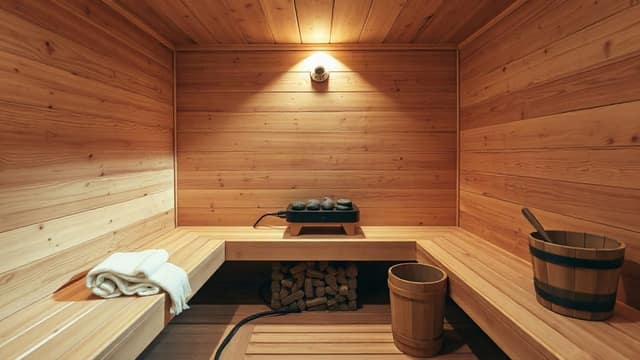
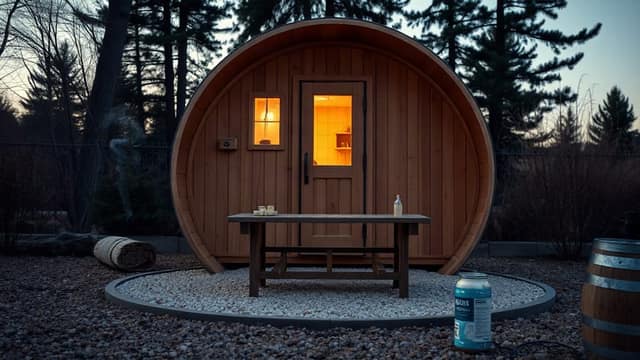
- Choose a traditional sauna if you want the heat the long studies used, a 15 to 20 minute session, and you can supply a 240 V circuit. A cedar barrel such as the Almost Heaven Pinnacle fits a yard.
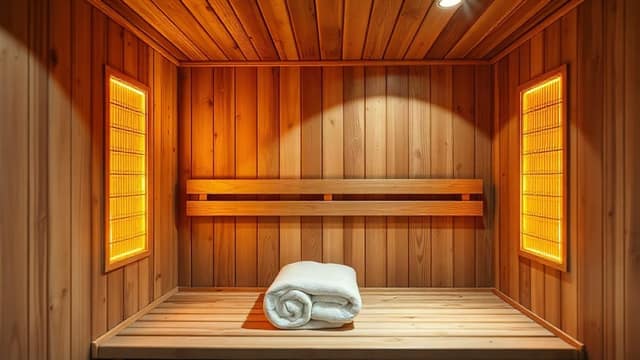
- Choose an infrared sauna if you want a lower 110 to 135°F cabin on a standard 120 V line. Read infrared vs traditional sauna before you decide.
- Choose a steam room if dry heat leaves you light-headed, you like soft, humid warmth and a 5 to 10 minute habit, and you have a tiled stall or a spot for a cabin.
- Choose a steam shower cabin if you rent or have no space for a room and want one in the bathroom, with a seat and a door. See best steam shower.
- Choose a portable steamer if you want to try steam before building. Best portable steam sauna compares tents.
- Choose a sauna if your goal is a weekly routine after training. Sauna after workout covers timing.
- Choose neither if you have a heart rhythm problem, are pregnant or drink alcohol before sessions, until a doctor agrees.
If you are torn between a steam room and an infrared cabin, infrared vs steam sauna takes that pair. And if you want dry heat with a little wet, dry vs wet sauna is the page.
Which comes first, the sauna or the steam room?
In two lines
No study we found sets an order, so go by comfort and keep each stay short. Doing 5 to 10 minutes of steam and 15 to 20 of sauna in one visit does not stack, so cut each one.
Many people start in the steam room because it is cooler, then move to the sauna, and some reverse it. Cleveland Clinic and Columbia both advise 5 minutes for beginners and a drink of water. Rest between rooms, shower, and stop if you feel faint.
Having both at home is possible, and it is a plumbing, wiring and floor-plan question. Steam room vs sauna combo at home covers layouts and the extra circuit. For a cold dip after either, see cold plunge and sauna contrast therapy.
Which sauna and steam setups should you look at?
In two lines
Three saunas and three steam setups cover most homes: a 6 kW barrel, a 6 kW cabin and a 120 V infrared cabin, then a 5 kW generator, a 3 kW cabin and a 1,600 W tent.
All figures are the maker's pages we read on November 17, 2026. A licensed electrician should confirm every circuit.
Almost Heaven Pinnacle: the dry-heat barrel
Almost Heaven lists the Pinnacle at 78 x 71 x 81.5 in outside, with a 6 kW heater on 240 V and a 30 A hardwired cable. The lights take a separate 120 V, 15 A plug. The staves are 1 3/8 in thick. The maker lists no weight, and the 715 lb figure on some pages comes from resellers. Read Almost Heaven saunas for the brand.
Best for: a yard and the hot, dry routine of the Finnish studies.
Not for: a space with no 240 V line, or a pad that cannot take a 38.5 sq ft barrel.
Redwood Outdoors Cabin 4-person: the room for a household
Redwood Outdoors lists the cabin at 67 x 78 x 92.5 in and 1,150 lb on its own page, with a 6 kW Harvia KIP heater as the base. Other listings give lower weights and other sizes, so use the maker's page. The brand is covered in Redwood Outdoors saunas.
Best for: a family of up to four that will use it several times a week.
Not for: a deck with a weight limit under 1,150 lb plus bathers.
Sun Home Equinox 2-person: infrared on a 120 V line
Sun Home lists 1,880 W and 15.67 A on a dedicated 20 A circuit, with six 500 W heaters, four far infrared and two full spectrum. Inside it measures 45.4 x 39.9 x 70.3 in, and it weighs 541 lb. The top is 165°F on the product sheet; the pages that give 2,020 W describe the 3-person Equinox. See Sun Home saunas.
Best for: two adults who want gentler heat indoors.
Not for: anyone who wants steam or a 190°F room.
Mr. Steam MS 90E: the generator for a stall
Mr. Steam lists the MS 90E as a 5 kW generator drawing 21 A at 240 V on 10 AWG wire. The maker says steam begins in about 5 minutes, and stone, glass and marble count as extra volume under its sizing method. The warranty is limited lifetime and ends with commercial use. Our steam shower generator page covers sizing.
Best for: a one-person tiled shower stall you build or already have.
Not for: a room with glass walls on several sides.
Mesa WS-300A: the steam cabin for one
The dealer page lists 47 x 35 x 85 in, a 3 kW generator, 6 body jets, a fold-down seat, 220 V and a 20 A dual-pole breaker. These figures are dealer listings and not maker pages. Our best steam shower page compares eight cabins.
Best for: a small bathroom with no room to tile and waterproof a stall.
Not for: two people at once.
SaunaBox SmartSteam XL: the try-before-you-build tent
SaunaBox lists a 3.6 L reservoir, 1,600 W, steam to 130°F, a 60 minute timer and a 1 year warranty. It sits on a household outlet and seats up to 2. Steam shower kit shows the step up.
Best for: renters who want to learn whether they like steam.
Not for: anyone who wants a permanent room.
6 common mistakes when choosing between a sauna and a steam room
In two lines
The costliest mistakes are about expectations and safety: steam at 115°F feels as hot as dry air at 170°F, alcohol raises the risk of arrhythmia, and 5 to 10 minutes of steam is not 15 to 20 of sauna.
1. Judging by the number on the dial
Wet air hands heat to your skin faster, so a 100 to 120°F steam room can feel as hot as a 170°F sauna. Start at 5 minutes in either.
2. Skipping the doctor with a heart or blood pressure condition
Cleveland Clinic and Medical News Today both list heart disease, and the sources disagree on pregnancy. Ask first.
3. Stacking full sessions
Do not run 20 minutes of sauna and 10 of steam back to back. Cut each, rest between rooms and drink water.
4. Drinking beforehand
Alcohol raises the risk of low blood pressure and arrhythmia in either room. Skip the session.
5. Expecting weight loss or detox
Podstawski found the loss in 674 students was water. Neither room is a diet.
6. Underestimating the steam build
A steam room needs waterproofing, a drain and a 21 A circuit for a 5 kW generator; a plug-in cabin or tent avoids that.
How we researched this page
In two lines
We read the studies through their PubMed abstracts, plus Cleveland Clinic, Columbia, Medical News Today, WebMD, the EPA and the maker pages, on November 17, 2026. Nothing here is hands-on, and we print no prices.
We found no source that sets an order for using the two rooms, and the Garolla study was read as an abstract, not in full. The Mesa WS-300A figures are dealer listings, and the Almost Heaven and Sun Home links go to home pages because their product pages refused automated reads.
FAQ
Which is hotter, a sauna or a steam room?
A sauna, by 50 to 80°F. A traditional sauna reaches 150 to 195°F and a steam room 100 to 120°F. Wet air feels hotter than its number, so the gap feels smaller than it is.
Is a steam room or sauna better for weight loss?
Neither burns fat in a meaningful way. Podstawski found the loss in 674 students was water, and Medical News Today says no evidence shows steam rooms aid weight loss.
Is a steam room or sauna better for skin?
No trial compares them. The 2001 sauna review found heat does not dry the skin, with a possible gain in psoriasis and more itching in atopic dermatitis. A skin condition is a question for a dermatologist.
Is a steam room or sauna better for a cold or sinus infection?
Steam may feel soothing for a stuffy nose, and the Cochrane evidence is low quality. Skip shared rooms while sick, and ask your doctor about a sinus infection.
Can you use a sauna and a steam room on the same day?
Many people do, with short stays and water between; no source we read sets a limit. Cut each session if you feel heavy or dizzy.
Can you use a steam room or sauna while pregnant?
Ask your doctor first. Cleveland Clinic lists pregnancy and trying to conceive as reasons to check, and Medical News Today lists pregnancy among reasons to avoid a steam room. One review judged an uncomplicated pregnancy low risk, so the sources disagree.
Does a steam room or sauna affect male fertility?
A small study found a sauna lowered sperm count and motility, and it reversed after the men stopped. We found no steam room study. Cleveland Clinic lists male infertility as a reason to check with a provider.
Can a steam room or sauna lower blood pressure?
Not proven for either as a treatment. Observational sauna data link frequent use to lower risk, and a 6-man mist sauna trial found no change. See sauna and blood pressure, and ask your doctor.
Which is easier to install at home, a sauna or a steam room?
A plug-in infrared cabin or a portable steamer is easiest. A built steam room is hardest, with waterproofing, a drain and a 240 V circuit; a sauna kit sits between, see best sauna kits.
Which is easier to keep clean, a sauna or a steam room?
A sauna, because it dries between sessions. A steam room stays wet, so dry it after each use and watch humidity, as the EPA advises. Public steam rooms add shared germs.
Sources
- Laukkanen and colleagues, Association between sauna bathing and fatal cardiovascular and all-cause mortality events, JAMA Internal Medicine, 2015
- Laukkanen, Laukkanen and Kunutsor, Cardiovascular and other health benefits of sauna bathing, Mayo Clinic Proceedings, 2018
- Kunutsor, Laukkanen and Laukkanen, Sauna bathing reduces the risk of respiratory diseases, European Journal of Epidemiology, 2017
- Singh and colleagues, Heated, humidified air for the common cold, Cochrane Database of Systematic Reviews, 2017
- Iwase and colleagues, mist sauna bathing, International Journal of Biometeorology, 2014
- Petrofsky and colleagues, Moist heat or dry heat for delayed onset muscle soreness, Journal of Clinical Medicine Research, 2013
- Hannuksela and Ellahham, Benefits and risks of sauna bathing, American Journal of Medicine, 2001
- Podstawski and colleagues, Sauna-induced body mass loss, The Scientific World Journal, 2014
- Garolla and colleagues, Seminal and molecular evidence that sauna exposure affects human spermatogenesis, Human Reproduction, 2013
- Kutlu and colleagues, Turkish bath-associated infectious dermatoses, 2025
- Cleveland Clinic, Sauna benefits and risks
- Columbia University, Go Ask Alice, What is the difference between a steam room and a sauna?
- Medical News Today, Steam room: benefits, risks, and differences to sauna
- WebMD, Health benefits of steam rooms
- US EPA, A brief guide to mold, moisture and your home
- Almost Heaven Saunas, Pinnacle and Logan product pages
- Mr. Steam, residential steam generators and warranty
- Sun Home Saunas, Equinox 2-person specifications
- SaunaBox, SmartSteam XL specifications
Keep comparing
 Home SaunaInfrared, outdoor cabin, barrel and blanket, with real watts, amps, dimensions and EMF
 Infrared SaunaTen infrared saunas compared from 1 to 4 seats, indoor and outdoor, by size in inches, amps, kWh
 Outdoor SaunaCabins, barrels, cubes and infrared, with real weights, heaters, circuits
 Portable Saunas for HomeEight real models compared on size, watts, amps, top heat and weight, with the Lifepro blanket recall
 Red Light and Near Infrared SaunaNine home saunas with red or near infrared LEDs compared on wavelength in nm, published mW/cm2, size