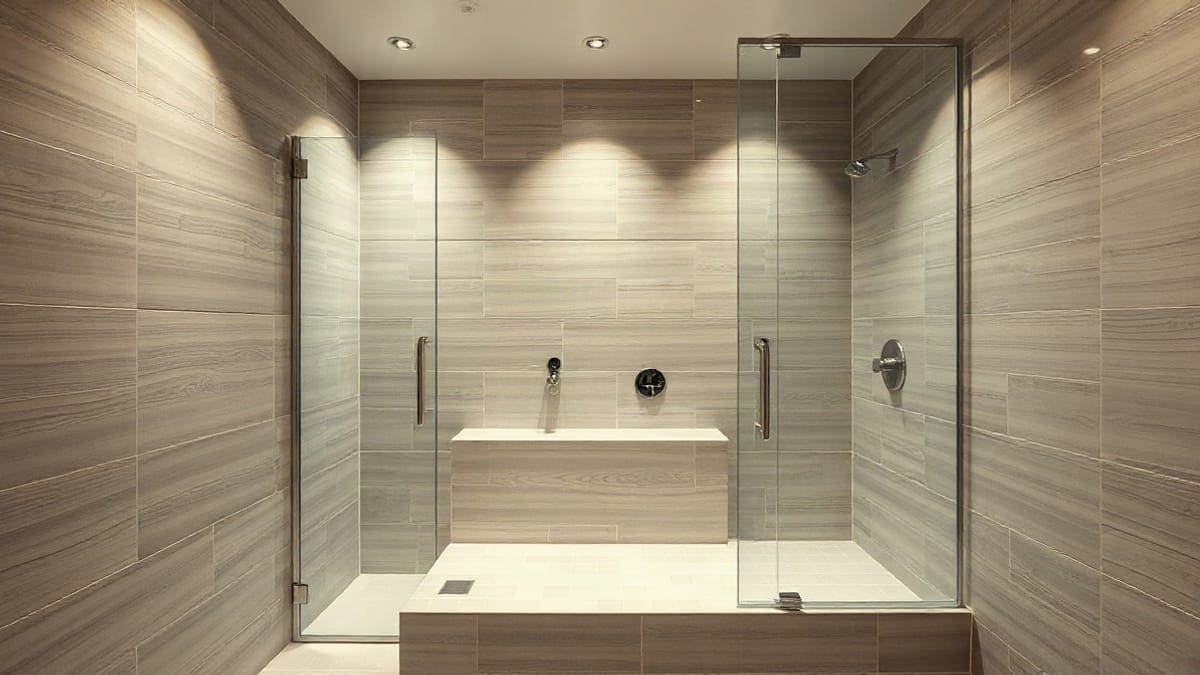
A steam room is passive: a generator outside the room turns water into vapor that reaches a steam head low on a wall, and the room only has to hold it, sized by cubic feet. That is why the envelope matters more than the machine. This guide walks through room size, generator power, the circuit, waterproofing, the drain, the bench and upkeep, then ends on two cabins and two generators to start from. Plan on a licensed plumber and electrician for the real work. We print no prices, and every figure comes from maker manuals, builder guides and dealer pages read in November 2026.
What is a steam room?
In two lines
A steam room is a small enclosed room filled with water vapor at about 100 to 120°F, near saturation, where you sit for a short session. A home version is the same idea built into a bathroom, a basement corner or a spare room.
The heat comes from the moisture on your skin, not from hot dry air, and sources differ on the number: WebMD says 110 to 120°F and Medical News Today says 100 to 110°F. A steam sauna in a tent or cabin is a related product, covered in wet sauna and traditional steam sauna.
How does a home steam room work?
In two lines
A home steam room works by boiling water in an electric generator and piping the steam through a 1/2 in line to a steam head. Mr. Steam says steam begins to appear in about 5 minutes, and one builder guide plans for 15 to 20 minutes to reach full temperature.
Four parts do the work: the generator boils the water, the steam line carries it, the steam head releases it and the control sets time and temperature and holds the room at your setting.
The steam line is the part people get wrong. Mr. Steam wants insulation rated 212 °F or higher, and a line that runs down and then up makes a trap that blocks the flow. Makers allow different line lengths: Kohler and Steamist 25 ft, ThermaSol 50 ft and Mr. Steam 60 ft of insulated line.
For what a session feels like and why people use one, read steam room benefits. For the right air temperature and minutes, read how long to stay in a steam room.
Where in the house can a steam room go?
In two lines
A steam room can go in any space you can seal, drain and reach with a 240 V circuit, and the best spots already have plumbing. Each location trades cost against moisture risk, and none of them is free of either.
- An existing tiled shower already has the drain, water and walls; check that the door reaches the ceiling and that you can slope the ceiling.
- A bathroom corner or tub alcove has short pipe runs; a cabin needs 11 to 15 sq ft and 2 in of extra height for its vent pipe.
- A spare room or large closet gives full freedom on size but needs a new drain and a floor that holds water.
- A basement corner has a slab and easy drain access; the EPA says the rest of the basement should stay below 60 percent humidity.
An upper floor adds weight: the Mesa WS-609P cabin weighs 600 lb before water and bathers. For a dry second room, compare sauna vs steam room, or see a sauna and steam room combo at home.
How big should a home steam room be?
In two lines
For one or two people, a room of 4 x 3 ft up to 6 x 5 ft with an 8 ft ceiling is the usual range. That is 96 to 240 cu ft, which suits a 6 to 9 kW generator.
Bigger rooms need 10 kW and larger units, which need a heavier circuit. Keep the ceiling at 8 ft or less: Mr. Steam and ThermaSol both say a taller ceiling needs a bigger generator, and Vinotemp says a tall room can leave the floor cold.
| Room (ft) | Volume (cu ft) | Seats at 2 ft each | Fits |
|---|---|---|---|
| 3 x 3 | 72 (at 8 ft) | 1 to 2 | Converted shower |
| 4 x 3 | 96 | 2 | Small bathroom or large stall |
| 5 x 4 | 160 | 2 to 3 | Bathroom with a tub removed |
| 6 x 4 | 192 | 3 | Spare room |
| 6 x 5 | 240 | 3 to 4 | Basement corner |
The seat count is our estimate at about 2 ft of bench per adult, not a maker figure.
How do you size the steam generator?
In two lines
Multiply length by width by height in feet, adjust the volume for the walls and ceiling, then choose the generator whose rating covers the result. Materials and glass change the answer, so the same room can land on two different kW sizes depending on the maker.
Mr. Steam's method adds 40 percent of the volume for tile on cement board or a mortar bed, 110 percent for natural stone, marble, glass block or concrete, and 15 percent for each foot above 8 ft. It says to take the next lower model for acrylic or other synthetic walls. The table applies it to six rooms; the arithmetic is ours.
| Room | Base (cu ft) | Adjustments | Adjusted (cu ft) | Mr. Steam model | Draw at 240 V |
|---|---|---|---|---|---|
| 4 x 3 x 8, tile | 96 | plus 40% (38.4) | 134.4 | MS150E, 6 kW (up to 150) | 25 A |
| 5 x 4 x 8, tile | 160 | plus 40% (64) | 224 | MS225E, 7.5 kW (up to 225) | 32 A |
| 6 x 4 x 8, tile | 192 | plus 40% (76.8) | 268.8 | MS400E, 9 kW (up to 360) | 38 A |
| 6 x 5 x 8, tile | 240 | plus 40% (96) | 336 | MS400E, 9 kW (up to 360) | 38 A |
| 6 x 5 x 9, tile | 270 | plus 40% (108), plus 15% (40.5) | 418.5 | MS SUPER 1E, 10 kW (up to 475) | 42 A |
| 6 x 5 x 8, natural stone | 240 | plus 110% (264) | 504 | MS SUPER 2E, 12 kW (up to 575) | 50 A |
The 5 x 4 room lands at 224 cu ft against a 225 cu ft ceiling, so one extra inch of height pushes it up a size; when a room sits that close to a limit, take the larger generator. The 9 ft row shows the rule: one foot of height turned a 9 kW room into a 10 kW room.
Other makers rate their units on raw volume: Kohler lists 5 kW for 84 cu ft, 7 kW for 112 and 9 kW for 240 and says to go up a size for each foot above 8 ft, and ThermaSol lists its 6 kW PROI-84 at 84 cu ft. ThermaSol's sizing material says the wall material does not change its answer, which disagrees with Mr. Steam's 40 percent, so ask each maker about your own walls. Unit-by-unit figures are in the steam shower generator guide.
What power does a home steam room need?
In two lines
Plan on a dedicated 240 V circuit: about 21 A for 5 kW, 25 A for 6 kW, 32 A for 7.5 kW and 38 A for 9 kW, per the Mr. Steam chart. A 9 kW unit is 9,000 W / 240 V = 37.5 A.
| Generator | Draw at 240 V | Rated volume (Mr. Steam, adjusted) |
|---|---|---|
| 5 kW, MS90E | 21 A | 100 cu ft |
| 6 kW, MS150E | 25 A | 150 cu ft |
| 7.5 kW, MS225E | 32 A | 225 cu ft |
| 9 kW, MS400E | 38 A | 360 cu ft |
| 10 kW, MS SUPER 1E | 42 A | 475 cu ft |
| 12 kW, MS SUPER 2E | 50 A | 575 cu ft |
Makers do not always list the same number. Mr. Steam gives 21 A as the draw of a 5 kW unit, while Kohler lists 40 A for its 5 kW K-5525 as the circuit (Kohler spec sheet). One is the current the unit pulls, the other is the breaker and wire to install. Use the number in your own unit's manual, and let a licensed electrician size the breaker and cable.
How do you waterproof and seal a steam room?
In two lines
You line every wall, the ceiling and the floor with a continuous waterproof, vapor-limiting layer, then finish it with tile or another non-porous surface. Steam goes through ordinary paint and drywall, so the structure behind the tile is what gets damaged if the layer fails.
- One sheet of polyethylene. One builder guide calls for a single cross-laminated polyethylene sheet over the ceiling and all walls, lapped over the pan, with cement board and thinset over it.
- A bonded membrane. Schluter's KERDI-DS is a 20 mil membrane listed at 0.19 perms on one datasheet. The industry detail for tile method SR613 says a secondary vapor retarder is needed when the membrane exceeds 0.5 perms and the room is in continuous use.
| Element | What the sources say |
|---|---|
| Ceiling slope | 2 in per foot (Vinotemp, TCNA detail); 1 to 2 in per foot (ThermaSol); "sloped" with no number (Mr. Steam) |
| Ceiling height | 8 ft or less (Mr. Steam, Vinotemp); more than 10 ft not recommended (ThermaSol) |
| Walls and ceiling | Tile, marble, molded acrylic or another non-porous, non-corrosive surface |
| Floor | Drain, plus non-skid strips (Mr. Steam warns of slip hazards) |
| Window | Double paned and tempered safety glass |
| Joints | Sealed with silicone (Vinotemp) |
A 2 in per foot slope over a 5 ft room is a 10 in drop, so decide which wall is the low one before framing.
What about the door, the drain, the vent and the lights?
In two lines
The door must close tight, the floor must drain, the room itself must have no fan or heater, and any light must be made for wet rooms. Each is a small item with a large effect on whether the room works.
- Door. Mr. Steam recommends a gasketed door; a gap at the top of a glass door leaks steam.
- Drain. Mr. Steam says to provide a floor drain. The generator's own 1/2 in drain valve should not drain into the steam room or share an under-sink trap unless the unit sits higher than the sink.
- Vent. Mr. Steam bars any heater, fan or air conditioner from inside the steam room, and Vinotemp does not recommend ceiling vents. ThermaSol suggests an exhaust fan or sealable transom to clear steam after use, so put the fan in the surrounding space or on a closable opening.
- Lights. Use fixtures listed for wet or steam locations, and ask your installer which listing the inspector wants; we found no maker rule with a number.
- Bench and floor. Use non-porous tile, solid-surface or molded acrylic and add the non-skip strips Mr. Steam requires; check any wooden stool with the maker, since we found no bench height or depth.
- Control and steam head. Mount the control where you can start the room from outside, and keep the steam head away from any seat. Maker heights differ, from 6 to 12 in above the floor for Mr. Steam to 18 in for Steamist and at least 24 in for ThermaSol, so follow the manual for your unit.
How do you build a steam room at home?
In two lines
You build a steam room by framing and sloping the ceiling, installing the drain, lining the room with a waterproof layer, adding the door, running the electrical and plumbing, then mounting the generator, line and head. Each layer hides the one before it.
- Pick the site and size, and work out the generator from the table above.
- Frame the room with a ceiling sloped to one wall and an access spot for the generator.
- Rough in the drain and a cold water line with a shutoff valve and a drip pan under the generator.
- Run the dedicated 240 V circuit, sized by the electrician.
- Line the room with the waterproof layer, sealing every penetration, then tile.
- Set the gasketed door, plus tempered double-paned glass if there is any.
- Mount the generator, line and head, pitching the line 1/4 in per foot and cutting the 1.5 in hole for the head.
- Fit the warning label and run a dry cycle to check leaks. Mr. Steam supplies a peel-and-stick label that goes where every user can see it.
The Mr. Steam generator takes a 3/8 in NPT cold line with a strainer and a shutoff valve ahead of it, and hot water should not feed it.
Cost and scope of the full job are on steam shower installation and cost, and a kit-based approach is on steam shower kit. If you are building a dry room instead, read how to build a sauna.
Do you need a plumber and a permit?
In two lines
Yes to both in most places. Mr. Steam says all plumbing must be done by a qualified licensed plumber under national and local codes, and an electrician should wire a dedicated 240 V line.
A permit usually follows from the electrical and plumbing work, and the inspector is the one who says which listing or GFCI rule applies.
Call the building department before you frame, not after the tile is up. Ask whether a permit covers the circuit, the drain and the structure, whether the generator circuit needs a GFCI, and whether the ceiling slope or height has limits.
How do you use a steam room at home?
In two lines
Turn the generator on, wait for steam to fill the room, sit on the bench for a short first session. Mr. Steam says to limit use to 10 to 15 minutes until you know how your body reacts; exact minutes are on the time and temperature page.
- Start the generator 5 to 20 minutes before you go in, depending on the unit and the room.
- Rinse off lotion or oil, then sit, breathe normally and keep your head below the steam head.
- Get out if you feel dizzy, drowsy or lightheaded.
- Rinse with lukewarm water, drink water and open the door to let the room dry.
For what steam may and may not do for health, see steam room benefits and sauna and blood pressure. For the market view of what home heat rooms cost to buy and run, see sauna cost.
If you want sauna and steam in one session, the order and gaps are on steam room or sauna first.
How do you keep a home steam room clean?
In two lines
Wipe the surfaces, flush the generator, dry the room after each use and keep indoor humidity under control. The room is warm and wet, which is what mold likes, so the routine matters more than any product.
| Task | How often | Source or basis |
|---|---|---|
| Open the door and run the vent in the surrounding space | After every session | EPA: keep indoor humidity below 60 percent, ideally 30 to 50 percent |
| Flush the generator by opening its drain valve | Every 2 months, more often in hard water | Mr. Steam manual |
| Test the water hardness | At install | Mr. Steam range: 8 to 85 ppm |
| Dry any water damage within 24 to 48 hours | When it happens | EPA mold guide |
An optional AutoFlush valve on Mr. Steam units drains the generator after each use, once the water has cooled for about 2 hours. Mr. Steam says scale from hard water can cause the unit to fail.
For wood surfaces in a nearby sauna the routine differs, and how to clean a sauna covers it. If a generator stops producing steam, steam shower not working lists the causes.
How much does a home steam room cost to run?
In two lines
A steam room costs little to run per session: at most 1 to 4.5 kWh, plus under 1.5 gallons of water. Multiply the kWh by your utility's rate for the real figure. We print no dollar amounts, because rates and unit prices change often.
The ceiling on energy is the generator's rating times the run time, since the thermostat cycles the elements and real use is lower.
| Generator | Session | Most it can use | Water, 20 min (Mr. Steam) |
|---|---|---|---|
| 6 kW | 20 min | 2.0 kWh | 0.80 gal |
| 7.5 kW | 30 min | 3.75 kWh | 1.0 gal |
| 9 kW | 30 min | 4.5 kWh | 1.2 gal |
These are our calculations (kW x hours) and an upper bound. The build bill is the larger cost, and it is covered on steam shower installation and cost.
Which cabins and generators are worth starting from?
In two lines
If you would rather buy than build, two cabins and two generators cover most homes. The cabins ship with walls, glass and a sized generator. The two generators go into a room you build, using the sizes worked out above.
Mesa WS-300A: the smallest cabin
The WS-300A is a 47 x 35 x 85 in walk-in with a 3 kW generator, 6 body jets and a fold-down center seat. It uses 11.4 sq ft of floor and lists a 220 V, 20 A dual-pole breaker.
Best for: one bather in a small bathroom. Not for: two people at once.
Mesa WS-803A: a cabin with two seats
The WS-803A is a 54 x 35 x 85 in walk-in with a 3 kW generator, 12 jets and two corner seats. It takes 13.1 sq ft and, per its dealer page, the same 20 A, 220 V breaker as the smaller Mesa.
Best for: a couple who want seats on a 20 A circuit. Not for: anyone who wants a generator above 3 kW.
Mr. Steam MS150E: a generator for a small tiled room
The MS150E is a 6 kW generator drawing 25 A at 240 V, rated for 150 cu ft of adjusted room volume, with a 3/8 in water inlet and a 1/2 in steam outlet. It suits the 4 x 3 x 8 ft tiled room worked out above.
Best for: a tiled room of up to about 107 cu ft before adjustment. Not for: a stone room or one with a 9 ft ceiling, which need a larger unit.
KOHLER K-5525: a 5 kW generator for a small shower
The K-5525 is a 5 kW generator rated for 84 cu ft on a 240 V, 40 A circuit. Kohler says its generators shut off after 20 minutes unless reactivated and wants the steam head within 25 ft.
Best for: a tiled shower of up to 84 cu ft. Not for: a room above 8 ft in height, where Kohler says to size up.
For the full cabin field, including the Ariel Platinum and Maya Bath models, read best steam shower. If you want a tent that needs no building, see best portable steam sauna.
6 common mistakes with a home steam room
In two lines
The costliest mistakes are about size, structure and paperwork: a 5 x 4 x 8 ft tiled room needs 224 cu ft of generator, not 160, and one extra foot of ceiling can add a kilowatt size.
1. Sizing by floor area
Generators are rated in cubic feet: a 6 x 5 x 8 ft room is 240 cu ft before any adjustment.
2. Forgetting the wall factor
Mr. Steam adds 40 percent for tile and 110 percent for stone, so the same 6 x 5 x 8 ft room goes from 9 kW to 12 kW.
3. Building a flat or tall ceiling
Slope it 1 to 2 in per foot and keep it at 8 ft or less; each extra foot adds 15 percent in Mr. Steam's method.
4. Trusting paint and drywall
Steam goes through both. Use a continuous waterproof, vapor-limiting layer and seal every penetration.
5. Putting a fan or heater inside
Mr. Steam bars heating, venting and cooling devices from inside the room; put the fan outside the enclosure.
6. Skipping the permit
Plumbing and the 240 V line need licensed trades, and the inspector decides on the GFCI. Call before you frame.
How we researched this page
In two lines
We read the maker manuals and sheets from Mr. Steam, Kohler, ThermaSol and Steamist, builder guides from Vinotemp and Ask the Builder, the EPA mold guide and four dealer pages, in November 2026. We print no prices, and nothing here is hands-on.
Two figures rest on thin ground. Schluter's KERDI-DS datasheet gave 0.19 perms and another document 0.18, and the Schluter page itself returned an error, so we cite the number as listed. Mr. Steam publishes no bench dimensions or lighting rule, and the maker pages for the Mesa, Ariel and Maya cabins could not be read, so those cabin figures come from dealers. The seat counts in the room table are our estimate.
FAQ
Is a steam cabin the same thing as a steam room?
Nearly. A cabin is a factory-made enclosure for one or two people with a shower head; a room is built on site, often larger, with a bench.
Can I turn my bathroom into a steam room?
Yes, if the walls, ceiling and door can be sealed and waterproofed. A tiled shower with a floor-to-ceiling door is the easy case; a drywall ceiling must be rebuilt with a slope and a vapor-limiting layer, and the exhaust fan stays outside the enclosure.
What size room do I need for a home steam room?
Plan 96 to 240 cu ft, from 4 x 3 x 8 ft to 6 x 5 x 8 ft, which seats two to four people. A 4 x 3 x 8 ft tiled room is 96 cu ft, which Mr. Steam adjusts to 134.4 cu ft.
How many kW does a home steam room need?
Between 5 and 9 kW for most rooms up to 360 adjusted cu ft: a 5 x 4 x 8 ft tiled room needs 7.5 kW by Mr. Steam's method, and stone walls, glass or tall ceilings push it to 10 kW or more.
Does a steam room need a 240 V circuit?
Yes. Home generators run on 208 to 240 V single-phase on a dedicated breaker, about 21 A at 5 kW and 38 A at 9 kW, and a plain 120 V outlet cannot supply it. A licensed electrician sizes the breaker and wire.
Does a steam room need to be waterproof?
Yes, fully. Steam moves through ordinary drywall and paint, so the room needs a continuous waterproof layer on the walls, ceiling and floor, a sloped ceiling and a floor drain.
Can a steam room go in a basement?
It can, if the space is sealed and has a drain or a way to add one. The EPA advises keeping indoor humidity below 60 percent, ideally 30 to 50 percent, so ventilate the surrounding room afterward.
Can you put a window in a steam room?
Yes, with double paned, tempered glass, as Mr. Steam specifies. Glass loses heat, so size the generator up if the room has a lot of it.
Does a steam room cause mold?
Only if the room stays wet. Open the door after use, wipe the bench and flush the generator every 2 months; the EPA says to dry water damage within 24 to 48 hours.
How long does it take a home steam room to heat up?
Steam begins in about 5 minutes, according to Mr. Steam, and a builder guide plans 15 to 20 minutes for the room to reach its setting; a small, well-sealed room heats faster.
Sources
- Mr. Steam residential steambath generator installation, operation and maintenance manual
- KOHLER Steam Specification Guide, Invigoration Series (form 22-3187-0822)
- KOHLER K-5525 5 kW steam generator specification sheet
- ThermaSol PROI-84 specification sheet
- Steamist TSG-7 and TSG-10 specification sheet
- ThermaSol steam shower design tips
- Vinotemp steam room construction guidance
- Ask the Builder, steam room construction tips
- IMI detailing series, TCNA method SR613 steam room
- Schluter Systems, commercial steam showers (KERDI-DS)
- US EPA, a brief guide to mold, moisture and your home
- Mesa WS-300A dealer page
- Mesa WS-803A dealer page
- Mesa WS-609P dealer page
Keep comparing
 Home SaunaInfrared, outdoor cabin, barrel and blanket, with real watts, amps, dimensions and EMF
 Infrared SaunaTen infrared saunas compared from 1 to 4 seats, indoor and outdoor, by size in inches, amps, kWh
 Outdoor SaunaCabins, barrels, cubes and infrared, with real weights, heaters, circuits
 Portable Saunas for HomeEight real models compared on size, watts, amps, top heat and weight, with the Lifepro blanket recall
 Red Light and Near Infrared SaunaNine home saunas with red or near infrared LEDs compared on wavelength in nm, published mW/cm2, size