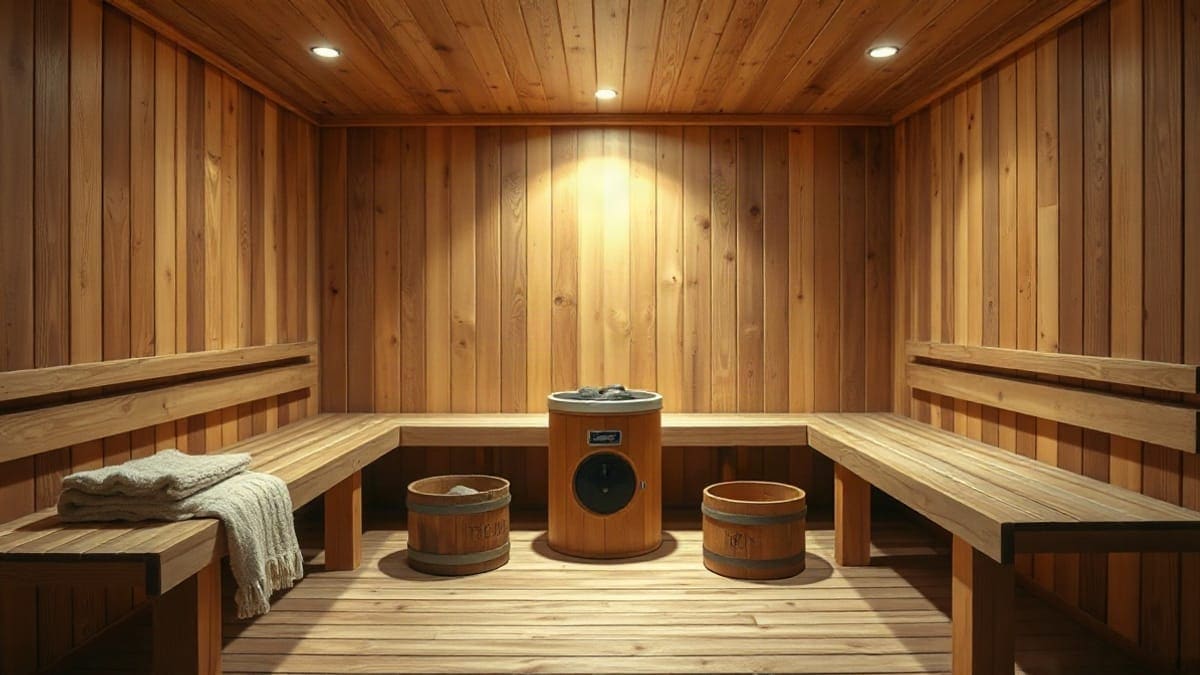
Peak Saunas sells eleven infrared saunas from a Chicago company, and no stove or steam saunas at all. Every model is full-spectrum infrared with a red light panel and a 150°F ceiling indoors (170°F outdoors). Peak states its warranty by component and publishes red light output at three distances, which many rivals skip. It offers a 30-day home trial with fees, and it does not publish a factory country or a measured EMF reading. The sections below give size, weight and power for each model, then the red light panel, the circuit, the warranty and the trial. Our buy buttons are affiliate links to Peak, and a sale through them pays this site.
Are Peak Saunas good, and is Peak Saunas legit?
In two lines
Yes on paperwork: Peak states warranty by component (7 and 3 years), publishes red light output at three distances and lists weights and clearances. It does not publish a factory country, an mG reading or an ETL number, so buyers who want third-party proof should ask.
The company is a real, reachable business: Peak Wellness USA LLC at 73 W Monroe St in Chicago, with a published phone line staffed Monday to Friday, 8 am to 7 pm Central, and a written refund policy. What it does not publish is as telling as what it does: no factory country, no EMF number and no ETL listing on the pages we read.
Is Peak Saunas a good company? On paperwork, yes: it also warns up front when a model needs an electrician, which many sellers skip. The gaps matter mainly to buyers who want third-party proof.
Are Peak Saunas good quality? Peak says its cabins are hand-finished Canadian hemlock or Canadian red cedar, with clasp-together panels indoors and tongue-and-groove panels outdoors. We have not handled one, and we do not test saunas, so quality beyond those specs rests on owner reports. Peak's own pages claim more than 4,200 reviews and more than 10,000 customers. Those are company figures and we could not check them independently. We also did not check the Better Business Bureau record, so look at it yourself before you order.
Are Peak Saunas worth it? That depends on what you value. Peak sits at the premium end of infrared brands because it bundles a red light panel, an app, speakers, an ionizer and a foot heater into each cabin. If you only want heat, a cheaper far infrared cabin from JNH Lifestyles does that job. If you want the red light panel and a long warranty, Peak is one of the few brands that puts the numbers on the page.
Who is behind Peak Saunas, and where are they made?
In two lines
Peak Wellness USA LLC of Chicago runs the brand, led by founder and CEO Austin Laudenslager, with a warehouse in Southern California. Peak gives no founding year and does not say where its saunas are built.
Laudenslager signs the brand's comparison pages. The About page says Peak sold other brands' saunas before launching its own line, and lists a warehouse in Southern California. It gives no founding year, so we cannot say how long Peak has been in business, and nobody should repeat a date that the company has not published.
Where are Peak saunas made? Peak does not say. Its pages state "U.S.-based support" and a Chicago address, which describe where the company sits, not where a factory is. Sun Home and Peak both leave the factory country out; JNH Lifestyles at least says it builds in its own production facility. Ask Peak in writing where your model is built, because it affects parts supply and tariffs.
Where is Peak Saunas located? Chicago, Illinois, for the company, and Southern California for the warehouse. Support runs from a U.S. phone and text line at (470) 665-3747 and from support@peaksaunas.com.
What does Peak Saunas sell in 2026?
In two lines
Peak sells eleven infrared saunas and no other kind: 3 for one person, 3 for two and 2 for three indoors, plus 3 outdoor cabins for 2, 4 and 5 people. We found no stove, steam or traditional model.
The store also lists an outdoor cover, installation services and a "welcome box" with a towel and oils. Peak's own accessories include a membership called the Peak Wellness Club, which Peak says is free for life with a purchase and offers daily guided sessions and 30-day programs.
| Model | Seats | Where | Wood | Red light | Power |
|---|---|---|---|---|---|
| Mini | 1 | Indoor | Hemlock | Compact 9 x 12.6 in panel | 120 V, 15 A circuit |
| Shasta | 1 | Indoor | Hemlock | Full-body panel | 120 V outlet |
| Rainier | 1 | Indoor | Red cedar | Full-body panel | 120 V outlet |
| Crown | 2 | Indoor | Hemlock | Ceiling light | 120 V, 15 A |
| Everest | 2 | Indoor | Hemlock | Full-body panel | 120 V, 20 A |
| Fuji | 2 | Indoor | Red cedar | Full-body panel | 120 V, 20 A |
| Denali | 3 | Indoor | Hemlock | Two full-body panels | 240 V, 20 A |
| Matterhorn | 3 | Indoor | Red cedar | Two full-body panels | 240 V, 20 A |
| Patagonia | 2 | Outdoor | Hemlock | Full-body panel | 240 V, 20 A |
| El Capitan | 4 | Outdoor | Hemlock | Two full-body panels | 240 V, 30 A |
| Kilimanjaro | 5 | Outdoor | Hemlock | Full-body panel | 240 V, 30 A |
The pairs are the same sauna in two woods: Shasta and Rainier, Everest and Fuji, Denali and Matterhorn. Peak says hemlock has almost no scent and red cedar is aromatic. It sells the hemlock version at a lower price, which we do not print because Peak changes prices often.
The one-person cabins: Mini, Shasta and Rainier
The Mini is 31.5 x 31.8 x 67.1 in outside and weighs 313 lb; the Shasta and Rainier are 42 x 40 x 75 in and weigh 305 lb. The Mini fits a closet or bathroom and runs on a 15 A circuit. Its red light is a small 9 x 12.6 in panel that faces you. The Shasta and Rainier add a 9 x 36 in panel of 216 LEDs that covers you from head to shin. Interior sizes are 27.5 x 26.6 x 62.6 in for the Mini and 38 x 36 x 67 in for the other two. Peak lists no wattage for any of the three.
Peak says the Mini takes two adults about 90 minutes to assemble. For a person who wants one outlet and a modest footprint, the Shasta is the better pick, since the Mini's 62.6 in interior height is tight for tall users. For other single-seat cabins see best one-person sauna.
The two-person cabins: Crown, Everest and Fuji
The Fuji and Everest are 53 x 44 x 75 in outside, 49 x 40 x 67 in inside; the Crown is 48 x 44 x 79 in outside and 42 x 38 x 71 in inside. Peak calls the Fuji its best seller and the largest indoor two-person full-spectrum sauna on the market, which is Peak's claim, not an independent ranking. The Fuji has eight heaters and one pair of figures that disagree: 2,050 W on one Peak page we read and 2,100 W on another. Both need a dedicated 120 V, 20 A outlet. The Crown is the entry two-seater: a standard 120 V, 15 A outlet on its own breaker, and a red light built into the ceiling rather than a wall panel.
Weights are stranger. Peak lists the Fuji at 385 lb and the same-size Everest at 305 lb, and the smaller Crown at 385 lb. Hemlock and cedar should not differ by 80 lb in an identical cabin, so ask Peak for the shipping weight of the one you order. Our best 2 person sauna guide compares the Fuji with rivals, and best 2 person infrared sauna goes deeper on that class.
The three-person cabins: Denali and Matterhorn
The Denali and Matterhorn are 61 x 44 x 75 in outside and 57 x 40 x 67 in inside, weigh 375 lb and 400 lb, and carry two front-wall red light panels of 216 LEDs each. Peak lists a dedicated 240 V, 20 A circuit for both. Assembly takes two adults about 3 hours, by Peak's estimate. The Denali's electrical figures conflict between Peak sources; the section on circuits below sets them out. Peak says the Denali is the Matterhorn's twin in hemlock.
Our best indoor sauna page puts the Denali beside Sun Home and JNH cabins for rooms like a basement or a home gym.
The outdoor cabins: Patagonia, El Capitan and Kilimanjaro
The three outdoor cabins reach 170°F, have a black aluminum exterior with a hemlock interior, and weigh 695 to 1,031 lb. The Patagonia seats two (52 x 42 x 83 in, 798 lb) on a 240 V, 20 A outdoor-rated circuit. The El Capitan seats four (81 x 55 x 83 in, 695 lb) with two red light panels on a 240 V, 30 A circuit. The Kilimanjaro seats five (59 x 59 x 83 in, 1,031 lb) on a 240 V, 30 A circuit. Peak says assembly takes half a day for the Patagonia and a full day, with two or more adults, for the other two.
Peak also lists an outdoor cover for the 2, 3 and 4 person cabins, and heater and bench replacement parts for the El Capitan on its store. For comparison with other garden cabins, read best outdoor infrared sauna and best outdoor sauna.
How do the Peak models compare on size, weight and power?
In two lines
Floor area runs from 7.0 sq ft (Mini) to 30.9 sq ft (El Capitan), and weight from 305 to 1,031 lb. Weight per sq ft is highest on the Patagonia (53 lb) and the Mini (45 lb), so those two matter most for the floor underneath.
Floor area is outside width times depth. A cabin plus two adults of 180 lb each loads a floor, so the table shows both numbers. Weights and sizes come from the Peak product pages read on November 17, 2026.
| Model | Outside (W x D x H) | Floor area | Weight | Weight per sq ft |
|---|---|---|---|---|
| Mini | 31.5 x 31.8 x 67.1 in | 7.0 sq ft | 313 lb | 45 lb |
| Shasta / Rainier | 42 x 40 x 75 in | 11.7 sq ft | 305 lb | 26 lb |
| Crown | 48 x 44 x 79 in | 14.7 sq ft | 385 lb | 26 lb |
| Everest / Fuji | 53 x 44 x 75 in | 16.2 sq ft | 305 / 385 lb | 19 / 24 lb |
| Denali / Matterhorn | 61 x 44 x 75 in | 18.6 sq ft | 375 / 400 lb | 20 / 22 lb |
| Patagonia | 52 x 42 x 83 in | 15.2 sq ft | 798 lb | 53 lb |
| El Capitan | 81 x 55 x 83 in | 30.9 sq ft | 695 lb | 22 lb |
| Kilimanjaro | 59 x 59 x 83 in | 24.2 sq ft | 1,031 lb | 43 lb |
A typical residential floor is rated for about 40 lb per sq ft of live load, spread across a room, and a cabin concentrates its weight. A Patagonia with two adults is about 1,158 lb on 15.2 sq ft, or 76 lb per sq ft, so put it on a slab or a deck framed for it, and ask a builder. The indoor Fuji with two adults is about 745 lb on 16.2 sq ft, or 46 lb per sq ft.
Which Peak sauna fits which case?
In two lines
Pick the Shasta for one person on one outlet, the Crown for two on a 15 A circuit, the Fuji or Everest for two on 20 A, the Denali or Matterhorn for three on 240 V, and the Patagonia for a deck or patio.
This table matches common cases to a model and says what to check.
| Your situation | Pick | Why | Check first |
|---|---|---|---|
| Apartment, one outlet, one person | Shasta | 42 x 40 in footprint, full panel, 120 V | The outlet should not share a breaker with a heater |
| Closet or low basement | Mini | 7 sq ft, 67.1 in tall | Interior is only 27.5 x 26.6 in |
| Couple, one free 15 A circuit | Crown | 120 V, 15 A | Red light is a ceiling light, not a wall panel |
| Couple, red light matters | Fuji or Everest | 49 x 40 in interior, wall panel | 20 A dedicated outlet, 17 A draw |
| Allergic to cedar scent | Hemlock model | Peak says hemlock has almost no scent | Compare the twin before ordering |
| Three people, home gym | Denali or Matterhorn | Two red light panels, 57 in bench | 240 V circuit and an electrician |
| Deck, patio or pool | Patagonia | Aluminum shell, 170°F | Outdoor-rated 240 V, 20 A circuit |
| Family of four or five | El Capitan or Kilimanjaro | 76 in or 54 in interior | 240 V, 30 A and a slab |
For a wider look at red light cabins from other brands, see best red light sauna and best full spectrum infrared sauna.
What is in Peak's red light panel, and what does it do?
In two lines
Peak's full panel has 8 wavelengths from 630 to 1060 nm, 216 dual-chip LEDs on a 9 x 36 in face, and output of 175 mW/cm² at 6 in, 107 at 12 in and 80 at 24 in, published for the Fuji and Everest.
Four wavelengths are red (630, 650, 660 and 670 nm) and four are near infrared (810, 830, 850 and 1060 nm). Peak publishes the irradiance at three distances, which is the useful number, because it tells you what reaches your skin at a bench distance of about 24 in. Peak gives these figures for the Fuji and Everest and does not break the output down for each other model.
That is clearer than most. Peak sets it against a brand that says "red light" without wavelengths or output. The comparison is Peak's marketing, and the Sunlighten and Clearlight facts on those pages are Peak's reading of their sites, so read the rivals' own pages. The Mini has a compact panel and the Crown has a ceiling-mounted light, so those two do not match the numbers above.
What does red light do? Peak lists skin, circulation, joints and recovery. Research on photobiomodulation exists, but results depend on dose and device, and a sauna cabin is not a clinical treatment. Our red light therapy sauna page covers what the studies show and what they do not. Peak also says the panel can run with the heat off.
Does a Peak sauna need a special circuit?
In two lines
Six Peak models run on 120 V, but only the Mini, Shasta, Rainier and Crown fit a standard outlet. The Fuji and Everest need a dedicated 20 A line, and the five 240 V cabins need an electrician for a 20 A or 30 A circuit.
The Fuji, at 2,050 W on a 120 V line, draws about 17.1 A (2,100 W would be 17.5 A). The usual rule treats a continuous load as 80 percent of the breaker, which is 16 A on a 20 A circuit. So the Fuji sits above that mark and an electrician should confirm the line. Peak does state the 20 A dedicated outlet and a NEMA 5-20 receptacle. Wattage for the Mini, Shasta, Rainier, Crown and Everest is not on the pages we read, so we cannot do the same sum for them.
The Denali figures conflict. Its product page says 240 V and 20 A, and an earlier Peak read listed 2,850 W, which is about 11.9 A at 240 V. A Peak buyer's guide we read earlier cited 240 V, 30 A and a larger 71 x 47 x 75 in footprint. We could not re-open that guide this week. Peak's current product page says 20 A, so plan for that, and ask Peak to confirm in writing before the electrician wires it.
Do infrared saunas use a lot of electricity? Modestly. At 2,050 W, a Fuji that ran flat out for 1 hour would use at most about 2.05 kWh, and a four-session week at that ceiling would be about 8.2 kWh. Real draw is lower once the panels cycle, but Peak does not publish an average, so treat these as upper bounds. Our sauna electrical requirements page explains 120 V versus 240 V in full, and sauna cost covers running costs.
What does the Peak warranty and 30-day trial cover?
In two lines
Peak's warranty is limited lifetime for home use, with 7 years on structure, wood and heaters and 3 years on controls and the red light panel.
If a part fails, Peak says it sends the replacement, and in the first year it covers a technician visit if a phone fix fails. A separate commercial warranty runs 5 years on heaters and wood, 3 years on controls and 1 year on lights, sound and the app. Peak's comparison pages say rivals cover for less time, which is their claim.
The 30-day home trial has conditions. You may assemble and use the sauna. To return it you must disassemble it, repack it in the original crate, email support, and pay a 25 percent restocking fee plus all return freight. Orders can be cancelled before they ship for a 5 percent fee. A damage claim must be made within 48 hours of delivery. For a 400 lb cabin, "free trial" is not the right phrase, and you should budget for it.
| Term | What Peak says |
|---|---|
| Home warranty, structure, wood, heaters | 7 years |
| Home warranty, controls and red light | 3 years |
| First-year service | Technician visit if a phone fix fails |
| Trial period | 30 days from delivery |
| Restocking on return | 25 percent |
| Return freight | Paid by the buyer |
| Cancellation before shipping | 5 percent fee |
| Damage report window | 48 hours |
Compare that with the short warranties in JNH Lifestyles and the 7-year terms at Sun Home Saunas.
What EMF and certification does Peak publish?
In two lines
Peak gives no reading in mG, no distance, no instrument and no ETL or UL listing number. A claim without a reading is marketing, not data, so ask Peak for the report and the listing file number before you pay.
Peak labels the Shasta, Rainier, Everest and Fuji "near zero EMF" in their product names and tags several cabins "low EMF", but none of the pages we read gives a test report.
EMF is measured in mG at a set distance from the panels. Sun Home cites a lab figure of about 0.5 mG; Peak gives none. If low EMF matters, ask Peak for the report and the distance, and see our infrared sauna EMF explained guide. ETL means a lab such as Intertek has listed the product against a safety standard, and you should ask for the listing number, not just the word "certified".
How does Peak compare with Sunlighten, Clearlight and JNH?
In two lines
Peak leads on red light output and warranty detail. Sun Home wins on a stove sauna and a published EMF claim, JNH on entry cost, and Sunlighten or Clearlight are the names to check for low EMF.
The table uses published specs and flags where a rival's number comes from Peak's own comparison pages.
| Peak | Sun Home | JNH | Sunlighten and Clearlight | |
|---|---|---|---|---|
| Heat types | Infrared only | Infrared and traditional | Infrared only | Infrared (Sunlighten); infrared plus others (Clearlight) |
| Red light output published | Yes, 3 distances | Model dependent | Arki only, ranges | Peak says not stated |
| EMF reading | None | 0.3 to 0.9 mG claimed | "Under 8 mG" on some | Check each brand |
| Warranty (home) | 7 and 3 years | Up to 7 years | 1 to 2 years | Per brand |
| Outdoor cabins | Yes, 3 | Yes | Not found | Check each brand |
When to buy something else. Choose Sun Home for a stove sauna or a published EMF test. Choose JNH Lifestyles for the lowest entry cost and a plug-in cabin. Choose Sunlighten or Clearlight when you want to compare a well-known low EMF brand. Choose Redwood Outdoors for a garden cabin with a stove option. Our best sauna brands page lines them up, and best infrared sauna ranks the models.
Do Peak saunas have an app, and how does setup work?
In two lines
Peak says you can preheat from your phone and set temperature and session length in an app or on a touchscreen. Heat-up takes 30 to 45 minutes, and delivery is free in the contiguous U.S. in a crate called PeakGuard.
Every listed cabin has Bluetooth speakers, chromotherapy lighting, an oxygen ionizer and a foot heater on every listed cabin. Outdoors, heat-up is longer in freezing weather. The red light panel is controlled by the Peak RLT app. Pairing steps and the instruction manual come with the cabin, and Peak's support team handles app problems at (470) 665-3747.
The carrier calls to book a delivery time. Indoor cabins arrive at your garage or front door and outdoor ones at the curb. In-stock cabins ship in 2 to 4 business days, per Peak, but owners quote far longer waits on pre-orders. Assembly is by you, with a clasp-together design, or by a paid installer from Peak's store. Does Peak sell a discount code? We found none on the pages we read; Peak instead includes a welcome box with a towel, oils and a hat.
Can Peak Saunas help your health?
In two lines
Sauna use is linked with better heart outcomes in observational research, mostly on Finnish traditional saunas: 2,315 men followed for about 20 years had lower fatal cardiovascular disease with 4 to 7 sessions a week. That shows an association, and no study there tested a Peak cabin.
The best-known study (Laukkanen et al., JAMA Internal Medicine, 2015) compared Finnish men who used a sauna 4 to 7 times a week with those who went once a week. It was an observational study, which shows an association, not that sauna caused the benefit.
Peak's product pages also cite two later papers from the same group, in Age and Ageing (2017) and BMC Medicine (2018), and describe their results as benefits of owning a sauna. We did not re-read those papers for this page, and they studied Finnish sauna bathing rather than infrared cabins with red light. Do not take a Peak page as proof that a Peak cabin will deliver those results.
Ask your doctor before using any sauna if you are pregnant, have heart disease, low blood pressure, take medicines that affect sweating or blood pressure, or drink alcohol. Children and older adults need extra care. Our sauna health studies and infrared sauna benefits pages go through the evidence, and how to use a sauna covers a safe session.
What do Peak owners ask about sessions and other sauna types?
In two lines
Peak publishes the cabin limits, 150°F indoors and 170°F outdoors, and leaves the routine to you. Session length, time of day, workout days and cold plunging each have their own guide on this site.
Session length is covered in how long to stay in a sauna and the usual infrared range in infrared sauna temperature. Morning or evening is the subject of best time of day to sauna, and a workout day is in sauna after workout. If you plan to follow a session with cold water, read cold plunge and sauna contrast therapy first.
Readers also ask what a sauna does for energy, heart rate and blood pressure, which sauna benefits and sauna and blood pressure answer with studies. Weight loss is mostly water, and sauna weight loss shows the numbers. Peak sells no steam or stove cabin: for those see sauna vs steam room, infrared vs steam sauna, best portable steam sauna and what is a sauna for the basics, plus sauna temperature for stove heat.
Best for and not for: who should buy a Peak?
In two lines
A Peak suits buyers who want a wall-mounted red light panel with published irradiance and a 7-year heater and wood warranty. It does not suit anyone who wants a stove sauna, an ETL number before paying or an easy return on a heavy cabin.
| Best for | Not for |
|---|---|
| Buyers who want a wall-mounted red light panel with published irradiance | Buyers who want a traditional hot-rock sauna |
| People who want one brand for indoor and outdoor cabins | Buyers who need an ETL number or an mG reading before paying |
| Owners who value a 7-year heater and wood warranty | Anyone who needs a free, easy return on a heavy cabin |
| Couples who want a 49 x 40 in interior on a 120 V line | Renters with only a 15 A outlet who want a roomy two-seater |
Where can you buy Peak saunas, and what about similar models?
In two lines
Buy direct from peaksaunas.com, where our links go. The store offers financing through Bread Pay and an HSA/FSA option at checkout, and whether a sauna qualifies depends on your plan and a doctor's note.
For a wider shop around, see saunas for sale and best home sauna, which names Peak's Fuji among home picks.
6 common mistakes when buying a Peak sauna
In two lines
Six mistakes cost Peak buyers the most: putting a Fuji on a 15 A outlet, treating the 30-day trial as free (25 percent restocking), expecting a published EMF reading, and planning around one set of Denali figures.
Putting a Fuji or Everest on a standard outlet
Both need a dedicated 120 V, 20 A outlet with a NEMA 5-20 receptacle. At 2,050 W the Fuji draws about 17.1 A, so a shared 15 A line will trip.
Treating the 30-day trial as free
Returning a cabin means disassembling it, repacking it in the crate, a 25 percent restocking fee and all return freight. A damage claim must be made within 48 hours of delivery.
Expecting a published EMF reading
Peak calls four cabins near zero EMF in their names but publishes no mG reading, no distance and no ETL listing number. Ask for the report before you pay for low EMF.
Planning around one set of Denali figures
Peak's product page says 240 V and 20 A, while an older guide said 240 V, 30 A and a 71 x 47 x 75 in footprint. Get the figures confirmed in writing before the electrician wires it.
Trusting the weight of a cabin without asking
Peak lists the Fuji at 385 lb and the same-size Everest at 305 lb. Ask for the shipping weight of the one you order before you plan the floor and the delivery.
Setting the Patagonia on a deck nobody checked
The Patagonia weighs 798 lb on 15.2 sq ft, about 76 lb per sq ft with two adults. Put it on a slab or a deck framed for it, and ask a builder.
How we researched this page
In two lines
We read Peak's store, product, warranty, trial and About pages on November 17, 2026, the day Peak updated its product pages. We did not test any sauna.
The limits matter. Peak's our-story, FAQ and EMF pages returned 404, so we found no founding year, factory country or mG reading, and the Fuji and Denali figures conflict between Peak sources. We did not re-read the studies Peak cites, and rivals' facts on Peak's comparison pages are Peak's reading of their sites.
FAQ
What should you expect to pay for a Peak sauna?
Peak shows the price on each product page, and it changes with offers, so we print no figure. The Crown is the lowest-priced model, and the hemlock twins cost less than their cedar versions, per Peak. Check the live page for today's number, and compare sauna cost for the wider picture.
Are Peak saunas made in the USA?
Peak does not say where it builds them. The company is American, with a Chicago address and a Southern California warehouse, but those do not show a factory country. Ask Peak in writing.
What stores sell Peak saunas?
Peak sells through its own site. Resellers list some models, and they may show different specs, so confirm against peaksaunas.com. Our saunas for sale page covers retailers in general.
How many kilowatt-hours does a Peak cabin draw?
At the Fuji's 2,050 W, an hour at full draw uses at most about 2.05 kWh, and the heaters cycle, so real use is lower. See the circuit section above and sauna electrical requirements.
What is the difference between the Fuji and the Everest?
Same size, same red light panel and same 120 V, 20 A outlet. The Fuji is aromatic red cedar and the Everest is hemlock, which Peak says has almost no scent. Peak lists different weights for them, so ask which is correct.
Is there a promo code for a Peak sauna?
We found no code on the pages we read. Every sauna ships with a welcome box, and the store runs seasonal offers, so check the live page and ask the support line.
Is the Peak Denali 20 A or 30 A?
The current Denali page says a dedicated 240 V, 20 A circuit. An earlier Peak buyer's guide we read said 240 V, 30 A. Have Peak confirm the figure for your serial before an electrician installs.
Do Peak saunas have an app?
Yes, per Peak: temperature and session length from the app or touchscreen, plus a separate Peak RLT app for the red light panel. Pairing steps are in the manual.
How long does a Peak sauna take to heat up and assemble?
Peak says 30 to 45 minutes to reach top temperature and about 90 minutes to 3 hours to assemble indoors, half a day to a full day outdoors.
Can you return a Peak sauna?
Within 30 days of delivery, if it is disassembled and repacked in the original crate. Peak charges a 25 percent restocking fee and you pay return freight.
Is a Peak sauna safe, and who should not use it?
Used within the manual's limits, an infrared cabin is a common home product, and Peak's top temperature is 150°F indoors. Pregnant users, people with heart disease or low blood pressure, and anyone on affecting medicines should ask a doctor first. The CPSC recall list shows any infrared cabin recall, such as the 2026 Sauna360 notice.
Do portable saunas really work?
Portable saunas are a different product from Peak's rigid cabins, and results depend on the heater and the tent. See best portable sauna and portable infrared sauna.
How many sauna sessions per week are enough?
That is a general sauna question, answered with studies on how often to use a sauna.
Sources
- Peak Saunas, home page and model list
- Peak Saunas, about us
- Peak Saunas, Fuji 2-Person
- Peak Saunas, Denali 3-Person
- Peak Saunas, Patagonia outdoor 2-Person
- Peak Saunas, refund policy
- Peak Saunas, Peak vs JNH
- Peak Saunas, Peak vs Sunlighten
- Laukkanen et al., JAMA Internal Medicine 2015, PubMed
- NFPA 70, National Electrical Code
Keep comparing
 Lifepro Saunas and Sauna BlanketsRejuvaWrap, BioRemedy blanket recall, RejuvaCure cabins, steam tent, sauna tent and NordPod, with watts, amps
 Sun Home Luminar Outdoor Infrared Sauna Review2 and 5 person outdoor infrared cabins, 970 and 1,070 lb, 240 V on 20 A or 30 A, 170°F ceiling
 Redwood Outdoors 4 Person Cabin Sauna Review1,150 lb, 67 x 78 x 92.5 in, 6 kW Harvia KIP on 240 V and 30 A, heat-treated hemlock, heater options, pad math
 Home SaunaInfrared, outdoor cabin, barrel and blanket, with real watts, amps, dimensions and EMF
 Infrared SaunaTen infrared saunas compared from 1 to 4 seats, indoor and outdoor, by size in inches, amps, kWh